






Multiple Myeloma
Latest News
Advertisement
Latest Videos










































Advertisement
More News
Multiple myeloma has seen significant treatment advances over the past decade. In 2015 alone, the FDA approved 5 new agents or regimens for previously treated patients.

The combination of elotuzumab, lenalidomide, and dexamethasone has excellent activity and is well-tolerated in the treatment of high-risk smoldering multiple myeloma (SMM), providing hope that it can delay or even halt progression to MM.

According to the results of the phase III StaMINA trial evaluating posttransplant therapy in multiple myeloma, a second a round of chemotherapy or stem cell transplant does not improve progression-free survival or overall survival compared with the current standard course of treatment alone.
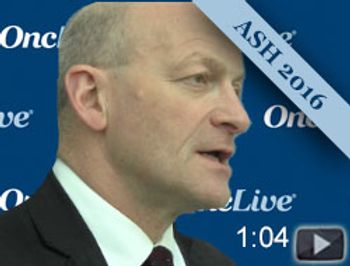
Graham Jackson, MD, PhD, Northern Institute for Cancer Research, Newcastle University, discusses results of a study that determined lenalidomide (Revlimid) is a highly-effective maintenance therapy in myeloma patients of all ages.

Subcutaneous delivery of daratumumab was well tolerated with comparable efficacy to the FDA-approved intravenous dose in patients with relapsed/refractory multiple myeloma.

Adding venetoclax to bortezomib and dexamethasone showed very promising efficacy and acceptable safety for patients with relapsed/refractory multiple myeloma.

Selinexor, in combination with dexamethasone, induced a response rate of 20.5% (n = 16) among 78 heavily pretreated patients with relapsed/refractory multiple myeloma, according to results from the phase IIb STORM trial presented at the 2016 ASH Annual Meeting.

Treatment with the combination of pembrolizumab, pomalidomide, and dexamethasone demonstrated promising durable efficacy and a tolerable safety profile for patients with relapsed/refractory multiple myeloma.
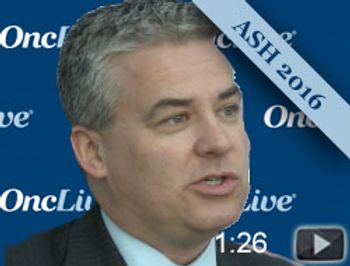
Michael A. Thompson, MD, PhD, medical director, precision medicine, Vince Lombardi Cancer Clinic, Aurora Health Care, discusses some of the recent exciting advancements in the field of multiple myeloma during the American Society of Hematology (ASH) Annual Meeting.

An investigational anti-BCMA chimeric antigen receptor T-cell therapy demonstrated an objective response rate of 78% in patients with relapsed/refractory multiple myeloma.
The European Commission has granted a conditional approval to ixazomib in combination with lenalidomide and dexamethasone for adult patients with multiple myeloma following at least 1 prior therapy.

Shaji Kumar, MD, professor of Medicine, Mayo Clinic, discusses his vision for the future treatment landscape of multiple myeloma.
Rafael Fonseca, MD, professor of Medicine, Mayo Clinic, discuses the recent FDA approval of daratumumab (Darzalex) in combination with lenalidomide and dexamethasone or bortezomib (Velcade) and dexamethasone for patients with relapsed multiple myeloma following at least 1 prior therapy.

The FDA has approved daratumumab in combination with lenalidomide and dexamethasone or bortezomib and dexamethasone for patients with relapsed multiple myeloma following at least 1 prior therapy, based on findings from the phase III POLLUX and CASTOR studies.

Philippe Moreau, MD, head of the Hematology Department, University Hospital of Nantes, France, discusses the combination treatments being used to treat patients with multiple myeloma.
Pivotal clinical trial findings from the past year will likely have a game-changing effect on the multiple myeloma landscape, according to Rafael Fonseca, MD. Moreover, he adds, oncologists may be looking at a future where the number of drugs in a single regimen continues to grow in an effort to further improve outcomes.

Impactful clinical trial data that have led to approvals of novel agents and regimens over the last few years has led to a significant transformation in the multiple myeloma landscape.

Using combination regimens in an effective manner will likely be a go-to method with immunotherapy in multiple myeloma, in an effort to induce durable responses in patients.

Shaji Kumar, MD, professor of Medicine, Mayo Clinic, discusses the management of elderly patients with multiple myeloma.

Sundar Jagannath, MD, discusses the importance of the standardization of a 3-drug regimen for newly diagnosed multiple myeloma, how the regimen may evolve going forward, and other novel agents on the horizon.
George Somlo, MD, medical oncologist, City of Hope, discusses treatment considerations in multiple myeloma.

Denosumab is noninferior to zoledronic acid at delaying skeletal-related events for patients with multiple myeloma.
Rafael Fonseca, MD, professor of Medicine, Mayo Clinic, discusses some of the ongoing clinical trials that could be potentially practice changing for the treatment of patients with multiple myeloma.

Shaji Kumar, MD, professor of Medicine, Mayo Clinic, discusses the International Myeloma Working Group’s recently released updated consensus criteria for response and minimal residual disease (MRD) assessment in multiple myeloma.
George Somlo, MD, medical oncologist, City of Hope, discusses some of the novel agents being evaluated for the treatment of patients with multiple myeloma.
Advertisement
Advertisement
Trending on OncLive
1
RELATIVITY-1093 Trial Aims to Advance Nivolumab Plus Relatlimab and Chemo in Nonsquamous NSCLC
2
Dostarlimab Monotherapy Elicits Durable cCRs in dMMR/MSI-H Locally Advanced Rectal Cancer
3
NEXERA-303 Trial Aims to Bring TGFβR2×PD-1 Bispecific Antibody INCA33890 Into First-Line MSS CRC
4
The OncFive: Top Oncology Articles for the Week of 10/25
5