






Non-Hodgkin Lymphoma
Latest News
Advertisement
Latest Videos
















































Advertisement
More News

Juan Pablo Alderuccio, MD, discusses the combination of loncastuximab tesirine with rituximab in patients with relapsed or refractory follicular lymphoma.

Sattava S. Neelapu, MD, discusses updated data from the 5-year follow-up analysis evaluating axi-cel in relapsed/refractory indolent non-Hodgkin lymphoma.

Jennifer Amengual, MD, discusses the efficacy of tazemetostat plus lenalidomide and rituximab in relapsed/refractory follicular lymphoma.

Grzegorz S. Nowakowski, MD, and Samuel Yamshon, MD, discuss follicular lymphoma data from ASH 2024.
Grzegorz S. Nowakowski, MD, and Samuel Yamshon, MD, discuss data for mosunetuzumab in newly diagnosed follicular lymphoma.
Grzegorz S. Nowakowski, MD, and Samuel Yamshon, MD, discuss 2-year follow-up data for liso-cel in relapsed/refractory follicular lymphoma.
Grzegorz S. Nowakowski, MD, and Samuel Yamshon, MD, discuss CD19 expression and the use of tafasitamab in relapsed/refractory DLBCL.
Grzegorz S. Nowakowski, MD, and Samuel Yamshon, MD, discuss their clinical practice experience using tafasitamab in relapsed/refractory DLBCL.
Grzegorz S. Nowakowski, MD, and Samuel Yamshon, MD, discuss data for tafasitamab in relapsed/refractory follicular lymphoma.

A phase 2 study demonstrated that TAK-007 had a favorable safety profile with early efficacy in relapsed/refractory B-cell non-Hodgkin lymphoma.

T-DXd wins FDA approval in HER2-low and -ultralow breast cancer, 177 Lutetium edotreotide boosts PFS in GEP-NETS, and more from OncLive this week.

CARGO Therapeutics announced that it will discontinue the phase 2 FIRCE-1 trial evaluating firi-cel in relapsed/refractory large B-cell lymphoma.
Peter Riedell, MD, details the safety and efficacy of rapcabtagene autoleucel in relapsed/refractory diffuse large B-cell lymphoma.

Dasom (Caroline) Lee, MD, discusses real-world data for second-line axi-cel in relapsed/refractory large B-cell lymphoma.

Zachary Frosch, MD, MSHP, discusses the investigation of travel burden/costs related to bispecific antibodies in diffuse large B-cell lymphoma or follicular lymphoma.

Meta: Lori A Leslie, MD, discusses 5-year follow-up data from the ZUMA-5 trial evaluating axi-cel in relapsed/refractory indolent non-Hodgkin lymphoma.
Andrew Ip, MD, discusses comparative real-world outcomes of commercial CD19-directed CAR T-cell therapies in large B-cell lymphoma.
Grzegorz S. Nowakowski, MD, and Samuel Yamshon, MD, break down the current treatment landscape for relapsed/refractory follicular lymphoma.
Axi-cel sustained long-term efficacy in relapsed/refractory follicular lymphoma and marginal zone lymphoma.

Epcoritamab produced responses in older patients with newly diagnosed large B-cell lymphoma.

Glofitamab plus polatuzumab vedotin generated durable remissions in heavily pretreated, relapsed/refractory large B-cell lymphoma.

Dasom (Caroline) Lee, MD, discusses real-world early outcomes of treatment with second-line axi-cel in relapsed/refractory large B-cell lymphoma.
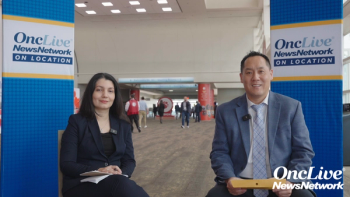
S. Vincent Rajkumar, MD, of Mayo Clinic; Nosha Farhadfar, MD, of Methodist Physician Practices; and Sonali Smith, MD, of University of Chicago Medicine, sit down with Chandler Park, MD, FACP, to discuss the latest in multiple myeloma, graft-vs-host disease, and non-Hodgkin lymphoma, respectively, from the 2024 ASH Annual Meeting.
Tisagenlecleucel maintained long-term efficacy and safety in relapsed/refractory follicular lymphoma.

Data from a retrospective analysis showcase the real-world effectiveness of tafasitamab for relapsed/refractory DLBCL in the United States.
Advertisement
Advertisement
Trending on OncLive
1
Ifinatamab Deruxtecan BLA Voluntarily Withdrawn in Previously Treated Extensive-Stage SCLC
2
Tegavivint Plus Osimertinib Shows Early Activity in First-Line EGFR-Mutated NSCLC
3
FDA Approves Lirafugratinib for Pretreated, Locally Advanced or Metastatic Cholangiocarcinoma
4
FDA Grants Priority Review to Perioperative Durvalumab Plus Neoadjuvant Enfortumab Vedotin in MIBC
5