Pembrolizumab demonstrated an objective response rate of 18% in data from two clinical trials exploring the PD-1 inhibitor as a treatment for patients with pretreated recurrent or metastatic head and neck squamous cell carcinoma.

Pembrolizumab demonstrated an objective response rate of 18% in data from two clinical trials exploring the PD-1 inhibitor as a treatment for patients with pretreated recurrent or metastatic head and neck squamous cell carcinoma.

In patients with platinum-sensitive relapsed serous ovarian cancer, olaparib (Lynparza) was found to significantly increase overall survival when given as maintenance therapy.

Results of an analysis presented at the 2016 ASCO Annual Meeting demonstrate the difficulty in determining the prevalence of germline cancer susceptibility gene mutations in patients with colorectal cancer (CRC) who do not harbor Lynch syndrome.

A device using tumor treating fields that was administered to patients with unresectable pancreatic cancer showed early signs of tolerability and safety when in combination with gemcitabine in the frontline setting.

Cabozantinib reduced the risk of death by 34% compared with everolimus in patients with previously treated advanced renal cell carcinoma, according to updated data from the phase III METEOR trial.

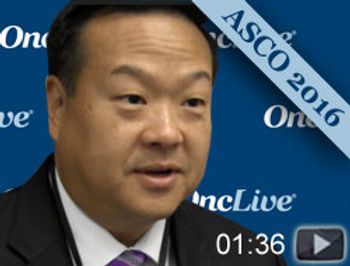
Edward S. Kim, MD, chair, Solid Tumor Oncology and Investigational Therapeutics, Donald S. Kim Distinguished Chair for Cancer Research, Levine Cancer Institute, Carolinas HealthCare System, discusses the significance of the TAPUR clinical trial, which is being conducted by ASCO.

Three-fourths of patients with advanced lymphoma achieved durable objective responses to treatment with chimeric antigen receptor T-cell therapy targeting CD19 even after a low-dose chemotherapy conditioning regimen.

An immunotherapy/antiangiogenesis combination proved to be safe and tolerable for patients with recurrent glioblastoma, preliminary data from an ongoing trial showed.

The PD-L1 inhibitor avelumab demonstrated durable responses and promising early survival data for patients with pretreated metastatic Merkel cell carcinoma.

Pembrolizumab (Keytruda) is associated with an exceptional overall response rate in patients with relapsed/refractory Hodgkin lymphoma.

Robert Ferris, MD, PhD, vice chair for Clinical Operations, associate director for Translational Research, and coleader of the Cancer Immunology Program at the University of Pittsburgh Cancer Institute, discusses the CheckMate-141 trial, which found that treatment with single-agent nivolumab (Opdivo) reduced the risk of death by 30% and doubled 1-year overall survival (OS) rates compared with investigator's choice of therapy for patients with recurrent or metastatic head and neck squamous cell carcinoma (SCCHN).

Maura N. Dickler, MD, Memorial Sloan Kettering Cancer Center, discusses the results of the single-arm MONARCH 1 trial, which examined the efficacy of the CDK4/6 inhibitor abemaciclib in heavily pretreated patients with refractory, hormone-receptor (HR)–positive, HER2-negative advanced breast cancer.

Adding the CDK 4/6 inhibitor palbociclib (Ibrance) to letrozole reduced the risk of disease progression by 42% compared with letrozole alone in patients with ER-positive, HER2-negative advanced or metastatic breast cancer.

The combination of dabrafenib and trametinib continued to demonstrate impressive overall survival and progression-free survival findings for patients with BRAF-mutant metastatic melanoma in 3-year follow-up data from the phase III COMBI-d study.

Reinhard Dummer, MD, professor, Department of Dermatology, University of Zurich Hospital, discusses the results of the phase III NEMO trial, which compared the efficacy of binimetinib with dacarbazine in patients with NRAS-mutant metastatic melanoma.

Alectinib improved progression-free survival by 66% compared with the current standard crizotinib as initial inhibitor therapy in patients with advanced or recurrent ALK-positive non–small cell lung cancer.

At a minimum follow-up of 18 months, the combination of nivolumab and ipilimumab reduced the risk of disease progression by 58% compared with ipilimumab alone, and single-agent nivolumab lowered the risk of progression by 45% versus ipilimumab monotherapy in patients with advanced melanoma.

David A. Reardon, MD, discusses results of a cohort from the open-label CheckMate-143 trial, which explored the combination of nivolumab (Opdivo) and ipilimumab (Yervoy) in patients with recurrent glioblastoma multiforme (GBM).

The MEK inhibitor binimetinib reduced the risk of progression or death by 38% compared with dacarbazine in patients with NRAS-mutant metastatic melanoma.

Avelumab demonstrated clinical activity in patients with advanced or unresectable mesothelioma, with an overall response rate of 14.3%.

Treatment with single-agent nivolumab improved overall survival and objective response rates compared with investigator's choice of therapy for patients with recurrent or metastatic head and neck squamous cell carcinoma.

Young black women with breast cancer are much less likely to have BRCA testing or, if they carry a BRCA mutation, to undergo risk-reducing prophylactic mastectomy or salpingo-oophorectomy.

An analysis of over 28,000 patients younger than 65 with incurable cancers found that approximately three-fourths of them received aggressive care within the last 30 days of life and one-third died in the hospital.

Patients with lung cancer who participated in a web-based system for reporting and tracking their symptoms achieved dramatic gains in survival compared with individuals who were followed with typical protocols.

Researchers who set out to understand the affordability of cancer drugs across the globe concluded that lower prices in some poorer countries don’t equate to better access.

The combination of dabrafenib and trametinib was highly effective as a treatment for patients with BRAF V600E-mutant non–small cell lung cancer.

Single-agent nivolumab induced responses in 66% of patients with classical Hodgkin lymphoma who had progressed following autologous stem cell transplant and brentuximab vedotin.

About one third of patients with advanced renal cell carcinoma who were treated with single-agent nivolumab in the second-line setting or later were still alive at 4 and 5 years in long-term follow-up data from phase I and phase II clinical trials.

Patients with metastatic urothelial carcinoma who were ineligible for standard cisplatin-based chemotherapy achieved a 24% reduction in tumor size and had a median survival of 14.8 months after taking the immunotherapy agent atezolizumab (Tecentriq).

Bernard A. Fox, PhD, chief, Laboratory of Molecular and Tumor Immunology, Earle A. Chiles Research Institute at Providence Portland Medical Center, discusses the significance of the Immunoscore Validation Project.