

CRX100 plus a tumor-specific oncolytic vaccinia virus generated responses and was well tolerated in patients with recurrent, platinum-resistant ovarian cancer.
CRX100 plus a tumor-specific oncolytic vaccinia virus generated responses and was well tolerated in patients with recurrent, platinum-resistant ovarian cancer.

Durvalumab plus carboplatin and paclitaxel, followed by maintenance durvalumab with or without olaparib, showed improved efficacy vs chemotherapy alone in endometrial cancer.

Lenvatinib plus pembrolizumab did not best chemotherapy in pMMR endometrial cancer, but did offer a survival benefit in some subgroups of patients.

From key sessions at the 2024 SGO Annual Meeting to updates in the field, gynecologic oncology experts share their key takeaways from the meeting.

Christian Marth, MD, PhD, discusses the LEAP-001 trial of lenvatinib plus pembrolizumab vs chemotherapy in advanced or recurrent endometrial cancer.
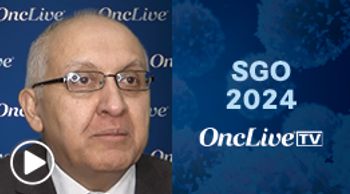
Mansoor Raza Mirza, MD, discusses findings from part 2 of the ENGOT-EN6-NSGO/GOG-3031/RUBY trial in primary advanced or recurrent endometrial cancer.

ChatGPT may provide comprehensive and correct answers to genetic counseling questions for patients with gynecologic cancers.
Black patients with endometrioid endometrial carcinoma experienced an increased risk of death and lower enrollment in clinical trials vs White patients.

Judy Hayek, MD, discusses outcomes with minimally invasive vs open interval complete gross resection in patients with advanced ovarian cancer.

Leslie M. Randall, MD, MAS, discusses patient-reported outcomes from the ENGOT-cx11/GOG 3047/KEYNOTE-A18 trial in locally advanced cervical cancer.

Patients with perivascular epithelioid sarcoma of gynecologic or peritoneal origin experienced durable responses when treated with nab-sirolimus.

The activity of nab-sirolimus plus letrozole is under study in patients with advanced or recurrent endometrioid endometrial cancer.

Dimitrios Nasioudis, MD, discusses outcomes of patients with metastatic vulvar squamous cell carcinoma who underwent sentinel lymph node biopsy.

Sara Corvigno, MD, PhD, discusses the incidence of chemotherapy-related clonal hematopoiesis of indeterminate potential in patients with ovarian cancer.

Neoadjuvant tislelizumab in combination with chemotherapy was safe and produced responses in patients with locally advanced cervical cancer.

Mirvetuximab soravtansine improved health-related quality of life in patients with FRα-positive, platinum-resistant ovarian cancer.

Olaparib plus cediranib failed to improve PFS and OS vs chemotherapy in patients with platinum-resistant or -refractory epithelial ovarian cancer.

Dostarlimab plus carboplatin/paclitaxel improved overall survival vs placebo plus chemotherapy in primary advanced or recurrent endometrial cancer.
The addition of pembrolizumab to chemotherapy led to a favorable overall survival benefit vs chemotherapy plus placebo in endometrial cancer.
Social determinants of health were associated with geographical variations in the rates of cervical cancer in the United States.
Meghan K. Berkenstock, MD, discusses common ocular toxicities associated with the use of novel antibody-drug conjugates, and the subsequent development of mitigation strategies for these treatment-related adverse effects in gynecologic cancers.
Ursula A. Matulonis, MD, discusses common toxicities associated with mirvetuximab soravtansine-gynx, and how to properly manage these treatment-related adverse effects for patients with folate receptor alpha-high ovarian cancer.

Cara A. Mathews, MD, discusses 7-year overall survival data from the phase 3 SOLO-1 trial in patients with ovarian cancer.
Dimitrios Nasioudis, MD, discusses how the use of next-generation sequencing can help identify the unique molecular profile of endometroid ovarian cancer.
Lindsey K. Buckingham, MD, discusses an investigation into the use of patient-reported outcomes from the cancer-specific Geriatric Assessment (GA) to predict frailty in women with ovarian cancer, as well as planning the next steps for this research in other gynecologic cancers.
Brian M. Slomovitz, MD, discusses the evaluation of letrozole and ribociclib from the phase 2 GOG 3026 trial in recurrent low-grade serous ovarian carcinoma.

Shannon N. Westin, MD, MPH, FACOG, discusses the outcomes of the phase 1b SOLAR trial, which examined olaparib with selumetinib in patients with RAS-mutant gynecologic malignancies and other solid tumors.
Pamela T. Soliman, MD, MPH, discusses the use of circulating tumor DNA a clinical trial end point in endometrial cancer.

Neoadjuvant treatment with olaparib prior to surgical resection and adjuvant chemotherapy was well tolerated and led to a 100% optimal resection rate in patients with newly diagnosed, BRCA-mutant ovarian, primary peritoneal, or fallopian tube cancer.
Meghan K. Berkenstock, MD, discusses the management of antibody-drug conjugate-related ocular toxicities in gynecologic cancers.