
The addition of pegvorhyaluronidase alfa (PEGPH20) to standard nab-paclitaxel/gemcitabine improved progression-free survival over standard therapy in patients with metastatic pancreatic ductal adenocarcinoma.

Your AI-Trained Oncology Knowledge Connection!
The addition of pegvorhyaluronidase alfa (PEGPH20) to standard nab-paclitaxel/gemcitabine improved progression-free survival over standard therapy in patients with metastatic pancreatic ductal adenocarcinoma.
Andrew E. Hendifar, MD, medical oncology lead for the Gastrointestinal Disease Research Group, Cedars-Sinai Medical Center, discusses HALO-202 in metastatic pancreatic ductal adenocarcinoma.
Jordi Bruix, MD, head of the Barcelona Clinic Liver Cancer (BCLC) at University of Barcelona, discusses the updated findings of the RESORCE Trial in hepatocellular carcinoma.
Combination therapy with AM0010, a PEGylated human interleukein (IL)-10, plus fluorouracil (5-FU), leucovorin, and oxaliplatin (FOLFOX) demonstrated encouraging clinical activity in metastatic pancreatic ductal adenocarcinoma.
Alexander J. Stratigos, MD, University of Athens Medical School, discusses prevention techniques for melanoma.
Paolo A. Ascierto, MD, National Tumour Institutue “Fondazione G. Pascale,” Unit of Melanoma, Naples, Italy, discusses the sequencing of targeted therapies for patients with melanoma.
The first known trial of combined ublituximab (TG-1101), ibrutinib (Imbruvica), and umbralisib (TGR-1202) showed that the combination was well tolerated and had activity across heavily pretreated patients with high-risk B-cell malignancies.
Combination ibrutinib (Imbruvica) and venetoclax (Venclexta) set the bar high and aims to achieve eradication of minimal residual disease within a year of treatment in patients with relapsed or refractory chronic lymphocytic leukemia.
The combination of obinutuzumab and CC-122 was well tolerated and demonstrated promising response rates and durable remissions in patients with relapsed or refractory diffuse large B-cell lymphoma, follicular lymphoma, and marginal zone lymphoma.

Matthew J. Matasar, MD, discusses the potential of polatuzumab vedotin in patients with relapsed/refractory follicular lymphoma or diffuse large B-cell lymphoma.
Farhad Ravandi-Kashani, MD, professor, Department of Leukemia, The University of Texas MD Anderson Cancer Center, discusses vadastuximab talirine plus hypomethylating agents in acute myeloid leukemia.
Eric Smith, MD, PhD, medical oncologist, Memorial Sloan Kettering Cancer Center, discusses CD19 (19-28Z) CAR T-cell therapy in B-cell acute lymphoblastic leukemia.
CTL019, an investigational chimeric antigen receptor T-cell therapy, demonstrated high response rates and a manageable safety profile in pediatric and young adult patients with relapsed and/or refractory acute lymphoblastic leukemia.
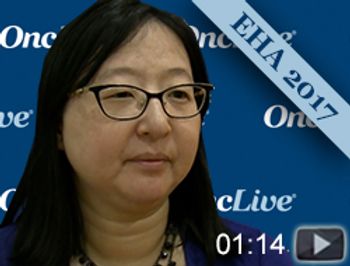
Eunice Wang, MD, chief, Leukemia Service, professor of Oncology, Departments of Medicine and Immunology, Roswell Park Cancer Institute, discusses FLT3 mutations in acute myeloid leukemia.
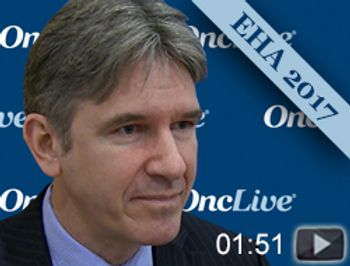
Miguel-Angel Perales, MD, deputy chief, Adult Bone Marrow Transplant Service, director, Adult Bone Marrow Transplantation Fellowship Program, Memorial Sloan Kettering Cancer Center, discusses the remaining questions with CAR T-cell therapy in hematologic malignancies.
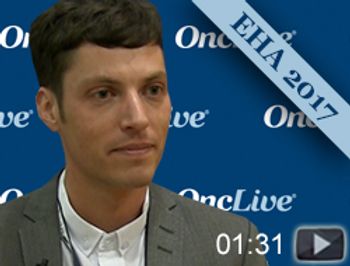
Christian Winther Eskelund, MD, Copenhagen University Hospital, Rigshospitalet, discusses a study of TP53 mutations in mantle cell lymphoma.

Paul A. Hamlin, MD, discusses his research with cerdulatinib in patients with certain types of non-Hodgkin lymphoma.
Results from the phase III Myeloma XI study showed that patients with myeloma had deeper responses after induction and after allo-stem cell transplantation with outpatient-delivered quadruplet therapy than with sequential immunomodulatory triplet combinations.
Patients with newly-diagnosed multiple myeloma who did not elect to undergo stem cell transplant but remained on single agent ixazomib maintenance fared as well as those who received SCT.
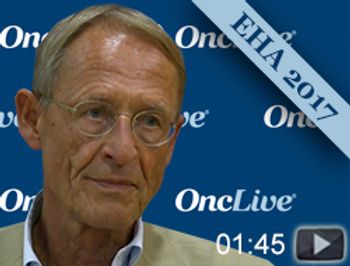
Wolfgang Hiddemann, MD, PhD, director of the Department of Hematology and Oncology, University of Munich, discusses the updated results of an immunochemotherapy study in follicular lymphoma.
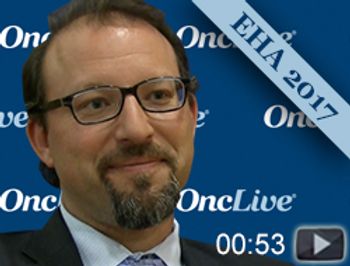
Paul A. Hamlin, MD, chief of the Medical Oncology Service at Memorial Sloan Kettering Cancer Center, discusses a study of cerdulatinib in non-Hodgkin lymphoma.
All patients with multiple myeloma in a phase I study showed a response following treatment with an active dose of bb2121, an investigational anti–BCMA CAR T-cell construct.
Investigators reported the characterization of early clinical and serum biomarkers that may identify specific patients with ALL being treated with 19-28z chimeric antigen receptor T cells needing an early intervention to mitigate the development of severe neurotoxicity.
Jorge E. Cortes, MD, discusses ongoing advances with FLT3 inhibitors in acute myeloid leukemia.
Jorge E. Cortes, MD, professor and deputy chair, Department of Leukemia, The University of Texas MD Anderson Cancer Center, discusses FLT3 Inhibitors in acute myeloid leukemia.
Treatment with JCAR017 demonstrated a complete response rate of 59% and an objective response rate of 86% for patients with relapsed or refractory diffuse large B-cell lymphoma.
Chan Cheah, MD, University of Western Australia, discusses treatment for patients with nodular lymphocyte predominant Hodgkin lymphoma.
Angelo Fama, MD, Division of Hematology, Mayo Clinic, discusses a case control study of the GB Virus-C (GBV-C) infection and the risk of lymphoma.
Combining pembrolizumab with rituximab induced a high response rate in patients with relapsed follicular lymphoma.

Copanlisib showed an objective response rate of 59.2% without inducing major colitis events or elevation of hepatic transaminases in patients with relapsed or refractory indolent B-cell lymphoma.