

John M. Burke, MD, discusses results from a US community-based healthcare practitioner survey on challenges in initiating venetoclax for patients with CLL.
John M. Burke, MD, discusses results from a US community-based healthcare practitioner survey on challenges in initiating venetoclax for patients with CLL.

First-line pirtobrutinib plus venetoclax and obinutuzumab generated high uMRD6 remission rates among patients with chronic lymphocytic leukemia.

Eunice S. Wang, MD, on ziftomenib plus intensive induction in newly diagnosed, NPM1-mutated or KMT2A-rearranged acute myeloid leukemia.

Rachel E. Rau, MD, discusses findings that show blinatumomab plus chemotherapy improves DFS in newly diagnosed B-ALL.
Timothy S. Fenske, MD, MS, shares outcomes from the phase 3 ECOG-ACRIN EA4151 trial of patients with mantle cell lymphoma after first MRD-negative CR.
Axi-cel sustained long-term efficacy in relapsed/refractory follicular lymphoma and marginal zone lymphoma.

The BCL-2 inhibitor lisaftoclax was well tolerated and produced encouraging responses in relapsed/refractory multiple myeloma when given in combination with Pd.

Real-world data showed ide-cel was active in patients with central nervous system manifestations of multiple myeloma.
The GPRC5D-targeting CAR T-cell therapy arlocabtagene autoleucel also yielded a 53% complete response rate in relapsed/refractory multiple myeloma.
Epcoritamab produced responses in older patients with newly diagnosed large B-cell lymphoma.
Brexu-cel led to an ORR of 91% in patients with relapsed/refractory MCL who were naive to BTK inhibitors, according to new data from the ZUMA-2 trial.

BGB-16673 monotherapy showed early activity and a tolerable safety profile in relapsed/refractory Waldenström macroglobulinemia, CLL, and SLL.

Glofitamab plus polatuzumab vedotin generated durable remissions in heavily pretreated, relapsed/refractory large B-cell lymphoma.

Dasom (Caroline) Lee, MD, discusses real-world early outcomes of treatment with second-line axi-cel in relapsed/refractory large B-cell lymphoma.

Christina Poh, MD, discusses results from the phase 3 inMIND study of tafasitamab plus lenalidomide and rituximab for relapsed/refractory follicular lymphoma.

Cilta-cel boosted MRD-negativity rates in lenalidomide-refractory multiple myeloma, according to updated results from CARTITUDE-4.
Sonrotoclax plus zanubrutinib produced responses and was well tolerated in previously untreated chronic lymphocytic leukemia/small lymphocytic lymphoma.
Matthew Matasar, MD, discusses treatment with odronextamab monotherapy in patients with diffuse large B-cell lymphoma following CAR T-cell therapy.
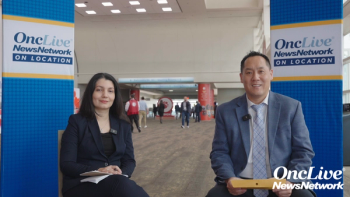
S. Vincent Rajkumar, MD, of Mayo Clinic; Nosha Farhadfar, MD, of Methodist Physician Practices; and Sonali Smith, MD, of University of Chicago Medicine, sit down with Chandler Park, MD, FACP, to discuss the latest in multiple myeloma, graft-vs-host disease, and non-Hodgkin lymphoma, respectively, from the 2024 ASH Annual Meeting.
C. Ola Landgren, MD, PhD, discusses tocilizumab prophylaxis in relapsed/refractory myeloma treated with teclistamab, elranatamab, or talquetamab.
Isatuximab plus initial VRd and Rd maintenance demonstrated deep responses and MRD negativity in transplant-ineligible newly diagnosed multiple myeloma.

Belantamab mafodotin plus bortezomib/dexamethasone improved OS over daratumumab plus bortezomib/dexamethasone in relapsed/refractory multiple myeloma.
Mikkael A. Sekeres, MD, discusses the results of combining luspatercept and lenalidomide in lower-risk, non–5q deletion myelodysplastic syndromes.

Frontline treatment with zanubrutinib continued to improve PFS vs bendamustine plus rituximab at 5 years in patients with treatment-naive CLL/SLL.
Second-generation BTK inhibitors were associated with a significantly lower incidence of cardiac adverse effects in B-cell malignancies.
The addition of uproleselan to chemotherapy did not meet the primary OS end point of a phase 3 trial evaluating patients with relapsed/refractory AML.
Robert M. Rifkin, MD, FACP, discusses the safety and efficacy of the phase 3 Dreamm-7 trial in patients with relapsed/refractory multiple myeloma.
Tisagenlecleucel maintained long-term efficacy and safety in relapsed/refractory follicular lymphoma.

Outpatient lymphodepletion prior to brexu-cel was safe and generated comparable 60-day non-relapse mortality vs inpatient administration in B-ALL and MCL.

Maintenance therapy with teclistamab with or without lenalidomide was safe and efficacious in newly diagnosed multiple myeloma.