
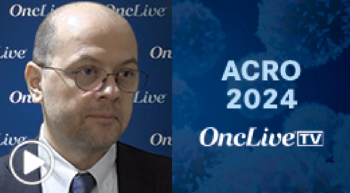
Vlad Gabriel Zaha, MD, PhD, discusses the risk of cardiovascular toxicity in patients with lung cancer undergoing treatment with radiation.

Your AI-Trained Oncology Knowledge Connection!
Vlad Gabriel Zaha, MD, PhD, discusses the risk of cardiovascular toxicity in patients with lung cancer undergoing treatment with radiation.
A case study of a patient with pre-B cell acute lymphoblastic leukemia showed helical tomotherapy with IMRT-based TBI is a viable option for organ sparing.
Hope S. Rugo, MD, draws on her own journey as a woman in oncology to provide insights on navigating career transitions and building support networks.
Stephanie L. Graff, MD, shares her journey to becoming an oncologist, advice for work-life balance, and ways to confront gender bias in medicine.
Nina Sanford, MD, discusses how radiation could help improve QOL for patients with rectal cancer and situations when radiation or surgery could be omitted.
Prolonged duration from neoadjuvant SCRT to surgery did not increase the risk of poor mesorectum specimen quality or post-operative morbidity in rectal cancer.
Raj Singh, MD, discusses radiation therapy in patients with metastatic lung cancer, highlighting the evolution of treatment within this landscape.
Idalid Franco, MD, MPH, discusses the use of radiation therapy and immunomodulatory agents in the treatment of endometrial cancer.
Paul D. Brown, MD, gives a history of prophylactic cranial irradiation in small cell lung cancer and describes its standing in the treatment paradigm.
Tian Zhang, MD, MHS, discusses areas of ongoing debate regarding prostate cancer management.
TNO155 plus spartalizumab or ribociclib was well tolerated and demonstrated disease control in patients with advanced solid tumors.

Stephanie L. Graff, MD, discusses the trajectory of her career growth in breast oncology and explains how different factors can play a role in an oncologist’s career path.
Hope S. Rugo, MD, discusses challenges that women face in the workplace in oncology care.
A high proportion of patients with metastatic solid tumors experienced stable disease following treatment with the immunocytokine in the DODEKA trial.
Neal Shore, MD, FACS, discusses findings from clinical trials in patients with prostate cancer who experience biochemical recurrence.
Maha Hussain, MD, FACP, FASCO, discusses clinical trials evaluating therapeutics for patients with metastatic castrate-resistant prostate cancer.
Heather McArthur, MD, MPH, discusses the prognostic benefits of circulating tumor DNA and limitations that prevent these results from being predictive.
Debu Tripathy, MD, discusses current considerations for the management of early-stage HER2-positive breast cancer.
Bernard H. Bochner, MD, FACS, discusses considerations for community oncologists when treating patients with muscle-invasive bladder cancer.
Wenxin (Vincent) Xu, MD, discusses the factors he takes into account when sequencing treatment options for patients with metastatic renal cell carcinoma.
Hope Rugo, MD, discusses the evolution of antibody-drug conjugates in hormone receptor–positive, HER2-positive, and HER2-low breast cancer.

Peter A. Humphrey, MD, PhD, presents on the standing of artificial intelligence in prostate cancer pathology.
Erica Stringer-Reasor, MD, highlights the evolution of therapies for patients with hormone receptor–positive, HER2-negative metastatic breast cancer.
Laura A. Huppert, MD, discusses data informing the sequence of immunotherapy and chemotherapy regimens in early-stage triple-negative breast cancer.
The inter-tumoral complexity of metastatic castration-resistant prostate cancer poses a treatment challenge that may be tackled by examining clonal evolution.
Scott T. Tagawa, MD, MS, FACP, FASCO, discusses the standing of PARP inhibitors in the treatment paradigm of metastatic castration-resistant prostate cancer.
Robert Dreicer, MD, discusses the shortcomings of current clinical trials in prostate cancer and what he sees as the biggest area of improvement.
Terry P. Mamounas, MD, MPH, FACS, discusses treatment options after neoadjuvant chemotherapy and how neoadjuvant chemotherapy influences axillary surgery.
PRMT5 inhibitors with antiestrogens represents a therapeutic strategy that may overcome resistance to CDK4/6 inhibitors in ER+/RB-deficient breast cancer.
Hope S. Rugo, MD, FASCO, shares progress made with ADCs and the interest in moving these agents up in the HR-positive/HER2-negative breast cancer paradigm.