Stephanie L. Graff, MD, FACP
Articles by Stephanie L. Graff, MD, FACP

Panelists discuss how genomic assays have become essential tools in modern breast cancer treatment, preventing overtreatment by enabling customized treatment plans that determine not only whether patients need chemotherapy but also which specific agents they should receive and whether treatment should be given before or after surgery.
Panelists discuss how genomic testing informs real clinical scenarios, demonstrating that for a 64-year-old healthy woman with a single positive lymph node, the 21-gene assay would guide treatment decisions, with cardiac assessment influencing whether anthracycline-based chemotherapy would be used if her score was high.
Panelists discuss how the TAILORx trial data were transformative for estrogen receptor–positive breast cancer by establishing clearer thresholds for chemotherapy benefit, while raising important questions about whether younger patients with intermediate scores benefit from chemotherapy itself or from the ovarian suppression it causes.
Panelists discuss how the RxPONDER trial data transformed breast cancer treatment by demonstrating that postmenopausal women with 1 to 3 positive lymph nodes and low recurrence scores could safely avoid chemotherapy, while highlighting the controversy about chemotherapy benefit in premenopausal patients where clinical judgment and nuanced assessment of menopausal status remain crucial.
Panelists discuss how the RSClin tool provides more personalized information by combining recurrence scores with clinicopathological data, offering patients specific predictions about their prognosis and potential chemotherapy benefit rather than general outcomes for patients with similar scores.
Panelists discuss how clinical factors such as nodal status influence genomic testing decisions, referencing the TAILORx and RxPONDER trials whose data demonstrated that chemotherapy benefit varies based on recurrence score and menopausal status, highlighting the need for nuanced shared decision-making rather than strict cutoffs.
Panelists discuss how they primarily use the 21-gene assay (Oncotype DX) for estrogen receptor–positive (ER+), HER2-negative (HER2–) breast cancers with minimal nodal disease due to its robust data from multiple trials, whereas other assays such as the Breast Cancer Index (BCI) are better for evaluating extended endocrine therapy benefits.
Panelists discuss how community practitioners face challenges with genomic testing due to working across multiple hospitals with different medical oncology groups who may have varying preferences for assays, emphasizing the importance of communication, established algorithms, and leveraging partnerships with testing companies.
Discover essential insights on breast cancer awareness, prevention, and treatment options to empower your health journey.
Discover essential insights on breast cancer awareness, prevention, and treatment options to empower your health journey.

Stephanie L. Graff, MD, FACP, FASCO, discusses current strategies for fertility preservation in patients with breast cancer.
Stephanie L. Graff, MD, FACP, FASCO, discusses data supporting the use of GnRH agonists for premenopausal women with breast cancer undergoing chemotherapy.

Bora Lim, MD, of The University of Texas MD Anderson Cancer, and Stephanie Graff, MD, of Brown University Health, sit down with Chandler Park, MD, FACP, to discuss the latest abstracts in breast cancer presented during the 2024 San Antonio Breast Cancer Symposium.

Drs Park and Graff discuss the evolution of treatment for patients with metastatic HR-positive breast cancer, including the role of CDK4/6 inhibitors.
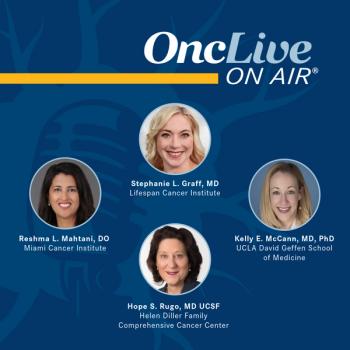
Breast Cancer Experts Share Obstacles and Successes as Women in Oncology
ByStephanie L. Graff, MD, FACP,Reshma L. Mahtani, DO,Kelly E. McCann, MD, PhD,Hope S. Rugo, MD, FASCO Drs Graff, Mahtani, McCann, and Rugo share moments that sparked their interest in oncology and setbacks they overcame when building their careers.

Stephanie L. Graff, MD, discusses the trajectory of her career growth in breast oncology and explains how different factors can play a role in an oncologist’s career path.

Stephanie L. Graff, MD, discusses findings from a pilot study exploring the association between disease recurrence and circulating tumor DNA positivity in patients with hormone receptor–positive, HER2-negative, node-positive, high-risk, early breast cancer who have received adjuvant treatment of abemaciclib and endocrine therapy.

Stephanie L. Graff, MD, discusses the advantages of interrupting endocrine therapy in premenopausal patients with endocrine-responsive breast cancer who are seeking to conceive, based on findings from the phase 3 POSITIVE trial.
Expert medical oncologists take a step into the future and discuss developments within the adjuvant setting of early-stage breast cancer they are most excited about.
Stephanie Graff, MD, and Rachel Layman, MD, review common toxicities and adverse effects to watch out for with endocrine therapy and CDK4/6 inhibitors, and how to manage these.
Expert medical oncologists talk about the impact of NATALEE trial data on their medical practice.
Stephanie Graff, MD, and Rachel Layman, MD, discuss the design and results of the NATALEE trial, which evaluated adjuvant ribociclib + endocrine therapy versus endocrine therapy alone in patients with HR+/HER2− early breast cancer.
Stephanie Graff, MD, describes her impression of the case and discusses the risk for recurrence in this particular patient.
Rachel Layman, MD, presents a clinical case of a patient who is diagnosed with HR+ early-stage breast cancer.
Experts in breast oncology discuss how they select endocrine therapy in BRCA1/BRCA2+ breast cancer.
Stephanie Graff, MD, and Rachel Layman, MD, discuss how they would apply the results of the monarchE trial to clinical case scenarios.
Rachel Layman, MD, summarizes how to dose CDK4/6 inhibitors in different clinical settings.
Experts in breast oncology review age-dependent outcomes with CDK 4/6 inhibitors.
Stephanie Graff, MD, and Rachel Layman, MD, discuss how to individualize care with CDK4/6 inhibitors in patients with high-risk early breast cancer.
Stephanie Graff, MD, and Rachel Layman, MD, discuss the design and results of the monarchE trial, which evaluated abemaciclib plus endocrine therapy for HR+, HER2 negative, node positive, high-risk early breast cancer.