
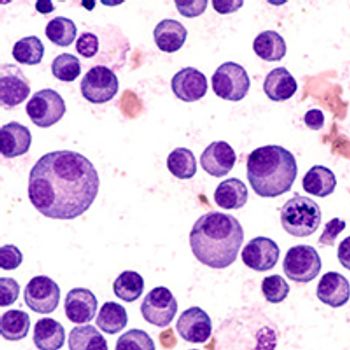
Tocilizumab plus teclistamab step-up dosing showed efficacy and a mainly mild safety profile in patients with relapsed/refractory multiple myeloma.
Tocilizumab plus teclistamab step-up dosing showed efficacy and a mainly mild safety profile in patients with relapsed/refractory multiple myeloma.
Treatment with BVd elicited PROs comparable with those who were treated with DVd in relapsed/refractory multiple myeloma.

Enfortumab vedotin plus pembrolizumab did not negatively affect quality of life in patients with advanced urothelial carcinoma.

The European Medicines Agency’s Committee for Medicinal Products for Human Use adopted a positive opinion for Avzivi, a monoclonal antibody referencing bevacizumab.
Treatment with a decreased dosing schedule of oral azacitidine was consistent with what has been previously known about the agent in intermediate-risk myelodysplastic syndrome.

Belantamab mafodotin plus bortezomib and dexamethasone improved median progression-free survival vs daratumumab plus bortezomib and dexamethasone in relapsed/refractory multiple myeloma.

Rivoceranib plus camrelizumab maintained a survival benefit vs sorafenib in advanced, unresectable hepatocellular carcinoma.

The addition of atezolizumab to bevacizumab and chemotherapy did not significantly improve overall survival or progression-free survival in patients with recurrent ovarian cancer.

Integrating liver transplantation into treatment with chemotherapy improved survival at 5 years vs chemotherapy alone in patients with definitively unresectable CRC liver metastases.

Using CD8-positive, PD-1-positive, TIM3-negative, and LAG3-negative TILs as a biomarker was not associated with improved clinical outcomes for patients with mccRCC treated with nivolumab plus ipilimumab.

Taletrectinib demonstrated high response rates and a tolerable safety profile in patients with ROS1-positive non–small cell lung cancer.

The combination of nivolumab and ipilimumab improved responses as well as survival outcomes in patients with ovarian or gynecologic clear cell carcinomas.

Trastuzumab deruxtecan improved PFS vs chemotherapy in pretreated, HR-positive, HER2-low or -ultralow metastatic breast cancer.

Zanidatamab continued to show confirmed responses, disease control, and prolonged overall survival in pretreated HER2+ biliary tract cancer.

Cabazitaxel plus abiraterone acetate and prednisone improved PSA response and extended PFS vs abiraterone acetate and prednisone in patients with mCRPC.

Pembrolizumab plus sacituzumab govitecan numerically improved PFS vs the ADC alone in HR-positive, HER2-negative metastatic breast cancer.

The delivery of palliative care through telehealth vs in-person visits was equally beneficial for patients with advanced non–small cell lung cancer.

The addition of lymphadenectomy to cytoreductive surgery did not improve progression-free or overall survival in advanced ovarian cancer.

Consolidation treatment with durvalumab after concurrent chemoradiation led to a survival benefit vs placebo in limited-stage small cell lung cancer.

Osimertinib after definitive chemoradiotherapy improved PFS vs placebo in locally advanced, EGFR-mutated non–small cell lung cancer.

Perioperative chemotherapy with FLOT improved OS vs neoadjuvant chemoradiation with CROSS in resectable esophageal cancer.

Neoadjuvant nivolumab/ipilimumab followed by TLND and response-driven adjuvant therapy reduced the risk of progression, recurrence, or death in melanoma.
Belantamab mafodotin plus BPd improved PFS vs PVd in relapsed/refractory multiple myeloma.
Tucidinostat plus R-CHOP improved efficacy and was safe in previously untreated DLBCL expressing MYC and BCL2.

Abemaciclib plus fulvestrant improved PFS vs fulvestrant alone in select patients with hormone receptor–positive/HER2-negative advanced breast cancer.

Inavolisib plus palbociclib and fulvestrant reduced the risk of progression or death in HR+/HER2– PIK3CA-mutated advanced or metastatic breast cancer.

Anthracycline/taxane/cyclophosphamide was linked to improved RFS in MammaPrint high-2–risk, BluePrint Luminal B, HR-positive, HER2-negative breast cancer.

Compared with standard-of-care chemotherapy, adagrasib significantly improved PFS and tumor responses in KRASG12C-mutated locally advanced or metastatic NSCLC.

The small molecule inhibitor DFF332 elicited clinical activity and had a tolerable safety profile in patients with advanced clear cell renal cell carcinoma.

Neoadjuvant sacituzumab govitecan demonstrated efficacy in patients with muscle-invasive bladder cancer, but its future role in the space is uncertain.