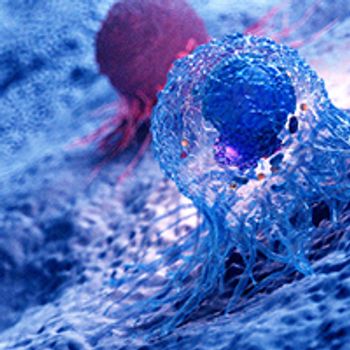
N-803, a novel IL-15 superagonist, in combination with intravesical Bacillus Calmette–Guérin induced an overall response in more than two-thirds of patients with non–muscle invasive bladder cancer.

Your AI-Trained Oncology Knowledge Connection!


N-803, a novel IL-15 superagonist, in combination with intravesical Bacillus Calmette–Guérin induced an overall response in more than two-thirds of patients with non–muscle invasive bladder cancer.

The European Committee for Medicinal Products for Human Use has announced that it does not support the marketing authorization of omburtamab for the treatment of patients with central nervous system/leptomeningeal metastasis from neuroblastoma.

Ursula A. Matulonis, MD, discusses the novelty of mirvetuximab soravtansine in platinum-resistant ovarian cancer, and how it will expand options for a traditionally difficult-to-treat population.

Max S. Topp, MD, highlights the rationale for studying bispecific antibodies in newly diagnosed diffuse large B-cell lymphoma, how the safety profile of glofitamab plus R-CHOP contributes to its potential for outpatient administration, and where future directions with this research may lead.


Findings from a recent prospective study show promising safety and patient outcomes data for locally advanced and borderline resectable pancreatic cancer treatment using ablative Stereotactic MRI-Guided On-table Adaptive Radiation Therapy, also known as SMART.

The FDA has not sent an action letter regarding the biologics license application for toripalimab in combination with chemotherapy as treatment for patients with recurrent or metastatic nasopharyngeal carcinoma.

Treatment with PDS0101 plus the tumor-targeting IL-12 fusion protein M9241 and bintrafusp alfa elicited encouraging overall survival data in patients with checkpoint inhibitor–naïve and –refractory advanced human papillomavirus–positive anal, cervical, head and neck, vaginal, and vulvar cancer.

Data concerning the long-term benefit of PARP inhibitors as maintenance therapy for select patients with ovarian cancer in later-line settings have come under fire in 2022 as several agents have failed to demonstrate improvements in OS outcomes.

David L. Saltman MD, PhD, discusses the unique features of the DetermaIO assay, noted the assay’s applications beyond lung cancer, and emphasized that biomarker combinations potentially have greater predictive benefits than single biomarkers.

The past decade has been a time of great progress in the research of Waldenström macroglobulinemia and the care of patients with the rare form of non-Hodgkin lymphoma.

Incidence of surgery refusal has increased by nearly 50% among Black and Hispanic women with potentially curable, nonmetastatic breast cancer over the past decade, according to findings from an analysis of Surveillance, Epidemiology, and End Results Program data.

Driven by his twin passions for music and science, Louis M. Staudt, MD, PhD, has made a career out of reading between the notes.

Neoadjuvant and adjuvant pertuzumab plus trastuzumab with docetaxel continued to show improvements in event-free survival, disease-free survival and overall survival vs trastuzumab/docetaxel and placebo in Asian patients with HER2-positive early or locally advanced breast cancer.

INT230-6 demonstrated direct tumor killing in soft tissue sarcoma and elicits an anti-cancer immune response within the injected tumor both alone and in combination with ipilimumab.

Anna Pavlick, DO, MBA, discusses key updates from clinical trials that continue to shape the treatment of patients with melanoma, the role of immunotherapy in the frontline setting, and the importance of toxicity management and patient support.

Lori J. Pierce, MD harbored a love for science and a general desire to know things, and she was not shy about asking questions. She displayed a gift for math early in life, a trait she and her older sister, Karen, both inherited from their father, Melvin H. Pierce.

Claire F. Verschraegen, MD, discusses how nivolumab and ipilimumab fit into the treatment paradigm, poses examples of when treatment-related adverse effects might influence which agents to use, and emphasizes the importance of considering the benefits of immunotherapy.

Moderately hypofractionated preoperative radiotherapy did not increase risk for major wound complication in patients with soft tissue sarcomas, according to findings from the single-arm, phase 2 trial HYPORT-STS.

Ritu Salani, MD, MBA, discusses the continued evolution of molecular profiling in endometrial cancer, advances in immunotherapy for endometrial and cervical cancer, and ongoing research in gynecologic cancers.

Jaffer A. Ajani, MD, has an unyielding drive that has resulted in breakthroughs in a deadly, but often overlooked, disease.

Investigators may have discovered a key detail about renal medullary carcinoma that could have significant ramifications for patients.

Treatment with INV-1120 was well tolerated and demonstrated preliminary signals of stable disease as a single agent in patients with advanced solid tumors.

Peter Dottino, MD, FACOG, discusses the need for more accurate early screening tests for ovarian cancer, why testing for early-stage endometrial cancer is also important, the process used to develop the screening test, and how it could be implemented into practice if it is approved by the FDA.

An unshakeable belief in the power of the immune system and a deep-seated desire to make the world a better place have guided Eric J. Small, MD, throughout his career.

Prior authorization on cancer treatments is delaying patient care, affecting outcomes, and diverting providers from patient care according to results of a survey conducted by the Association for Clinical Oncology.

Michael R. Harrison, MD, discusses the key long-term data of select doublet combinations in renal cell carcinoma, the early investigation of triplet therapy in the frontline setting, and more.

Konstantinos Leventakos, MD, PhD, discusses the emergence of immunotherapy and lurbinectedin as beneficial treatments in small cell lung cancer, where osimertinib fits into the non–small cell lung cancer treatment paradigm, and more.

During his career, David M. Gershenson, MD, has helped turn ovarian cancer treatment into an evidence-based field and built better therapies through an improved biological understanding of the disease.

Patient history and disease characteristics did not affect outcomes for patients with metastatic HER2-low breast cancer who received fam-trastuzumab deruxtecan-nxki in the DESTINY-Breast04 study.