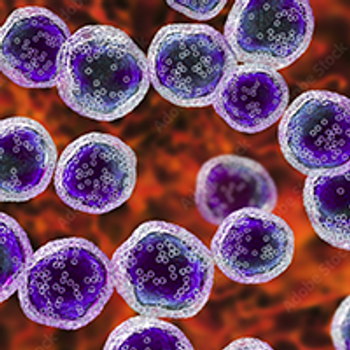
Obecabtagene autoleucel elicited an overall remission rate of 70% in 50 efficacy-evaluable adult patients with relapsed or refractory B-cell acute lymphoblastic leukemia, meeting the primary end point of the phase 2 FELIX trial.

Your AI-Trained Oncology Knowledge Connection!


Obecabtagene autoleucel elicited an overall remission rate of 70% in 50 efficacy-evaluable adult patients with relapsed or refractory B-cell acute lymphoblastic leukemia, meeting the primary end point of the phase 2 FELIX trial.

The FDA has granted a priority review to a supplemental biologics license applications for enfortumab vedotin and pembrolizumab used in combination for the treatment of patients with locally advanced or metastatic urothelial cancer who are not eligible to receive cisplatin-containing chemotherapy.

Melissa A. Lumish, MD, discusses emerging treatment strategies that could lead to more individualized treatment plans for patients with rectal cancer.

The United Kingdom’s National Institute for Health and Care Excellence has endorsed trastuzumab deruxtecan for use within the Cancer Drugs Fund for adult patients with HER2-positive, unresectable or metastatic breast cancer following at least 1 anti-HER2 treatment.

Glofitamab, an investigational CD20xCD3 T-cell engaging bispecific antibody, demonstrated promising results in patients with relapsed/refractory diffuse large B-cell lymphoma who received at least 2 prior lines of therapy.

Zanidatamab monotherapy produced responses in previously treated patients with HER2-amplified and -expressing biliary tract cancers.

Jeanne M. Palmer, MD, discusses a retrospective analysis of the PERSIST-1 and PAC203 trials, the symptoms that were analyzed across patient populations, and what the findings from this research indicate about the relationship between low platelet counts and symptoms such as fatigue in myelofibrosis.

Durvalumab monotherapy failed to elicit a statistically significant improvement in overall survival vs platinum-based chemotherapy as frontline treatment in patients with stage IV non–small cell lung cancer with at least 25% positivity of PD-L1 on tumor cells, or in a subgroup of patients at low risk of early mortality.

The United Kingdom’s Medicines and Healthcare Products Regulatory Agency has accepted a marketing authorization application seeking approval for sugemalimab plus chemotherapy as first-line treatment for patients with metastatic non–small cell lung cancer.

COM701 plus nivolumab demonstrated modest antitumor activity but a favorable safety profile in patients with metastatic microsatellite stable colorectal cancer.

Billy Truong, a doctoral candidate at Fox Chase Cancer Center, was awarded the American Society of Hematology Abstract Achievement Award for a poster that he presented at the 64th ASH Annual Meeting and Exposition.

The European Commission has approved fam-trastuzumab deruxtecan-nxki as monotherapy for the treatment of patients with advanced HER2-positive gastric or gastroesophageal junction adenocarcinoma who have received a prior trastuzumab-based regimen.

Top epigenetics researchers from around the world gathered in South Beach for the Fifth Biennial Miami Epigenetics and Cancer Symposium, hosted by Sylvester Comprehensive Cancer Center at the University of Miami Miller School of Medicine.

The FDA has approved a new indication for pafolacianine to aid surgeons in detecting lung cancer lesions in adult patients with known or suspected lung cancer.

The European Medicines Agency’s Committee for Medicinal Products for Human Use has recommended approval for the use of trastuzumab deruxtecan monotherapy for adults with unresectable or metastatic HER2-low breast cancer.

Alexander Spira, MD, PhD, FACP, discusses the rationale for targeting CEACAM5 in NSCLC, how tusamitamab ravtansine could provide encouraging frontline responses in the CEACAM5-positive, nonsquamous population, and enrollment challenges faced by ongoing clinical trials.

Stephen V. Liu, MD, discusses the effect of the FDA approval of atezolizumab on the development of other chemoimmunotherapy regimens and ongoing efforts to expand and individualize treatment options in small cell lung cancer.
Nour Abuhadra, MD, discusses what the data from DESTINY-Breast04 means for trastuzumab deruxtecan in the triple-negative breast cancer space and future areas of research for antibody-drug conjugates in this disease.

Leif Stenke, MD, PhD, discusses the role XS004 may have in future clinical development in chronic myeloid leukemia.

The FDA has approved nadofaragene firadenovec-vncg (Adstiladrin) for the treatment of adult patients with high-risk Bacillus Calmette-Guérin–unresponsive non–muscle invasive bladder cancer with carcinoma in situ with or without papillary tumors.

Alessandro Fatatis, MD, PhD, has been named Associate Director for Basic Research at Jefferson Health’s Sidney Kimmel Cancer Center.

The addition of zolbetuximab to capecitabine and oxaliplatin resulted in a statistically significant improvement in progression-free survival and overall survival vs placebo/CAPOX in patients with Claudin 18.2–positive, HER2-negative, locally advanced unresectable or metastatic gastric or gastroesophageal cancers, meeting the primary and secondary end points of the phase 3 GLOW trial.

The use of an individualized starting dose of niraparib led to a trend toward improved overall survival as maintenance therapy vs placebo in Chinese patients with platinum-sensitive, recurrent ovarian cancer regardless of germline BRCA mutation status, according to data from the phase 3 NORA trial.

As more and more people in the United States identify as lesbian, gay, bisexual, transgender, queer, intersex, or other sexual orientation or gender minority, the population of LGBTQI+ cancer survivors is becoming uniquely heterogeneous.

Joshua Brody, MD, discussed significant updates in MCL treatment presented at the 2022 ASH Annual Meeting, including results from the phase 1/2 BRUIN trial of pirtobrutinib, follow-up data from the phase 2 ZUMA-7 trial on CAR T-cell therapies, and next steps to expand the development of immunotherapies in this disease.

Alexander E. Perl, MD, MS, discusses the implications of the updated ELN guidelines, how genetic testing guides treatment in this disease, and ongoing research investigating novel AML targets such as NPM1 mutations or KMT2A translocations.

Neoadjuvant chemotherapy with dual HER2-blockade of pertuzumab and trastuzumab is well tolerated and increases the rate of pathological complete response in patients with HER2-positive breast cancer compared with regimens that contain trastuzumab only, while being neutral on drug cost.

Swayam Prabha, MBA, PhD was recently awarded a $792,000 American Cancer Society research scholar grant to investigate new methods for treating lung cancer.
Ranee Mehra, MD, discusses the significance of 5-year follow-up data and the subgroup analysis from KEYNOTE-048, the benefits and limitations of IO therapy in head and neck squamous cell carcinoma, and research aiming to expand the role of IO combination regimens in this space.

The FDA has approved updated labeling for capecitabine tablets (Xeloda) under an initiative aimed to ensure labeling information is clinically meaningful and scientifically up to date.