
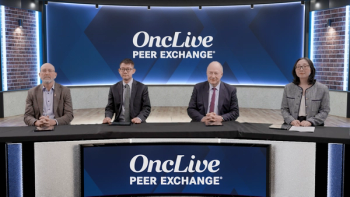
The discussion opens with an overview of the rapidly evolving treatment landscape in relapsed/refractory multiple myeloma, highlighting the expanding range of BCMA-directed therapeutic approaches.

In this OncLive Peer Exchange®, a panel of experts discusses the evolving treatment landscape for relapsed/refractory multiple myeloma (RRMM), with a focus on the expanding role of BCMA-directed bispecific antibodies and antibody-drug conjugates. Dr. Hans Lee, Dr. Paul Richardson, Dr. Jing Christine Ye, and Dr. Douglas Sborov examine how these therapies compare with CAR T-cell therapy in terms of mechanism, administration, toxicity, and practical use. The discussion highlights longer-term efficacy and durability data from the LINKER-MM1 and DREAMM clinical programs, including response depth, progression-free survival, and outcomes in patients with high-risk disease features. The panel also explores how disease burden, treatment urgency, access, manufacturing timelines, patient preferences, and toxicity profiles influence treatment selection and sequencing in RRMM. Additional discussion addresses emerging combination and earlier-line strategies, management of treatment-related toxicities, outpatient implementation, real-world considerations, and the importance of balancing treatment efficacy with safety and patient quality of life.
The discussion opens with an overview of the rapidly evolving treatment landscape in relapsed/refractory multiple myeloma, highlighting the expanding range of BCMA-directed therapeutic approaches.
Dr. Hans Lee and Dr. Douglas Sborov discuss how clinicians conceptualize the three major BCMA-directed treatment approaches in relapsed/refractory multiple myeloma: CAR T-cell therapy, bispecific antibodies, and antibody-drug conjugates.
Dr. Hans Lee and Dr. Jing Christine Ye discuss the evolution of clinical data for BCMA-directed bispecific antibodies in relapsed/refractory multiple myeloma, focusing on the increasing understanding of response depth and durability with longer follow-up.
Dr. Paul Richardson discusses clinical data and practical considerations for belantamab mafodotin as a BCMA-directed antibody-drug conjugate in relapsed/refractory multiple myeloma, highlighting findings from the DREAMM-7 study.
Dr. Hans Lee and Dr. Douglas Sborov discuss how clinical trial subgroup data can inform treatment selection for patients with high-risk relapsed/refractory multiple myeloma.
The panel discusses the practical advantages of off-the-shelf BCMA-directed therapies in relapsed/refractory multiple myeloma, particularly for patients with rapidly progressing disease or high disease burden who may not be able to wait for CAR T-cell manufacturing.
The panel discusses geographic access, community-based treatment, and evolving guideline recommendations for BCMA-directed therapies in relapsed/refractory multiple myeloma.
Dr. Hans Lee and the panel discuss emerging combination strategies and treatment sequencing for patients with relapsed/refractory multiple myeloma.
The panel discusses the movement of BCMA-directed therapies from relapsed/refractory multiple myeloma into earlier-line and newly diagnosed disease.
The panel discusses how clinicians may differentiate among BCMA-directed bispecific antibodies as the treatment landscape becomes increasingly crowded.
The panel discusses treatment strategies for patients with relapsed/refractory multiple myeloma who experience early disease progression following BCMA-directed therapy, including CAR T-cell therapy.
The panel looks ahead to emerging developments that may continue to shape treatment of relapsed/refractory multiple myeloma.
The panel discusses supportive care strategies for safely administering BCMA-directed therapies in relapsed/refractory multiple myeloma, with particular attention to bispecific antibodies and belantamab mafodotin.
The panel discusses strategies for managing toxicity and optimizing treatment duration with BCMA-directed therapies in relapsed/refractory multiple myeloma.