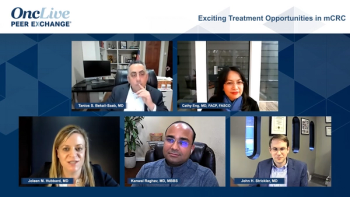
Experts in gastrointestinal oncology highlight their approaches to assessing patients with newly diagnosed metastatic colorectal cancer and explain the variables that factor into first-line treatment decisions.
Cathy Eng, MD, FACP, FASCO, of Vanderbilt-Ingram Cancer Center reacts to the increasing rate of colorectal cancer among the younger population and highlights topics that apply specifically to counseling younger patients.
The rationale for treating select patients with metastatic colorectal cancer with intensive therapy in the first-line setting vs waiting until disease progression.
Drs Cathy Eng and Joleen M. Hubbard explain how patients with metastatic colon cancer typically respond to initial treatment and describe the factors that impact second-line treatment decisions.
The role of molecular assays, including liquid biopsies, in providing information on resistance mechanisms in metastatic colorectal cancer and the impact of testing results on decisions for rechallenging with a previous therapy.
Considerations for treating BRAF-mutated metastatic colorectal cancer with the combination of a BRAF inhibitor plus anti-EGFR agent based on recently presented data.
Gastrointestinal oncologists consider when it is most appropriate to initiate the BEACON trial regimen of encorafenib-binimetinib-cetuximab as treatment for BRAF-mutated metastatic colorectal cancer.
The rationale for treating metastatic colon cancer with regorafenib in a later-line setting and the importance of applying the dose-escalation strategy demonstrated by the ReDOS trial into clinical practice.
Variables that impact patient selection for TAS-102 treatment as later-line therapy for metastatic colorectal cancer and considerations for using TAS-102 in combination with bevacizumab.
A panel of gastrointestinal oncologists discuss current options for molecular testing based on the understanding that predictive biomarkers play a role in the management of metastatic colon cancer.
Cathy Eng, MD, FACP, FASCO, describes data revealed by the KEYNOTE-177 trial and discusses best practices for using immunotherapy as first-line treatment of metastatic colorectal cancer.
Kanwal Raghav, MD, MBBS, of The University of Texas MD Anderson Cancer Center, discusses when it is most appropriate to initiate immunotherapy for metastatic colorectal cancer, highlighting the roles of tumor mutation burden and microsatellite instability as biomarkers for treatment.
Current trials exploring novel combinations that show potential in making microsatellite stable tumors hot and amenable to response to immunotherapy in metastatic colon cancer.
Closing out a discussion on novel therapies used to individualize treatment for patients with metastatic colorectal cancer, a panel of gastrointestinal oncologists highlight the most exciting treatment opportunities being explored to address current gaps in care.