
For the 11th consecutive year, OncLive is honored to recognize oncology leaders whose innovations have contributed to immeasurable improvements in outcomes for countless patients.
For the 11th consecutive year, OncLive is honored to recognize oncology leaders whose innovations have contributed to immeasurable improvements in outcomes for countless patients.
Tycel Phillips, MD, discusses the significance of the FDA approval of the bispecific antibody epcoritamab in patients with relapsed/refractory diffuse large B-cell lymphoma.
The potential effectiveness of employing placebo in cancer clinical investigation is not difficult to appreciate, but the use of this approach has been, and continues to be, controversial.
The addition of venetoclax to lenalidomide and rituximab produced early evidence of clinical efficacy with a tolerable safety profile in previously untreated patients with mantle cell lymphoma.
When patients with cancer are asked to be participants in a clinical trial, they are informed that a primary purpose of the investigative effort is to develop objectively valid, generalizable information that may be of value to patients with the same malignancy or benefit researchers in the development of future studies.
Ernest S. Han, MD, PhD, discusses the use of hyperthermic intraperitoneal chemotherapy in ovarian cancer.
Dr Kim discusses the evaluation of LP-300 for the treatment of patients with advanced lung adenocarcinoma, the rationale for exploring this agent in combination with chemotherapy, and the ongoing HARMONIC trial investigating the combination of LP-300 plus carboplatin and pemetrexed.
In this seventh episode of OncChats: Taking Organoids From Bench to Bedside Through Endoscopy in Pancreatic Cancer, Toufic A. Kachaamy, MD, Madappa Kundranda, MD, PhD, and Richard Burkhart, MD, discuss ongoing research such as the PASS-01 trial (NCT04469556) in pancreatic cancer and ways to translate advances in the metastatic setting to the curative setting.
Brian Ball, MD, discusses the significance of targeting RARA in AML, the rationale for SELECT-AML-1, and additional AML research that may contribute to the broadening treatment paradigm in the future.
Joshua G. Cohen, MD, FACOG, FACS, expands on the role of PARP inhibitors in the recurrent and up-front settings in ovarian cancer, and the clinical significance of the RUBY and NY-GY018 trials in endometrial cancer.
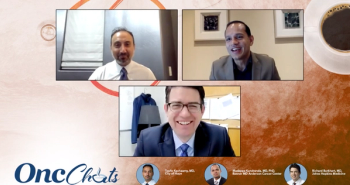
In this fifth episode of OncChats: Taking Organoids From Bench to Bedside Through Endoscopy in Pancreatic Cancer, Toufic A. Kachaamy, MD, Madappa Kundranda, MD, PhD, and Richard Burkhart, MD, provide insight into some of the regulatory challenges of organoid development and share expectations for the future of pharmacotyping in treatment selection.
Looking to replicate the impressive findings with CAR T-cell therapies observed in patients with hematologic malignancies, investigators have initiated the BASECAMP-1 trial, with the hope of identifying patients with advanced solid tumors who will be suitable candidates for treatment in a subsequent trial evaluating the investigational agent A2B530.
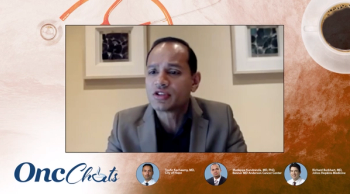
In this fifth episode of OncChats: Taking Organoids From Bench to Bedside Through Endoscopy in Pancreatic Cancer, Toufic A. Kachaamy, MD, Madappa Kundranda, MD, PhD, and Richard Burkhart, MD, review the potential advantages of using endoscopic ultrasound to enhance current molecular diagnostic techniques in pancreatic cancer.
Brian C. Ball, MD, discusses previous research on tamibarotene in newly diagnosed acute myeloid leukemia, and how these data support the ongoing phase 2 SELECT-AML-1 trial.
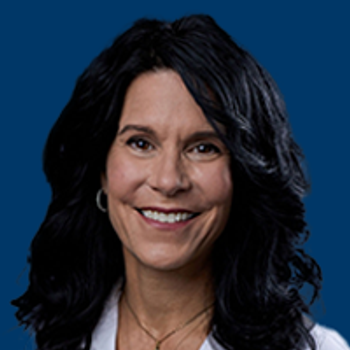
Hemostatic radiation is a method of managing bleeding in patients with gastrointestinal cancers or GI metastases from other primary tumors; however, a multidisciplinary team is required to implement this method, according to Marnee M. Spierer, MD, MBA.
In this fourth episode of OncChats: Taking Organoids From Bench to Bedside Through Endoscopy in Pancreatic Cancer, Toufic A. Kachaamy, MD, Madappa Kundranda, MD, PhD, and Richard Burkhart, MD, shed light on the process of obtaining sufficient tissue through endoscopic ultrasound–guided biopsies to generate organoids.
In this third episode of OncChats: Taking Organoids From Bench to Bedside Through Endoscopy in Pancreatic Cancer, Toufic A. Kachaamy, MD, Madappa Kundranda, MD, PhD, and Richard Burkhart, MD, highlight the three ways in which an organoid can be used to aid clinical sequencing and treatment selection in pancreatic cancer.
Recent events threaten to seriously diminish the well-established and generally positively viewed role of both scientific and clinical expertise in health-related public policy.
In this second episode of OncChats: Taking Organoids From Bench to Bedside Through Endoscopy in Pancreatic Cancer, Toufic A. Kachaamy, MD, Madappa Kundranda, MD, PhD, and Richard Burkhart, MD, provide an overview of patient-derived organoids and pharmacotyping in locally advanced pancreatic cancer.
In this first episode of OncChats: Taking Organoids From Bench to Bedside Through Endoscopy in Pancreatic Cancer, Toufic A. Kachaamy, MD, Madappa Kundranda, MD, PhD, and Richard Burkhart, MD, discuss the involvement of the gastroenterologist from diagnosis to palliative care in the management of patients with pancreatic cancer.

Miguel Villalona-Calero, MD, discusses the unique mechanism of action of KB-0742 and the rationale and design of a phase 1 trial investigating the safety and efficacy of KB-0742 in patients with relapsed/refractory solid tumors or non-Hodgkin lymphoma.
In this seventh episode of OncChats: Understanding Endoscopy in the Realm of GI Cancers, Madappa Kundranda, MD, PhD, and Toufic A. Kachaamy, MD, discuss the convergence of gastroenterology and interventional gastroenterology in gastrointestinal cancer management and the future of interventional endoscopy.
In this sixth episode of OncChats: Understanding Endoscopy in the Realm of GI Cancers, Madappa Kundranda, MD, PhD, and Toufic A. Kachaamy, MD, share efforts to increase awareness around endoscopy in gastrointestinal cancer.
In this fifth episode of OncChats: Understanding Endoscopy in the Realm of GI Cancers, Madappa Kundranda, MD, PhD, and Toufic A. Kachaamy, MD, review the potential role for endoscopic ablation in gastrointestinal cancer.
The evaluation of diagnostic quality in precision medicine should almost certainly be assessed by standards different from those used in drug development.
In this fourth episode of OncChats: Understanding Endoscopy in the Realm of GI Cancers, Madappa Kundranda, MD, PhD, and Toufic A. Kachaamy, MD, provide insight on the use of endoscopic submucosal resection and endoscopic evaluation for tumor response as it pertains to organ preservation in gastrointestinal cancer.
In this third episode of OncChats: Understanding Endoscopy in the Realm of GI Cancers, Madappa Kundranda, MD, PhD, and Toufic A. Kachaamy, MD, highlight the advantages and scope of endoscopic procedures in gastrointestinal cancer.
In this second episode of OncChats: Understanding Endoscopy in the Realm of GI Cancers, Madappa Kundranda, MD, PhD, and Toufic A. Kachaamy, MD, explain the evolution of minimally invasive surgery and the emergence of interventional radiology in gastrointestinal cancer.
As the great baseball catcher and philosopher Yogi Berra noted, “When you come to a fork in the road, take it.” And in my opinion, we surely are at that juncture with human papillomavirus vaccination.
In this first episode of OncChats: Understanding Endoscopy in the Realm of GI Cancers, Madappa Kundranda, MD, PhD, and Toufic A. Kachaamy, MD, discuss the importance of endoscopic oncology as it relates to rising cancer incidence and multidisciplinary care in gastrointestinal cancer.