
Experts discuss what role allogeneic transplants play in hematologic malignancies, specifically in AML and ALL.
Experts discuss what role allogeneic transplants play in hematologic malignancies, specifically in AML and ALL.
A panel of experts discuss the evolving landscape of newly diagnosed multiple myeloma.
Revumenib demonstrated clinically meaningful activity, including high response and minimal residual disease negativity rates, in heavily pretreated patients with KMT2A-rearranged acute leukemia.
NX-2127 showcased early efficacy in the form of responses with an acceptable toxicity profile in patients with relapsed or refractory B-cell malignancies, according to data from the ongoing phase 1 NX-2127-001 trial.
In this seventh episode of OncChats: Assessing the Promise of AI in Oncology, Toufic A. Kachaamy, MD, and Douglas Flora, MD, LSSBB, FACCC, discuss how artificial intelligence tools may be utilized to improve wait time for treatment, to provide more time for provider-patient interactions, and more.
Odronextamab produced durable responses and a generally manageable safety profile in patients with relapsed/refractory diffuse large B-cell lymphoma.
Brexucabtagene autoleucel is safe and effective in real-world patients with relapsed/refractory mantle cell lymphoma, regardless of the presence of high-risk features.
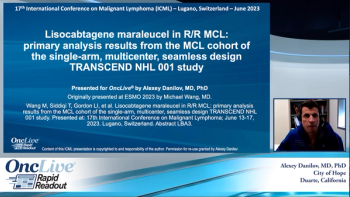
Alexey Danilov, MD, PhD, reviews data from the TRANSCEND NHL 001 study investigating lisocabtagene maraleucel in patients with relapsed/refractory mantle cell lymphoma.
In this sixth episode of OncChats: Assessing the Promise of AI in Oncology, Toufic A. Kachaamy, MD, and Douglas Flora, MD, LSSBB, FACCC, discuss potential opportunities to leverage artificial intelligence tools in cancer screening, diagnosis, staging, and prognosis.
This commentary examines the use of words and expressions in the oncology domain and the implications of different interpretations by patients and their families from professionals employing this language, including academic authors and members of their clinical teams.
In this fifth episode of OncChats: Assessing the Promise of AI in Oncology, Toufic A. Kachaamy, MD, and Douglas Flora, MD, LSSBB, FACCC, discuss the need for evidence to support the utilization of different artificial intelligence tools in healthcare.
Maurie Markman, MD, discusses the unique role of PARP inhibitors in the treatment of patients with ovarian cancer.
In this fourth episode of OncChats: Assessing the Promise of AI in Oncology, Toufic A. Kachaamy, MD, and Douglas Flora, MD, LSSBB, FACCC, explain the importance of having a diverse editorial board behind a new journal on artificial intelligence in precision oncology.
In this third episode of OncChats: Assessing the Promise of AI in Oncology, Toufic A. Kachaamy, MD, and Douglas Flora, MD, LSSBB, FACCC, discuss the launch of a new journal that will focus on educating the field on the latest research efforts being made with artificial intelligence.
Maurie Markman, MD, discusses the importance of designing clinical trials for patients with ovarian cancer that are based on real-world data and consider the increasing complexity of treatment sequencing in this disease.
In this second episode of OncChats: Assessing the Promise of AI in Oncology, Toufic A. Kachaamy, MD, and Douglas Flora, MD, LSSBB, FACCC, explain how artificial intelligence tools may be leveraged in the oncology field to provide personalized care.
It is time for society to address the critical nature of our current unsustainable oncology pharmaceutical marketplace, and it is also essential that whatever solutions are proposed and implemented do not incorporate inappropriate labeling of outcomes that negate meaningful measures of clinical benefit.
In this first episode of OncChats: Assessing the Promise of AI in Oncology, Toufic A. Kachaamy, MD, and Douglas Flora, MD, LSSBB, FACCC, define artificial intelligence and highlight the goals of these tools in healthcare.
It is difficult to browse a major medical journal these days and not find an article, commentary, or editorial that discusses the objectively rather profound implications for clinical science and health care delivery resulting from simply stunning advances in computer technology in the arena of artificial intelligence.
Maurie Markman, MD, highlights the rather profound fiscal implications of the combined effect of 2 quite different but closely related components of the rapidly evolving cancer treatment paradigm.
In this final episode of OncChats: Leveraging Endoscopic Ultrasound in Pancreatic Cancer, Toufic A. Kachaamy, MD, Madappa Kundranda, MD, PhD, and Tamas A. Gonda, MD, reiterate that the role of endoscopic therapies in pancreatic cancer continues to evolve.
Tycel Phillips, MD, discusses current and emerging therapeutic treatment strategies for patients with mantle cell lymphoma.
In this sixth episode of OncChats: Leveraging Endoscopic Ultrasound in Pancreatic Cancer, Toufic A. Kachaamy, MD, Madappa Kundranda, MD, PhD, and Tamas A. Gonda, MD, briefly discuss pancreatic cancer ablation and immune modulation.
Treatment with the first-in-class menin inhibitor revumenib generated complete remissions or complete remissions with partial hematological recovery in adult and pediatric patients with relapsed/refractory acute myeloid leukemia or acute lymphoblastic leukemia harboring KMT2A rearrangements.
Overall response rates with bispecific antibody monotherapy in patients with extramedullary relapsed/refractory multiple myeloma were lower than ORRs observed across all patients with relapsed/refractory multiple myeloma included in a systematic review evaluating the efficacy of this class of agents in this difficult-to-treat population.
Press Release
The transformative gift from the Panda Charitable Family Foundation brings together Eastern and Western medicine, advancing research, education and clinical care.
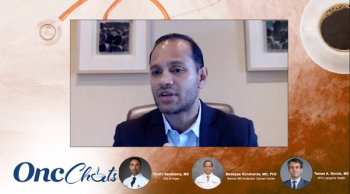
In this fifth episode of OncChats: Leveraging Endoscopic Ultrasound in Pancreatic Cancer, Toufic A. Kachaamy, MD, Madappa Kundranda, MD, PhD, and Tamas A. Gonda, MD, underscore the need for additional research evaluating the role of radiofrequency ablation and other approaches in pancreatic cancer, and avenues that are ripe for further exploration.
Key opinion leaders from across the hematologic oncology realm shared their biggest takeaways from the 2023 SOHO Annual Meeting.
Tycel Phillips, MD, MPH, discusses the use of bispecific antibodies and CAR T-cell therapy across hematologic malignancies, including in patients with mantle cell lymphoma and follicular lymphoma.
Tycel Phillips, MD, MPH, discusses treatment with bispecific antibodies and CAR T-cell therapy in patients with mantle cell lymphoma, and other non-Hodgkin lymphomas.