Articles by Amandeep Salhotra, MD
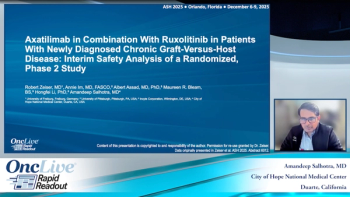
An expert discusses interim safety findings from a phase 2 randomized study evaluating axatilimab in combination with ruxolitinib for patients with newly diagnosed chronic graft-versus-host disease, presented by Amandeep Salhotra, MD, of City of Hope National Medical Center.
Amandeep Salhotra, MD, and Robert Negrin, MD, sit down with Chandler Park, MD, FACP, to discuss the latest abstracts in graft-vs-host disease presented during the 2025 ASH Annual Meeting & Exposition.
Panelists discuss how the future of chronic GVHD management looks promising with advances in graft manipulation strategies, expanded posttransplant cyclophosphamide use, dose optimization studies, oral CSF-1R inhibitors in development, and ongoing phase III trials studying current FDA-approved agents in earlier treatment lines and combination therapies to reduce patient morbidity and improve outcomes.
Panelists discuss how real-world evidence shows lower response rates and shorter time to next treatment compared to clinical trials due to more advanced patient populations and different monitoring practices, while highlighting the potential value of combination therapies using multiple FDA-approved agents simultaneously despite the lack of formal trial data supporting such approaches.
Panelists discuss how a 48-year-old female patient with chronic GVHD involving ocular, hepatic, and skin manifestations presents diagnostic challenges when elevated liver enzymes could indicate disease progression or drug toxicity from belumosudil and axicabtagene ciloleucel, leading to consideration of alternative treatments like mycophenolate or the preference for axicabtagene ciloleucel in patients with prior treatment failures or significant lung involvement despite the lack of head-to-head comparative data.
Panelists discuss how treatment selection for multiorgan chronic GVHD currently relies on trial data, toxicity profiles, and practical considerations like proximity to treatment centers and patient preference for oral vs intravenous therapy, while looking toward future developments in predictive biomarkers that could enable personalized treatment selection and early preemptive intervention before clinical symptoms develop.
Panelists discuss how the availability of novel agents has transformed chronic GVHD management by shortening steroid treatment duration to 2 to 3 weeks before adding second-line therapy, with response assessment focusing on dominant organ involvement rather than comprehensive National Institutes of Health criteria, and emphasizing patient-reported outcomes and quality of life measures as essential components of treatment evaluation in clinical practice.
Panelists discuss how a 52-year-old male patient developed multiorgan chronic GVHD 9 months post transplant with skin tightness, joint pain, and pulmonary involvement that showed minimal response to initial prednisone therapy and only moderate improvement after adding ruxolitinib, highlighting the importance of early detection through patient education and regular monitoring including spirometry to prevent irreversible fibrosis.
Panelists discuss how belumosudil works through anti-inflammatory and antifibrotic mechanisms by preventing actin filament polymerization and sequestering transcription factors, while axatilimab-csfr represents a novel approach targeting monocyte and macrophage pathways through CSF-1R blockade to reduce tissue inflammation and fibrosis in patients with chronic GVHD who have failed multiple prior therapies.
Panelists discuss how recent FDA approvals of 4 agents (ibrutinib, ruxolitinib, belumosudil, and axatilimab-csfr) have expanded treatment options for chronic graft-vs-host disease, with each drug targeting different mechanisms including BTK inhibition, JAK1/JAK2 inhibition, and ROCK2 pathway modulation, while also noting significant advances in disease prevention strategies.
Panelists discuss key updates from EBMT (European Society for Blood and Marrow Transplantation) 2025, including advancements in immune reconstitution, novel graft-vs-host disease (GVHD) prophylaxis strategies, and addressing ongoing unmet needs in allogeneic hematopoietic stem cell transplantation (alloHSCT), such as improved infection control, GVHD prevention, and enhancing long-term survival and quality of life.
Panelists discuss how unanswered questions regarding long-term outcomes and potential late toxicities, along with the need for further evaluation in specific patient subgroups, highlight the importance of continued research to refine the use of Orca-T across diverse populations.
Panelists discuss how Orca-T may expand patient eligibility for allogeneic hematopoietic stem cell transplantation (alloHSCT) by including those typically considered high-risk for traditional transplant due to its lower toxicity and improved safety profile, potentially broadening the pool of eligible patients.
Panelists discuss how Orca-T adds significant value to the allogeneic hematopoietic stem cell transplantation (alloHSCT) treatment landscape by reducing nonrelapse mortality and re-hospitalization rates, offering improved clinical outcomes and lower toxicity, thus enhancing patient recovery and quality of life posttransplant.
Panelists discuss how the results of the phase 1b Orca-T trial, compared with registry-based patients who are posttransplant cyclophosphamide (PTCy), demonstrates improved response rates and progression-free survival with a favorable safety profile, suggesting Orca-T may offer better clinical outcomes than standard PTCy-based therapies.
Panelists discuss how the Orca-T Phase 3 trial presented at EBMT (European Society for Blood and Marrow Transplantation) 2025 shows significant improvements in progression-free survival (PFS) and response rates compared with standard treatment, with manageable safety, highlighting its potential as a new treatment option pending further long-term studies.
Panelists discuss how Orca-T is a novel allogeneic cell therapy that reduces the risk of graft-vs-host disease (GVHD) by using T-cell-depleted grafts and a proprietary engineered approach, combined with single-agent tacrolimus to minimize immune suppression while preserving the graft-vs-leukemia effect.
Panelists discuss how advancing graft-vs-host disease (GVHD) management includes innovative strategies such as targeted therapies, graft engineering with regulatory T cells, optimization of posttransplant cyclophosphamide (PTCy), and the use of biomarkers for early detection, all aimed at improving GVHD prevention and treatment outcomes.
Panelists discuss how cautious use of posttransplant cyclophosphamide-based (PTCy) graft-vs-host disease (GVHD) prophylaxis may be considered in high-risk patients, certain donor types, or those with toxicity concerns, where more traditional regimens such as calcineurin inhibitors (CNIs) and methotrexate (MTX) may be preferred to balance GVHD prevention and minimize complications.
Panelists discuss how the Spanish Group for Hematopoietic Transplantation and Cellular Therapy (GETH/TC) real-world study highlights the effectiveness of posttransplant cyclophosphamide (PTCy)-based graft-vs-host disease (GVHD) prophylaxis in reducing acute GVHD incidence and treatment failure rates, supporting its adoption as a standard strategy, particularly in settings with limited donor availability.
Panelists discuss how long-term outcomes following posttransplant cyclophosphamide (PTCy)-based graft-vs-host disease (GVHD) prophylaxis in allogeneic hematopoietic stem cell transplantation (alloHSCT) show promising survival rates but highlight the ongoing need for optimization in GVHD management and supportive care due to the higher incidence of chronic GVHD and nonrelapse mortality.
Panelists discuss how graft-vs-host disease (GVHD) remains a significant complication in post-allogeneic hematopoietic stem cell transplantation (alloHSCT), with incidence rates varying by donor type and prophylaxis used, while emphasizing evolving prophylaxis practices and institutional variations in treatment approaches.
Panelists discuss how selecting a conditioning regimen for allogeneic hematopoietic stem cell transplantation (alloHSCT) involves balancing curative potential with toxicity based on patient fitness and disease risk, while emphasizing the importance of early referral and multidisciplinary coordination to optimize timing and individualize treatment planning.
Panelists discuss how the decision and timing of allogeneic hematopoietic stem cell transplantation (alloHSCT) in acute lymphoblastic leukemia (ALL) and myelofibrosis (MF) are guided by disease risk, remission status, prognostic scoring systems, and patient fitness to ensure that curative potential outweighs transplant-related risks.
Panelists discuss how the decision to pursue allogeneic hematopoietic stem cell transplantation (alloHSCT) in myelodysplastic syndromes (MDS) is driven by risk stratification, adverse cytogenetic and molecular features, and clinical trajectory, aiming to offer curative therapy to patients with poor prognoses despite potential transplant-related risks.
Panelists discuss how identifying appropriate candidates for allogeneic hematopoietic stem cell transplantation (alloHSCT) in acute myeloid leukemia (AML) involves evaluating remission status, relapse risk based on cytogenetics and molecular markers, treatment response, and European LeukemiaNet (ELN) risk classification to balance potential benefits against transplant-related risks.
The expert panel recaps and synthesizes key points and conclusions from each presentation and discussion over the course of the program.
Speculation on anticipated innovations in allo-HSCT and cellular therapy technologies in the future.
The expert panel shares emerging data on an engineered, allogeneic cell-based therapy administered as part of conditioning for allo-HSCT in patients with relapsed, refractory, or high-risk hematologic cancers.
Criteria for identifying patients with MDS most likely to benefit from transplant and choosing the optimal donor source and conditioning regimen on a case-by-case basis.