
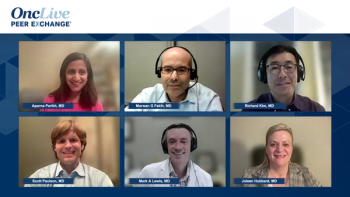
Considerations for patients to receive aggressive mCRC therapy regimens are navigated by the panelists.
Considerations for patients to receive aggressive mCRC therapy regimens are navigated by the panelists.
Side effect profiles driven by fruquintinib use are discussed.
Dr Lunning sits down with Alex Herrera, MD, to discuss the frontline management of Hodgkin lymphoma, including the SWOG 1826 trial.
Initial antitumor activity and safety data have been observed in the phase 1 portion of a phase 1/2a trial of IMM-1-104 in RAS-mutant solid tumors.
Mark A Lewis, MD, and Scott Paulson, MD, share their experiences utilizing fruquintinib.
Richard Kim, MD, discusses the significance of real-world evidence when selecting treatment sequencing strategy.
Managing dose adjustments and tolerability in metastatic colorectal cancer (mCRC) treatment regimens for optimal efficacy is underscored.
Medical experts provide key takeaways and impacts from the FRESCO-2 study.
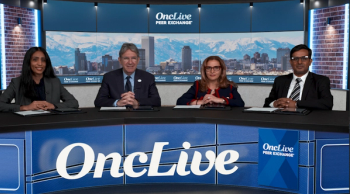
The expert panel recaps and synthesizes key points and conclusions from each presentation and discussion over the course of the program.
Marwan G Fakih, MD, drives a discussion highlighting a significant combination therapy in mCRC treatment.
Key safety considerations for the use of fruquintinib are explored.
Speculation on anticipated innovations in allo-HSCT and cellular therapy technologies in the future.
The expert panel shares emerging data on an engineered, allogeneic cell-based therapy administered as part of conditioning for allo-HSCT in patients with relapsed, refractory, or high-risk hematologic cancers.
Dr Parikh drives a conversation surrounding 3L treatment for patients diagnosed with metastatic colorectal cancer.
Medical experts open a discussion providing an update on the current impact of metastatic colorectal cancer and common treatment strategies.
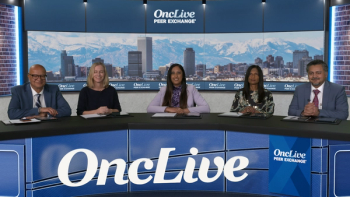
The expert panel concludes their discussion with clinical insights on treatment sequencing and therapeutic decision-making for patients who have relapsed.
A roundtable discussion on the evolving treatment landscape surrounding CAR T-cell therapy in multiple myeloma, with a focus on future directions and the management of adverse events.

Abhishek Tripathi, MD, discusses the phase 1/2 NEMIO trial of durvalumab/chemotherapy with/without tremelimumab in muscle-invasive bladder cancer.
Criteria for identifying patients with MDS most likely to benefit from transplant and choosing the optimal donor source and conditioning regimen on a case-by-case basis.
Safety and toxicity data from a clinical trial investigating a novel, precision-engineered allo-HSCT conditioning regimen for older patients with high-risk blood cancers.
Joseph Mikhael, MD, discusses treatment advancements and ongoing research in multiple myeloma.
Abhishek Tripathi, MD, discusses the significance of data from the phase 3 CheckMate 901 trial in metastatic or unresectable urothelial carcinoma.
The expert panel discusses recent clinical trial data on GPRC5D-targeting bispecific antibodies and how they apply to the multiple myeloma treatment paradigms.
Comprehensive insights on the adverse effects seen from bispecific antibodies in the treatment of patients with multiple myeloma.
This session will focus on considerations and outcomes of allo-HSCT specifically among patients over 55 years of age. The panel will discuss how transplant protocols and supportive care measures can be optimized for this population who are at higher risk of comorbidities, toxicity and poor functional status.
An overview of promising novel cellular therapies showing efficacy against hematologic cancers in early-phase clinical trials.
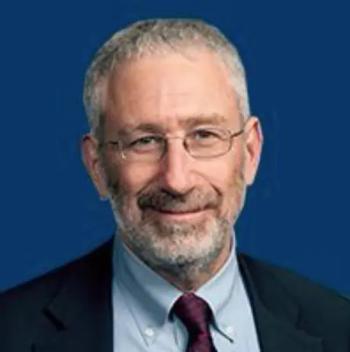
The foundation of physician recommendations and medical/regulatory policy will be guided by the outcomes of published clinical research.
Multiple myeloma specialists compare step-up dosing practices and provide clinical insights on treating patients with multiple myeloma.
Experts on multiple myeloma discuss how real-world evidence informs treatment selection for patients receiving bispecific antibodies.
Provide detailed case studies highlighting the development, clinical presentation, multidisciplinary management, and outcomes of patients with acute and chronic GvHD following allo-HSCT.