
Petros Grivas, MD, PhD, expands on key updates in the second-line management of urothelial cancer.
Petros Grivas, MD, PhD, expands on key updates in the second-line management of urothelial cancer.
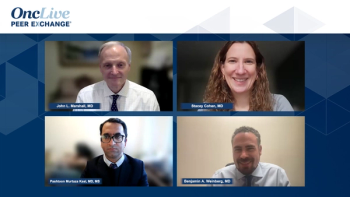
The panelists provide their final thoughts, exploring the prospective treatment landscape for patients with CRC.
The expert panel continues the discussion with thoughts on gaps in our understanding and application of MRD testing for colorectal cancer and a look to the future, highlighting potential advancements.
Stacey Cohen, MD, discusses the rationale and study design of the phase 2/3 CIRCULATE-NORTH AMERICA study evaluating adjuvant chemotherapy selection based on MRD, and the panel discusses barriers to enrollment.
The panel continues its review of data presented on MRD testing in colorectal cancer from the INTERCEPT and COSMOS-CRC-01 studies.
The panel reviews recent data on MRD testing in colorectal cancer, highlighting the INTERCEPT and COSMOS-CRC-01 studies.
Benjamin A. Weinberg, MD, presents the case of a 35-year-old man with oligometastatic disease, and the panel provides insights on treatment decisions.
Pashtoon Murtaza Kasi, MD, MS, emphasizes key aspects of liquid biopsy and ctDNA testing in the MRD treatment landscape.
Pashtoon Murtaza Kasi, MD, MS, reviews data from the BESPOKE CRC study, highlighting overall results and patient-reported outcomes.
Petros Grivas, MD, PhD, discusses frontline treatment options for patients with metastatic renal cell carcinoma.
Focusing on the GALAXY arm in the CIRCULATE-Japan study, experts on colorectal cancer discuss how recent data are informing the evolving treatment landscape.
Petros Grivas, MD, PhD, discusses potential future directions for adjuvant therapies in patients with resected renal cell carcinoma.
John L. Marshall, MD, presents the case of a 52-year-old woman with mid-rectal carcinoma, and the panel offers its initial impressions.
The panel discusses how MRD testing has evolved as a clinical tool in colorectal cancer, highlighting the phase 2/3 COBRA study and its implications.
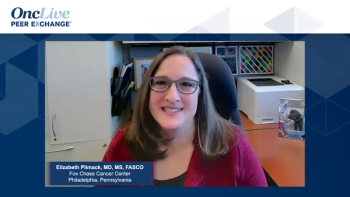
Elizabeth Plimack, MD, MS, FASCO, recaps the discussion with key takeaways on recent updates in bladder cancer.
Experts on colorectal cancer discuss practical considerations related to MRD testing, highlighting strategies to navigate potential challenges.
Pashtoon Murtaza Kasi, MD, MS, discusses MRD testing practices in the community oncology setting and provides recommendations on the integration of MRD testing into clinical practice.
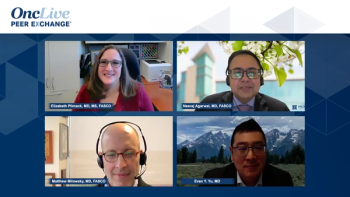
Experts on bladder cancer discuss exciting new agents and treatment strategies and where they can potentially fit into urothelial cancer treatment paradigms.
Focusing on metastatic urothelial carcinoma, the panel discusses the role of chemotherapy and outlines treatment sequencing approaches.
Evan Y. Yu, MD, provides insights on treatment approaches for patients with metastatic urothelial carcinoma in the second line and beyond.
The expert panel discusses how treatment strategies change based on cisplatin eligibility and the role of maintenance therapy in metastatic urothelial carcinoma.
Focusing on the adjuvant setting, the expert panel discusses the timing and frequency of MRD testing in patients with colorectal cancer.
Colorectal cancer specialists discuss MRD testing platforms and how to choose among the available testing assays.
GU medical oncologists offer their impressions of recent updates in the metastatic urothelial carcinoma space, focusing on CheckMate 901 and EV-302.
Neeraj Agarwal, MD, FASCO, provides a comprehensive overview of recent data in metastatic urothelial carcinoma, highlighting the CheckMate 901 and EV-302 studies.
Experts on colorectal cancer discuss the timing of testing for minimal residual disease in the treatment journey.
A panel medical oncologists provide an overview of circulating tumor DNA and its role in MRD (minimal residual disease) testing in the treatment of patients with colorectal cancer.
Experts on muscle-invasive bladder cancer respond to recent data in adjuvant therapy that were presented at ASCO GU 2024.
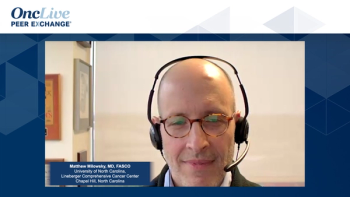
Following an overview of the evolving adjuvant therapy space, Matthew Milowsky, MD, FASCO, reviews recent updates from ASCO GU 2024 in muscle-invasive bladder cancer.
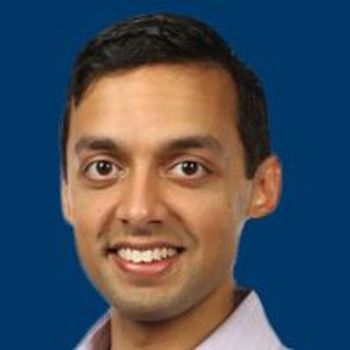
Rahul Banerjee, MD FACP, discusses the FDA’s decision to add a class-wide boxed warning for secondary malignancies on all approved CAR T-cell therapies.