
Jorge Nieva, MD, and Ashish Saxena, MD, PhD, talk about factors to consider when weighing the risk/benefit ratio associated with the use of cyclin-dependent kinase 4/6 inhibition.
Jorge Nieva, MD, and Ashish Saxena, MD, PhD, talk about factors to consider when weighing the risk/benefit ratio associated with the use of cyclin-dependent kinase 4/6 inhibition.
Jorge Nieva, MD, and Ashish Saxena, MD, PhD, discuss the impact of chemotherapy-induced myelosuppression on patients with SCLC.
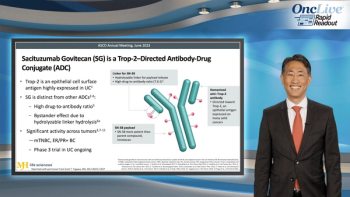
Expert Scott Tagawa, MD, MS, FASCO, FACP, reviews recent clinical trial data on UGT1A1- and Trop-2–guided treatment of metastatic urothelial carcinoma.
Scott Tagawa, MD, MS, FACP, discusses the evolution of PARP inhibitor use in metastatic castration-resistant prostate cancer and available PARP inhibitors for molecularly-selected patients in this space.
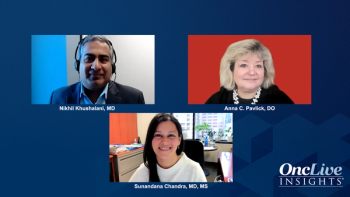
A panel of skin cancer experts offer closing thoughts on intralesional therapy for treating melanoma and CSCC.

Sunandana Chandra, MD, MS, Anna C. Pavlick, DO, MSc, MBA, BSN, and Nikhil Khushalani, MD, discuss the importance of multidisciplinary care in CSCC and patient counseling regarding available therapies.
An expert panel discusses the use of tumor-directed oncolytic therapies for melanoma and cutaneous squamous cell carcinoma.
A comprehensive overview of treatment approaches for patients with high-risk melanoma.
Experts on skin cancer discuss valuable end points for determining successful treatments for patients with metastatic melanoma.
A panel of skin cancer experts share their thoughts on treatment selection for patients with melanoma.
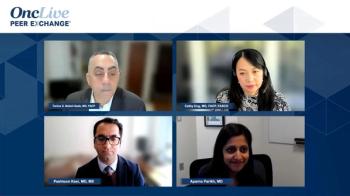
Fielding questions from the audience, expert oncologists discuss clinical trials, molecular testing, and early-stage disease in the context of HER2-amplified colorectal cancer.
An expert panel analyzes BRAF/MEK dual inhibitor therapy for the treatment of melanoma.
Anna C. Pavlick, DO, discusses factors that impact treatment selection for patients with melanoma.
Looking toward the future management of HER2-amplified colorectal cancer, panelists reflect on ongoing clinical trials and evolving treatment strategies.
Expert perspectives on the real-world use of HER2-directed therapies in patients with HER2-amplified colorectal cancer.
Expert oncologists look to the future of treatment for cutaneous squamous cell carcinoma.
Skin cancer expert Anna C. Pavlick, DO, discusses treatment duration approaches for cutaneous squamous cell carcinoma.
A focused discussion on HER2-amplified colorectal cancer and respective clinical trials that inform use of targeted agents in this setting.
Broadening their conversation, expert oncologists define the treatment algorithm for patients diagnosed with colorectal cancer.
Nikhil Khushalani, MD, gives a comprehensive overview of cemiplimab and pembrolizumab for treating CSCC.
Anna C. Pavlick, DO, overviews systemic therapy options for patients with unresectable or metastatic CSCC.
In the context of colorectal cancer clinical trials, panelists reflect on the role of liquid biopsies to help inform treatment decisionmaking.
A brief review of HER2 amplification and how it may impact the treatment pathway for patients with a diagnosis of colorectal cancer.
Nikhil Khushalani, MD, discusses the multidisciplinary team approach to treating patients with cutaneous squamous cell carcinoma.
Skin cancer experts discuss prognosis and unmet needs in the cutaneous squamous cell carcinoma and melanoma treatment spaces.

Anna C. Pavlick, DO, discusses the mechanism of action of vusolimogene oderparepvec in patients with anti–PD-1–failed cutaneous melanoma.
Expert panelists identify key takeaways and share their excitement for future directions in the management of metastatic colorectal cancer.
A panel of skin cancer experts give an overview of cutaneous squamous cell carcinoma and melanoma.
Before closing out their review of combination therapy in metastatic colorectal cancer, panelists discuss the STELLAR-303 and SUNLIGHT clinical trials.
A comprehensive review on combination strategies with immune checkpoint and tyrosine kinase inhibitors in patients with metastatic colorectal cancer.