

Jane L. Meisel, MD, discusses the impact of toxicities associated with endocrine therapy on quality of life as reported by patients with metastatic breast cancer.
Jane L. Meisel, MD, discusses the impact of toxicities associated with endocrine therapy on quality of life as reported by patients with metastatic breast cancer.

Sagar Lonial, MD, FACP, details agents of interest outside CAR T-cell therapies in multiple myeloma, including elranatamab and talquetamab.

Experts on breast cancer discuss challenges encountered in biomarker testing for patients with breast cancer.
Kevin Kalinsky, MD, MS, and Erica L. Mayer, MD, MPH, discuss testing practices for ESR1 mutations in patients with breast cancer.

Jane L. Meisel, MD, shares data from a study on communication challenges between providers and patients with metastatic breast cancer regarding TRAEs.
In case you missed it, here is a recap of the most popular episodes of OncLive On Air® from 2023.
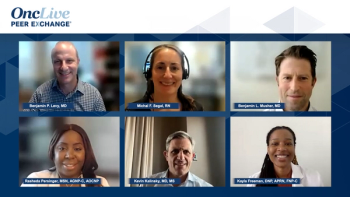
The expert panel concludes the program with key takeaways and closing thoughts on the evolving antibody-drug conjugate space.

Mylin A. Torres, MD, discusses using antibody-drug conjugates (ADCs) to treat patients with breast cancer.
Experts in breast, lung, and gastric malignancies provide insights on multidisciplinary care in oncology and educating community specialists.
Medical oncologists discuss prospects and challenges in the breast and lung cancer treatment landscapes.
Specialists in gastric cancer look to the future treatment landscape and review ongoing research in the disease space.

Clinical insights on best practices for treating patients with TROP2-targeted therapy.
The expert panel discusses TROP2 as a target for patients with cancer who are receiving antibody-drug conjugates.
A review of antibody-drug conjugates approved for treatment of patients with breast, lung, or gastrointestinal cancers.

Ticiana Leal, MD, and Sandip P. Patel, MD, discuss clinical trials evaluating the use of patritumab deruxtecan in patients with non–small cell lung cancer and remaining unmet needs.
Insights on managing antibody-drug conjugate toxicities for patients with gastric cancer.

A GI medical oncologist discusses the role of trastuzumab deruxtecan in the gastric cancer treatment space.
Clinical insights on where patritumab deruxtecan might fit in the treatment paradigm for patients with advanced non–small cell lung cancer.
Medical oncologists discuss the toxicity profile of patritumab deruxtecan and the safety outcomes from HERTHENA-Lung01 in non–small cell lung cancer.

Madhav V. Dhodapkar, MBBS, discusses the advantages and disadvantages of bispecific antibodies and CAR T-cell therapy in patients with relapsed/refractory multiple myeloma, as well as the potential role for the bispecific antibody linvoseltamab in this treatment paradigm.
A nurse practitioner provides insights on toxicity management strategies for patients with lung cancer who are receiving antibody-drug conjugates.

A medical oncologist reviews the antibody-drug conjugate landscape in lung cancer.
Anthony M. Hunter, MD, discusses the evolution of JAK inhibitors in myelofibrosis, a topic that was highlighted in a presentation at the 2023 SOHO Annual Meeting.
Experts on lung cancer review key data from the HERTHENA-Lung01 study investigating patritumab deruxtecan (HER3-DXd) in patients with advanced EGFR-mutated NSCLC.

A medical oncologist discusses the role of HER3 in the treatment of non–small cell lung cancer and provides an overview of the HERTHENA-Lung01 clinical trial.
Specialists in breast cancer review toxicity management practices for T-DM1 and trastuzumab deruxtecan [T-DXd].
A breast medical oncologist provides insights on antibody-drug conjugates in the breast cancer space and discusses ongoing research.
Expert perspectives on unmet needs and therapies available for patients with EGFR-mutated non–small cell lung cancer.

Ticiana Leal, MD, gives a comprehensive overview of treatment options for patients with EGFR-mutated NSCLC who progress on osimertinib therapy.
The expert panel has a comprehensive discussion about best practices for patient education and the barriers to effective testing.