
Expert perspectives on the role of an oncologic pharmacist within a tumor board and how they can improve upon precision medicine in cancer management.
Expert perspectives on the role of an oncologic pharmacist within a tumor board and how they can improve upon precision medicine in cancer management.
Comprehensive discussion on the role of tumor boards—or more specifically, molecular tumor boards—in the optimal management of patients with cancer.
Kathryn Maples, PharmD, BCOP, discusses recent approvals, updated labeling, and drug removals across leukemia, lymphoma, and multiple myeloma.
Key opinion leaders in the field of cancer management discuss resistance to the uptake of biomarker testing and precision medicine, with deference to the community setting.
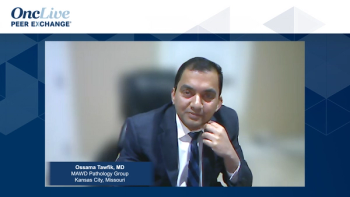
Expert pathologist Samuel K. Caughron, MD, FCAP, shares best strategies for the timing and utilization of biomarker testing while managing patients with cancer.
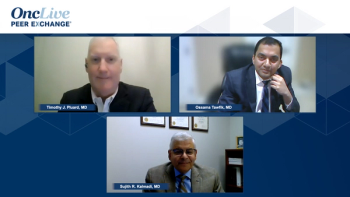
Timothy J. Pluard, MD; Ossama Tawfik, MD; and Sujith R. Kalmadi, MD, reflect on how they update their biomarker testing strategies as the field of cancer care and precision medicine evolves.
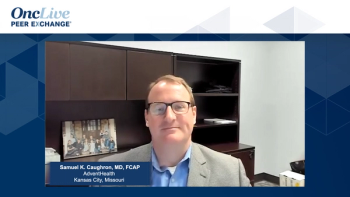
Expert perspectives on the wide array of biomarker testing modalities available to patients receiving treatment for cancer.
Comprehensive discussion on how best to interpret and document results from biomarker testing, along with considerations for communicating results with other healthcare professionals.
Key opinion leaders highlight challenges to adequate biomarker testing in cancer care and consider the value of collaboration to overcome these barriers.

For Kevin Kalinsky, MD, MS, director of breast medical oncology at the Winship Cancer Institute of Emory University in Atlanta, Georgia, his work on the RxPONDER trial serves as one of a few accomplishments for which he is grateful that have impacted clinical care.

Jane L. Meisel, MD, discusses the effect of the HER2-low classification for patients with breast cancer.

Suchita Pakkala, MD, discusses ongoing efforts to integrate local therapy into HER2-positive breast cancer treatment.

Jason Romancik, MD, discusses efforts to maximize the efficacy of CAR T-cell therapy in non-Hodgkin lymphoma.

Jason Romancik, MD, discusses the benefit of axicabtagene ciloleucel vs standard of care as a second-line treatment for patients with relapsed/refractory diffuse large B-cell lymphoma.
Nabil F. Saba, MD, FACP, expanded on efficacy data from a phase 2 trial investigating pembrolizumab plus cabozantinib in patients with recurrent metastatic head and neck squamous cell carcinoma and current challenges and safety concerns in selecting patients for evaluation.
A doublet regimen comprised of pembrolizumab and cabozantinib elicited encouraging responses in patients with recurrent metastatic head and neck squamous cell carcinoma, meeting the primary end point of a phase 2 trial.
Nabil Saba, MD, FACP, discusses the evaluation of pembrolizumab plus cabozantinib in patients with recurrent metastatic head and neck squamous cell carcinoma.

Jason Romancik, MD, discusses the design and key results from the phase 2 PILOT study.
Suchita Pakkala, MD, discussed how treatments like tucatinib and fam-trastuzumab deruxtecan-nxki have widened the armamentarium for patients with brain metastases; the importance of enrolling these patients in clinical trials; and what future treatment sequencing might look like for this population.
Jonathon B. Cohen MD, MS, discusses the management of chronic lymphocytic leukemia with BTK inhibitors, updates in the treatment of acute myeloid leukemia, and how CAR T-cell therapy could improve patient outcomes in diffuse large B-cell lymphoma and mantle cell lymphoma.
Kevin Kalinsky, MD, MS, discusses the role of chemotherapy with ovarian function suppression and hormonal therapy for premenopausal patients with HR–positive/HER2-negative breast cancer.

Jonathon B. Cohen, MD, MS, discusses the adverse effects associated with BTK inhibitors in chronic lymphocytic leukemia.

Jane Lowe Meisel, MD, discussed the emergence of HER2-low as a new category in breast cancer, outlining the significance of the phase 3 DESTINY-Breast04 trial and the unique qualities of trastuzumab deruxtecan in the HER2-positive and HER2-low populations.
Nabil Saba, MD, FACP, discusses the disparities seen in clinical trials in head and neck cancer.
Jonathon B. Cohen, MD, MS, discusses the evolution of treating patients with additional comorbidities in chronic lymphocytic leukemia.

Suchita Pakkala, MD, discusses the importance for clinical trial enrollment for patients with breast cancer who have brain metastases.
Victor M. Orellana-Noia, MD, discusses the treatment of high-risk and vulnerable patients with diffuse large B-cell lymphoma.
Victor M. Orellana-Noia, MD, discusses the patient population of the phase 3 POLARIX trial in diffuse large B-cell lymphoma.
Maintenance rituximab following first-line bendamustine plus rituximab or a combination of rituximab plus cyclophosphamide, doxorubicin, vincristine, and prednisone prolonged first-line treatment benefits and improved survival outcomes vs either induction regimen alone.

EGFR C797X mutations have become a leading mechanism of acquired resistance following treatment with the third-generation EGFR inhibitor osimertinib, outpacing MET amplification.