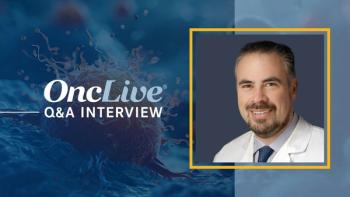
In case you missed any, read a recap of the episodes of OncLive On Air that aired in September 2026.
Brian Wolpin, MD, MPH, is driving advances in early detection, molecular diagnostics, and precision therapies for patients with gastrointestinal cancers
Brian M. Wolpin, MD, MPH, didn’t enter medicine with a clear blueprint for becoming one of the nation’s leading voices in gastrointestinal (GI) oncology. Rather, a growing curiosity about science, a profound respect for the patient experience, and a drive to make a difference propelled him to the helm of some of the most cutting-edge research in pancreatic and GI cancers.
Wolpin was named the 2025 Giant of Cancer Care in Gastrointestinal Oncology, a recognition he described not as an individual milestone, but as a testament to collective effort. “It means the culmination of a large team effort,” he said. “There is an amazing field of people dedicated to caring for patients with these cancers and doing research to improve their care. It’s just been an exceptional honor to get to work with them.”
Now serving as director of the Gastrointestinal Cancer Center, director of the Hale Family Center for Pancreatic Cancer Research, and the Robert T. and Judith B. Hale Chair in Pancreatic Cancer at Dana-Farber Cancer Institute, as well as a professor of medicine at Harvard Medical School in Boston, Massachusetts, Wolpin has helped define a new frontier in GI oncology through his ongoing contributions to translational cancer research, molecular diagnostics, and precision therapy.
Wolpin’s path into medicine was not defined by a single turning point; instead, a gradual convergence of interests, including a passion for helping individuals, an early fascination with the biological sciences, and a growing awareness of the profound impact that medical research could have on patient care, fueled his drive into the oncology field. Raised mostly in the Midwest in Ohio and Minnesota, he was captivated from an early age by the idea of helping people through science.
One unexpected source of inspiration was M*A*S*H. The iconic television series about military doctors in the Korean War enraptured Wolpin.
“I watched it quite a bit growing up and thought that it was amazing what they were able to do to try to help the soldiers,” he recalled. “That was one of first things that made me think medicine is something I might be interested in. I was also deeply influenced by my grandmother, who worked for many years as a nurse.”
After earning his undergraduate degree, Wolpin enrolled at Harvard Medical School, drawn to Boston by its density of research and medical institutions.
“It opened my eyes to the interplay between medicine and science,” he said. “In Boston, that interplay has historically been a big focus. It’s really a cherished part of the medical community here.”
During his medical training Wolpin was inspired to join the laboratory of the late David Livingston, MD, by the Dana-Farber cancer biologist’s passion for discovery, a passion that proved infectious.
“I took an extra year in medical school to work in his laboratory, mostly on breast cancer, but it really introduced me to the type of science you can do related to cancer. At the time, a lot of the work was on the functions of the BRCA1 and BRCA2 proteins, which has enormous clinical relevance for screening, treatment, and family risk. It was an incredibly interesting topic to
study as a medical student, allowed me to interact with multiple physician scientists who were oncology fellows at the time, and it really set me up for a future focused on melding medicine and science.”
After completing his residency at Brigham and Women’s Hospital and fellowship at Dana-Farber, Wolpin joined the GI oncology faculty at the institution in 2007. There, he began developing a research program focused on pancreatic cancer, specifically its molecular underpinnings, resistance to therapy, and how patient exposures and symptoms could shape opportunities for early detection.
But even as his lab grew, Wolpin never distanced himself from clinical work. “I continue to see caring for patients in the clinic as foundational to who I am, and I also lead a research laboratory where we study pancreatic cancer. I really have never been able to choose one over the other,” he said. “My hope has always been that by doing both, I’m better at each.” Wolpin also notes that, “the [work we do in the lab] is greatly influenced by [our experience in] the clinic. We try to stay very focused on problems we need to solve to help patients. The premise has been that if we could address those problems in the lab, then we could do better for our patients [in the clinic].”
This dual role has become a cornerstone of his leadership at Dana-Farber. As director of the GI Cancer Center, he mentors young clinicians and scientists while spearheading initiatives to improve the care of patients with gastrointestinal cancers.
“Gastrointestinal cancers remain common and difficult to treat. We have felt that only with dedicated teams of scientists and clinicians working together can we make the progress that our patients deserve. It has been a privilege to help these teams come together in our GI Cancer Center and get to work with such extraordinary people every day. Seeing the center’s trainees and faculty on podiums presenting their work brings me such joy and hope, knowing that their creativity and dedication will bring the changes that our patients desperately need.”
Another critical aspect of Wolpin’s career has focused on the Hale Family Center for Pancreatic Cancer Research at Dana-Farber, which Wolpin directs together with Andrew Aguirre, MD, PhD. This center has over 20 faculty working together to study and conquer pancreatic cancer.
“This is one of the most collaborative and dedicated groups of clinicians and scientists that I have ever had the privilege to know,” Wolpin said. “The heart and soul of the center is Judy Hale, who lost her husband to pancreatic cancer. She and her family have pushed us every day since to ensure things are different for subsequent patients and their families. Everyone in the center knows that our mission is to do the best possible science and bring that science rapidly to the clinic to help patients. Impatience for progress is key.”
Wolpin has grown the Hale Family Center from several faculty in 2016 to one of the largest and most dynamic academic entities nationally focused on improving the biologic understanding, early detection, and treatment of pancreatic cancer.
In terms of clinical impact, Wolpin’s research has directly informed the understanding of pancreatic ductal adenocarcinoma (PDAC) biology, facilitating new strategies for earlier cancer detection and new therapies in the clinic. His laboratory is particularly known for generating and interrogating large sets of patient clinical features, blood samples and tumor specimens to understand human PDAC, including within clinical trials of novel therapies. This has led to new insights into the inherited features, prediagnosis phenotype, genomic landscape, and mechanisms of therapy resistance for PDAC.
To advance this work, his laboratory has received funding from numerous sources, including the US National Cancer Institute, U.S. Department of Defense, Lustgarten Foundation, Stand Up to Cancer, Breakthrough Cancer, and Pancreatic Cancer Action Network, among others. Particularly influential has been funding from the Lustgarten Foundation Dedicated Laboratory program and the NCI Pancreatic Cancer Detection Consortium, where Wolpin served as initiating chair of the consortium steering committee for more than 5 years.
As a particular area of focus, the Wolpin Lab has demonstrated clear links between metabolic alterations and pancreatic cancer development. In 2013, it was showed that insulin resistance is both a classical risk factor for PDAC and a paraneoplastic manifestation of the disease, offering clinicians a potential metabolic signal for earlier intervention. In 2014, the group found that pancreatic tumors can cause amino acid elevations several years before diagnosis, highlighting the promise of metabolic biomarkers for identifying at-risk patients during a window when curative treatment remains possible. These discoveries have helped shape future studies and emerging screening approaches, moving insights from the laboratory into clinical practice in the fight against one of the most lethal malignancies.
Wolpin credits his own mentors, including Robert Mayer, MD, of Dana-Farber and Harvard Medical School, for his numerous accomplishments across his storied career. However, Mayer contests that Wolpin’s drive ultimately positioned him to make meaningful contributions to the field of GI oncology.
“Brian is an exceptional clinician who has emerged as an internationally recognized scholar of the biology and treatment of pancreatic cancer,” Mayer said. “He has become a gifted leader of a rapidly growing academic program and a mentor to scores of faculty and trainees. I am enormously proud to have influenced his growth
during the early days of his career and now to have the privilege of being his colleague.”
Additionally, Wolpin acknowledged the mentorship of Charles Fuchs, MD, MPH, formerly of Dana-Farber and the Yale School of Medicine in New Haven, Connecticut.
“Brian has been a brilliant crusader, advancing cutting- edge science and world-class clinical care for patients with pancreatic cancer,” said Fuchs, who is now the senior vice president and global head of hematology and oncology product development at Genentech. “Brian is a gifted innovator, combining a keen understanding of the science and an extraordinary ability to leverage scientific insights toward new treatment paradigms for patients in need. It has been a unique privilege to watch Brian’s career unfold and to see him receive this great recognition.”
Today, Wolpin pays that mentorship forward. Whether guiding junior faculty, advising fellows, or collaborating with peers across departments, he views team science as essential for both discovery and patient impact.
“This career has only been possible because of mentorship and collaboration,” Wolpin said. “You need exceptional mentors and collaborators on both the clinical and research side. Without that, I don’t think the work we’ve done would have been possible.”
Wolpin is currently focused on 2 broad areas he believes will be instrumental in reshaping outcomes for patients with pancreatic cancer: earlier detection and understanding tumor resistance to novel therapeutics.
Both are long-standing challenges in the field, but Wolpin remains optimistic that ongoing efforts in these domains could meaningfully shift the disease trajectory.
At Dana-Farber, his research team is bringing together a biologic understanding of the earliest abnormalities induced by a small pancreatic cancer with machine learning and computational modeling to identify often imperceptible signals of pancreatic cancer embedded within clinical and biological data. The goal is to move beyond reactive diagnosis toward a strategy of “interception,” detecting malignancy before a clinical diagnosis would be made, when curative intervention is still possible. “We’re working to identify patterns that can be detected in patient data and biospecimens, such as blood and stool samples, very early in the disease course, before tumors become more genomically complex or have the opportunity to spread beyond the pancreas,” Wolpin said.
Therapeutically, Wolpin continues to contribute to the growing body of research focused on actionable targets in pancreatic cancer and potential resistance mechanisms to new treatments that exploit them. Over the past several years, this work has focused heavily on targeting of KRAS mutations, which are present in more than 90% of patients with pancreatic adenocarcinoma. While KRAS G12C– targeted therapies have demonstrated efficacy in lung cancer and CRC, the G12C variant is rare in pancreatic tumors. However, new agents are emerging that target other KRAS alterations more commonly found in pancreatic cancer, such as KRAS G12D, G12V, and G12R mutations.
“Drugs that target important KRAS mutations in pancreatic cancer are now in the clinic and showing highly promising signals of efficacy, with one such agent now being evaluated in a phase 3 trial [NCT06625320]. It very much feels like a sea-change is coming for our patients with pancreatic cancer, with RAS inhibitors leading the way for a host of new therapy approaches, including antibody-based therapies, vaccines, and cell therapies, among others,” Wolpin noted.
“Altogether, we’re on the cusp of new treatment paradigms that will change the way this disease is treated. It is only because of the dedication and collaboration of patients, families, clinicians, and scientists that we find ourselves at such a promising junction in the fight against pancreatic cancer,” Wolpin said.