
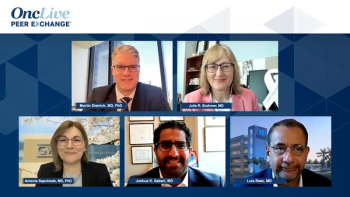
Expert panelists review the CodeBreaK trials focused on sotorasib in the treatment of patients with KRAS G12C-mutant non–small cell lung cancer.
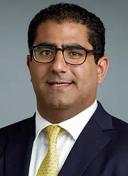
Joshua K. Sabari, MD, is an associate professor in the Department of Medicine at New York University (NYU) Grossman School of Medicine. He is also medical director, ofThoracic Medical Oncology at NYU Langone Health’s Perlmutter Cancer Center.
Expert panelists review the CodeBreaK trials focused on sotorasib in the treatment of patients with KRAS G12C-mutant non–small cell lung cancer.
Shared insight on the use of first-generation EGFR tyrosine kinase inhibitors and the role of immunotherapy in treating patients with NSCLC with uncommon EGFR mutations.
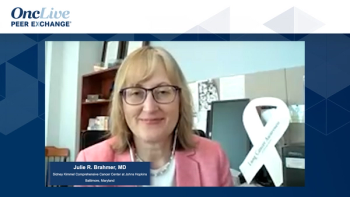
Julie R. Brahmer, MD, discusses treatment considerations when choosing between afatinib and osimertinib in patients with NSCLC with rare EGFR mutations.
Key opinion leaders on non–small cell lung cancer review treatment options for patients with EGFR mutations.
Experts on non–small cell lung cancer discuss strategies to improve molecular testing and opportunities for community physicians to reach out to expert oncologists for clinical insights.
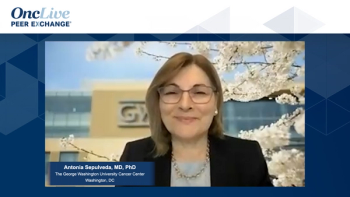
Antonia Sepulveda, MD, PhD, an expert on NSCLC, outlines discrepancies in molecular testing between academic and community settings.
Focused discussion on tissue testing and the effect of turnaround time on NSCLC treatment and molecular testing strategies.
Expert oncologists compare the logistics and sensitivities of liquid and tissue biopsies in the treatment of non–small cell lung cancer.
A panel of experts on the treatment of non–small cell lung cancer (NSCLC) discuss the role of biomarker testing and review testing strategies.
Joshua K. Sabari, MD, discusses key findings from the phase 1 LOXO-RAS-20001 study of the KRAS G12C inhibitor LY3537982 in KRAS G12C–mutant advanced solid tumors.
Closing out their review of treatment options for KRAS G12C–mutated NSCLC, expert oncologists look toward future utilization of novel targeted agents in this setting.

Centering discussion on KRAS inhibitors and associated clinical trials, Martin Dietrich, MD, PhD, and Joshua Sabari, MD, detail the second-line management of KRAS G12C–mutated non–small cell lung cancer.
Key opinion leaders identify the first-line treatment armamentarium for patients with KRAS G12C–mutated non–small cell lung cancer.
A brief review of how results from adequate molecular testing may help to inform the first-line management of non–small cell lung cancer.

Before closing out their discussion on IO therapy in non–small cell lung cancer, Melissa Johnson, MD, and Joshua Sabari, MD, identify treatment strategies in the setting of concomitant KRAS/p53 mutation.
Shared perspectives on the emerging strategies for the management of non–small cell lung cancer following the identification of KRAS/STK11, or KRAS/KEAP1 mutations.
A comprehensive discussion on how to overcome barriers that may inhibit access to adequate molecular testing in patients with non–small cell lung cancer.
Contextualizing treatment selection with the POSEIDEN and CheckMate 9LA clinical trials, experts consider how to select the optimal treatment for patients with concomitant KRAS/STK11, or KRAS/KEAP1–mutated NSCLC.
Expert perspectives on course-correcting the management of patients with NSCLC who may not have received adequate molecular profiling in the past.
Joshua K. Sabari, MD, discusses the importance of timely testing for uncommon mutations in non–small cell lung cancer.
Shared insight on best practices in non–small cell lung cancer management to utilize molecular testing and identify patients harboring KRAS G12C mutations.
A focused review of data from the POSEIDEN post-hoc analysis in patients with concomitant KRAS/STK11, or KRAS/KEAP1–mutated non–small cell lung cancer.
Expert oncologists Martin Dietrich, MD, PhD, and Joshua Sabari, MD, elucidate the emergence of KRAS G12C as a molecular marker in the setting of non–small cell lung cancer.
Expert oncologists Melissa Johnson, MD, and Joshua Sabari, MD, discuss the occurrence of individual KRAS, STK11, or KEAP1 mutations in patients with non–small cell lung cancer and if there is a role for immunotherapy in the treatment of these patients.
Josh Sabari, MD; Nicholas C. Rohs, MD; and Balazs Halmos, MD; conclude this series by discussing encouraging data and updates in non–small cell lung cancer treatment for patients who harbor KRAS and HER2 abnormalities.
Thoracic Night Live is devoted to spotlighting the biggest topics in lung cancer and pivotal studies discussed at medical meetings throughout the year. This episode is a review of the clinical advancements in lung cancer treatment throughout 2021. Funding from Daiichi Sankyo/Content Independently Developed by OncLive
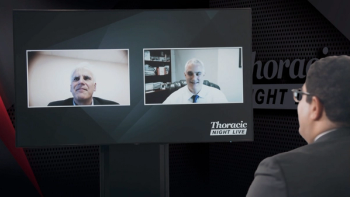
Thoracic Night Live is devoted to spotlighting the biggest topics in lung cancer and pivotal studies discussed at medical meetings throughout the year.
Joshua K. Sabari, MD, discusses selecting between available ALK inhibitors in ALK-positive non–small cell lung cancer.
Joshua K. Sabari, MD; Jamie Chaft, MD; and Vamsidhar Velcheti, MD, discuss the utility with circulating tumor DNA, intriguing data of which were presented during the 2021 ASCO Annual Meeting.
Joshua K. Sabari, MD; Jamie Chaft, MD; and Vamsidhar Velcheti, MD, cover the latest results with neoadjuvant immunotherapy strategies that were highlighted at the 2021 ASCO Annual Meeting.