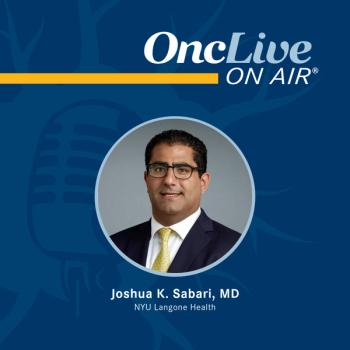
Joshua K. Sabari, MD

Joshua K. Sabari, MD, of NYU Grossman School of Medicine and NYU Langone Health’s Perlmutter Cancer Center

Joshua K. Sabari, MD, is an associate professor in the Department of Medicine at New York University (NYU) Grossman School of Medicine. He is also medical director, ofThoracic Medical Oncology at NYU Langone Health’s Perlmutter Cancer Center.

Articles by Joshua K. Sabari, MD

2 KOLs are featured in this series.

Panelists discuss how frontline treatment for HER2 mutant non–small cell lung cancer (mNSCLC) lacks FDA-approved targeted therapies, with current approaches varying between platinum-based chemotherapy with or without immunotherapy (such as the KEYNOTE-189 regimen), though some clinicians avoid immunotherapy in this population due to limited proven benefit in never-smokers who make up 60% of HER2-mutation patients, while considering whether to extrapolate from recently approved second-line targeted therapies like zongertinib.
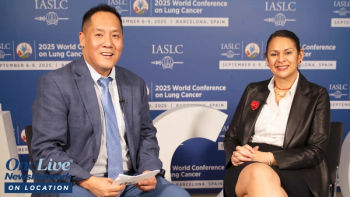
2 KOLs are featured in this series.

Panelists discuss how community oncologists can best serve patients by understanding that lung cancer is no longer 1 disease requiring uniform treatment, emphasizing that comprehensive molecular testing including both next-generation sequencing and immunohistochemistry (IHC) is critical for identifying targetable alterations like HER2 mutations that now have FDA-approved targeted therapies, making broad panel testing essential for optimal patient outcomes in 2025.

2 KOLs are featured in this series.

Panelists discuss how circulating tumor DNA (ctDNA) testing is valuable for up-front molecular profiling in all locally advanced or metastatic lung cancer patients to accelerate treatment decisions, but longitudinal ctDNA monitoring is not yet standard practice for assessing treatment response in HER2 mutations, though it can be useful at disease progression to identify resistance mechanisms and guide subsequent therapy decisions.

2 KOLs are featured in this series.

Panelists discuss how HER2 alterations in lung cancer differ from other cancers like breast cancer, where overexpression is more common and targetable with antibody-drug conjugates (ADCs), while in lung cancer the focus is primarily on HER2 exon 20 insertion mutations and other tyrosine kinase domain mutations, requiring both next-generation sequencing (NGS) and immunohistochemistry (IHC) testing since liquid biopsies can detect mutations but not overexpression.

4 experts are featured in this series.

Panelists discuss how ASCO 2025 highlighted exciting advances in targeted therapy including neoadjuvant approaches, dynamic biomarkers like circulating tumor DNA, mixed results with HER3-directed antibody-drug conjugates (ADCs) in the EGFR space, but promising data with trastuzumab-based ADCs, emphasizing the critical importance of comprehensive biomarker testing to ensure no patients miss potentially life-changing targeted therapies.

4 experts are featured in this series.

Panelists discuss how the ROS1 inhibitor landscape has evolved from crizotinib to entrectinib and now repotrectinib as the current standard of care, with repotrectinib showing impressive 35.7-month median PFS in treatment-naive patients despite increased dizziness toxicity, while next-generation agents like NVL-520 aim to spare TRK toxicity.

4 experts are featured in this series.

Panelists discuss how resistance mechanisms in ALK-positive disease are driving development of next-generation inhibitors like NVL-655 that spare TRK to reduce neurocognitive toxicity while targeting compound resistance mutations, though the success of lorlatinib makes frontline trials challenging due to extremely long progression-free survival requiring decade-long studies.

4 experts are featured in this series.

Panelists discuss how lorlatinib has become the new standard of care for ALK-positive patients based on CROWN trial data showing unprecedented 5-year progression-free survival (60% at 5 years, median not reached) and superior central nervous system control compared with earlier agents like alectinib, despite unique metabolic and neurocognitive toxicities requiring careful management.

4 experts are featured in this series.

CNS Metastases Management in KRAS G12C Patients Central nervous system (CNS) metastases affect approximately 40% of patients with KRAS G12C positive non–small cell lung cancer, presenting significant management challenges. Unlike EGFR- and ALK-positive patients who benefit from highly CNS-penetrant targeted agents, KRAS G12C patients have limited systemic options with proven intracranial activity. Stereotactic radiosurgery often becomes the preferred approach for CNS lesions, particularly when systemic options are exhausted after platinum-based chemotherapy and immunotherapy. For asymptomatic, small CNS metastases (≤5 mm without edema), systemic therapy initiation with close monitoring represents a reasonable approach. Immunotherapy and chemoimmunotherapy combinations demonstrate modest CNS response rates, while KRAS G12C inhibitors show approximately 40% to 43% intracranial response rates in untreated brain metastases. However, these response rates remain below 50%, necessitating careful patient monitoring and readiness for local ablative therapy. Surveillance strategies for CNS metastases vary among practitioners, with baseline MRI universally recommended but routine follow-up imaging practices differing. Some oncologists perform periodic surveillance scans for high-risk patients, while others monitor symptomatically. The lack of robust CNS activity from systemic agents emphasizes the importance of early detection and prompt local therapy intervention when CNS progression occurs.

4 experts in this video

Panelists discuss how medical professionals envision the future of early-stage non–small cell lung cancer (NSCLC) treatment evolving through the integration of novel therapies, predictive biomarkers, and personalized strategies to address current gaps in care, emphasizing the need for continued research to optimize outcomes and tailor interventions in resectable disease.

4 experts in this video

Panelists discuss how the diagnostic workup for unresectable stage III non–small cell lung cancer (NSCLC) requires comprehensive staging including imaging studies (PET-CT, brain MRI), tissue sampling through bronchoscopy or endobronchial ultrasound (EBUS), molecular and biomarker testing, and multidisciplinary evaluation to guide optimal treatment planning.

4 experts in this video

Panelists discuss how to treat patients who do not achieve a pathological complete response or major pathological response after neoadjuvant chemoimmunotherapy, considering options such as adjuvant therapy, close surveillance, or clinical trial enrollment based on individual risk factors and disease characteristics.

4 experts in this video

Panelists discuss how medical professionals are integrating targeted therapies, such as those for EGFR, ALK, and other mutations like RET and ROS1, into the treatment of resectable early-stage non–small cell lung cancer (NSCLC), with a focus on incorporating the ADAURA and ALINA regimens into clinical practice.