In this segment of the OncLive Peer Exchange®, Dr. Benjamin P. Levy, Dr. Julia Rotow, and Dr. Narjust Florez discuss challenges associated with tissue adequacy and repeat biopsy in non-small cell lung cancer (NSCLC), including HER2-mutant disease.

Narjust Florez, MD, is the associate medical director of the Cancer Care Access Program and a thoracic medical oncologist at the Dana-Farber Cancer Institute in Boston, Massachusetts.
In this segment of the OncLive Peer Exchange®, Dr. Benjamin P. Levy, Dr. Julia Rotow, and Dr. Narjust Florez discuss challenges associated with tissue adequacy and repeat biopsy in non-small cell lung cancer (NSCLC), including HER2-mutant disease.
In this segment of the OncLive Peer Exchange®, Dr. Benjamin P. Levy introduces the evolving treatment landscape for HER2-mutant non-small cell lung cancer (NSCLC) and welcomes panelists Dr. Julia Rotow and Dr. Narjust Florez.

In this segment, the panel discusses the emerging safety profile of next-generation CTLA-4-directed therapy in advanced squamous non-small cell lung cancer (NSCLC) and how toxicity findings should be interpreted alongside efficacy data.
In this segment, the panel reviews additional clinical data from the initial stage of the trial evaluating next-generation CTLA-4-directed therapy in advanced squamous non-small cell lung cancer (NSCLC).
In this segment, the panel examines early clinical data for a next-generation CTLA-4-directed therapy in patients with advanced squamous non-small cell lung cancer (NSCLC) whose disease has progressed following PD-L1 inhibitor and chemotherapy treatment.
In this segment, the panel explores the rationale for selectively targeting CTLA-4 within the tumor microenvironment in advanced squamous non-small cell lung cancer (NSCLC), with particular attention to intratumoral regulatory T cells (Tregs) and the potential to improve antitumor activity while limiting systemic toxicity.
In this segment, the panel discusses next-generation CTLA-4-directed therapies being engineered with the goal of improving selectivity and reducing the systemic toxicities associated with earlier CTLA-4 inhibitors in advanced squamous non-small cell lung cancer (NSCLC).
In this segment, the panel discusses the importance of proactive monitoring and multidisciplinary management of immune-related toxicities in patients with advanced squamous non-small cell lung cancer (NSCLC).

In this segment, the panel discusses the toxicity profile of CTLA-4-directed therapies and how experience with immune-modulating treatments has influenced their use in advanced squamous non-small cell lung cancer (NSCLC).
In this segment, the panel explains the biological rationale for combining CTLA-4 and PD-1 inhibition in advanced squamous non-small cell lung cancer (NSCLC).
In this segment, the panel discusses the potential role of genomic testing and biomarker identification in advanced squamous non-small cell lung cancer (NSCLC), particularly as new therapeutic approaches emerge following immunotherapy.
In this segment, Dr. Christian Rolfo reviews emerging therapeutic approaches being investigated for patients with advanced squamous non-small cell lung cancer (NSCLC) following progression on immunotherapy.
Explore post-immunotherapy options for advanced squamous NSCLC, weighing docetaxel±ramucirumab, patient concerns, and why new trials matter.

When immunotherapy stops working in squamous NSCLC, clinicians weigh docetaxel±ramucirumab, weekly dosing, and clinical trials.

Drs Florez and Riess discuss the distinction between HER2 overexpression and HER2 mutations in non–small cell lung cancer.

Narjust Florez, MD, discusses how the agenda for the Bridging the Gaps in Lung Cancer meeting evolves year to year based on emerging data and community feedback.
Narjust Florez, MD, discusses a trilingual, multidisciplinary workshop that was held at the 2026 ASCO Annual Meeting.
Narjust Florez, MD, discusses how the FDA approval of zidesamtinib in locally advanced or metastatic ROS1-positive NSCLC is an example of the fast pace of clinical oncology.
Narjust Florez, MD, and Stephanie J. McDonald, MSN, FNP-BC, AOCNP, discuss key adverse effects to watch and management strategies in EGFR-mutated NSCLC.
Narjust Florez, MD, and Stephanie J. McDonald, MSN, FNP-BC, AOCNP, discuss how nurse practitioners add valuable insight to treatment selection in EGFR-mutated NSCLC.
Narjust Florez, MD, and Stephanie J. McDonald, MSN, FNP-BC, AOCNP, discuss communication strategies between specialists and patients in EGFR-mutated NSCLC management.
Narjust Florez, MD, and Stephanie J. McDonald, MSN, FNP-BC, AOCNP, discuss initial conversations and methods of support for patients with EGFR-mutated NSCLC.
Narjust Florez, MD, and Stephanie J. McDonald, MSN, FNP-BC, AOCNP, discuss how care providers help drive treatment adherence in EGFR-mutated NSCLC.
High tumor burden lung cancer demands fast action: start chemo while awaiting biomarkers, then add osimertinib for quicker symptom relief.
High tumor burden lung cancer demands fast action: start chemo while awaiting biomarkers, then add osimertinib for rapid symptom relief.
New subcutaneous amivantamab cuts infusion reactions and steroid burden, reduces clinic visits, and shows improved outcomes in PALOMA-3.
PALOMA-3: subcutaneous amivantamab matches IV levels, slashes infusion reactions and steroids, and shortens clinic time.
New data show subcutaneous amivantamab matches IV efficacy, cuts infusion reactions and steroid prep, and slashes clinic time and costs.
Compare first-line EGFR-mutated lung cancer options: amivantamab combos vs osimertinib plus chemo, weighing survival, MET amplification coverage, toxicity, and visits.
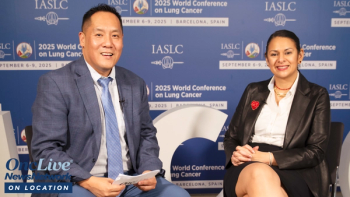
Narjust Florez, MD, and Joshua K. Sabari, MD, sit down with Chandler Park, MD, FACP, to discuss the latest abstracts in lung cancer presented during the International Association for the Study of Lung Cancer 2025 World Conference on Lung Cancer.

October 21st 2026
October 21st 2026
October 28th 2026