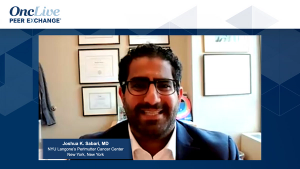
Joshua K. Sabari, MD, discusses the significance of the FDA approval of subcutaneous amivantamab for the treatment of patients with EGFR-mutant NSCLC.

Your AI-Trained Oncology Knowledge Connection!


Joshua K. Sabari, MD, is an associate professor in the Department of Medicine at New York University (NYU) Grossman School of Medicine. He is also medical director, ofThoracic Medical Oncology at NYU Langone Health’s Perlmutter Cancer Center.

Joshua K. Sabari, MD, discusses the significance of the FDA approval of subcutaneous amivantamab for the treatment of patients with EGFR-mutant NSCLC.

Panelists discuss clinical pearls for community oncologists, emphasizing that comprehensive testing is essential since zongertinib offers dramatic improvements with 75% response rates and progression-free survival exceeding 12 months in HER2 exon 20 mutations, while noting that HER2 immunohistochemistry testing shouldn’t be neglected for identifying patients who may benefit from trastuzumab deruxtecan, requiring a multilayered molecular profiling approach encompassing DNA, RNA, and protein analysis to provide new hope for patients with HER2-mutant disease.

Panelists discuss how combination therapies represent the future of HER2 mutation treatment, drawing parallels to successful EGFR combination strategies, with particular interest in anti-VEGF agents and potentially anti-PD-1/PD-L1 therapies, while noting that zongertinib’s favorable tolerability profile makes it an ideal candidate for combination approaches compared with more toxic agents like trastuzumab deruxtecan or sevabertinib, though current trial designs should incorporate 3-armed studies to evaluate up-front combination strategies rather than sequential monotherapy comparisons.

Panelists discuss how shared decision-making between zongertinib and trastuzumab deruxtecan (T-DXd) in second-line treatment involves presenting key differences to patients, including that T-DXd requires intravenous (IV) infusion with chemotherapy-like toxicities and closer monitoring (including cardiac function), while zongertinib is an oral, once-daily targeted therapy with better patient-reported outcomes and functional status improvements, fewer clinic visits after initial monitoring, and superior tolerability, leading to a preference for zongertinib first followed by T-DXd sequencing.

Panelists discuss how treatment sequencing for HER2-mutation non–small cell lung cancer (NSCLC) prioritizes zongertinib over trastuzumab deruxtecan in the second-line setting due to superior efficacy and tolerability, while noting that special populations like patients with baseline lung dysfunction (favoring zongertinib to avoid interstitial lung disease risk) or CNS (central nervous system) metastases (where zongertinib shows promising brain activity but may require concurrent radiation for larger lesions) require individualized, case-by-case management with close monitoring and early imaging follow-up.

Joshua K. Sabari, MD, discusses the significance of the FDA approval of first-line maintenance therapy with lurbinectedin plus atezolizumab for ES-SCLC.

Panelists discuss a clinical scenario involving a 73-year-old Asian woman with stage 4 lung adenocarcinoma harboring a HER2 exon 20 insertion mutation (A775-G776 YVMA) who initially responded to carboplatin, pemetrexed, and pembrolizumab for 4 cycles followed by maintenance therapy, but now presents with progressive cough and shortness of breath suggesting clinical progression, requiring decisions about next-step management in this fit patient with good performance status.

Panelists discuss how emerging second-line treatment options for HER2-mutant non–small cell lung cancer (NSCLC) include sevabertinib (a dual HER2/EGFR exon 20 inhibitor with higher gastrointestinal toxicity but similar efficacy to zongertinib) and other brain-penetrant tyrosine-kinase inhibitors (TKIs) in development, while noting that multiple ongoing phase 3 trials are studying frontline comparisons of these targeted therapies vs chemotherapy plus immunotherapy, creating a complex treatment landscape where the principle of using the best therapy first must consider efficacy, tolerability, and quality-of-life factors.

Panelists discuss how the Beamion LUNG-1 trial demonstrated zongertinib’s impressive efficacy in second-line treatment of HER2–mutant non–small cell lung cancer (NSCLC)with a 75% response rate and 14.1-month duration of response in previously treated patients, while showing a favorable safety profile as a true targeted therapy with mainly low-grade diarrhea and minimal toxicities compared with chemotherapy-like side effects, and maintaining activity even after prior trastuzumab deruxtecan treatment with a 50% response rate.

Panelists discuss how second-line treatment options for HER2-mutant non–small cell lung cancer (NSCLC), particularly trastuzumab deruxtecan (T-DXd), require careful management of significant adverse effects, including interstitial lung disease/pneumonitis (especially concerning after prior immunotherapy due to the antibody’s immune-active properties), topoisomerase inhibitor–related gastrointestinal toxicity requiring strong antiemetic protocols, and cytopenias leading to fatigue and infection risk, making it more complex to manage than traditional precision medicine targeted therapies.

Panelists discuss how frontline treatment for HER2 mutant non–small cell lung cancer (mNSCLC) lacks FDA-approved targeted therapies, with current approaches varying between platinum-based chemotherapy with or without immunotherapy (such as the KEYNOTE-189 regimen), though some clinicians avoid immunotherapy in this population due to limited proven benefit in never-smokers who make up 60% of HER2-mutation patients, while considering whether to extrapolate from recently approved second-line targeted therapies like zongertinib.

Panelists discuss how community oncologists can best serve patients by understanding that lung cancer is no longer 1 disease requiring uniform treatment, emphasizing that comprehensive molecular testing including both next-generation sequencing and immunohistochemistry (IHC) is critical for identifying targetable alterations like HER2 mutations that now have FDA-approved targeted therapies, making broad panel testing essential for optimal patient outcomes in 2025.

Panelists discuss how circulating tumor DNA (ctDNA) testing is valuable for up-front molecular profiling in all locally advanced or metastatic lung cancer patients to accelerate treatment decisions, but longitudinal ctDNA monitoring is not yet standard practice for assessing treatment response in HER2 mutations, though it can be useful at disease progression to identify resistance mechanisms and guide subsequent therapy decisions.

Panelists discuss how HER2 alterations in lung cancer differ from other cancers like breast cancer, where overexpression is more common and targetable with antibody-drug conjugates (ADCs), while in lung cancer the focus is primarily on HER2 exon 20 insertion mutations and other tyrosine kinase domain mutations, requiring both next-generation sequencing (NGS) and immunohistochemistry (IHC) testing since liquid biopsies can detect mutations but not overexpression.

Narjust Florez, MD, and Joshua K. Sabari, MD, sit down with Chandler Park, MD, FACP, to discuss the latest abstracts in lung cancer presented during the International Association for the Study of Lung Cancer 2025 World Conference on Lung Cancer.


Dr Sabari highlights key research investigating telisotuzumab vedotin in patients with c-Met–overexpressing non–small cell lung cancer.

Panelists discuss how ASCO 2025 highlighted exciting advances in targeted therapy including neoadjuvant approaches, dynamic biomarkers like circulating tumor DNA, mixed results with HER3-directed antibody-drug conjugates (ADCs) in the EGFR space, but promising data with trastuzumab-based ADCs, emphasizing the critical importance of comprehensive biomarker testing to ensure no patients miss potentially life-changing targeted therapies.

Joshua K. Sabari, MD, discusses response rates observed with zidesamtinib in patients with advanced ROS1-positive non–small cell lung cancer.

Panelists discuss how real-world data becomes crucial for guiding treatment decisions in rare subsets like ROS1-positive patients where head-to-head trials are challenging, and how next-generation inhibitors like NVL-520 and taletrectinib aim to improve efficacy while reducing TRK-related toxicities through more selective targeting.

Panelists discuss how the ROS1 inhibitor landscape has evolved from crizotinib to entrectinib and now repotrectinib as the current standard of care, with repotrectinib showing impressive 35.7-month median PFS in treatment-naive patients despite increased dizziness toxicity, while next-generation agents like NVL-520 aim to spare TRK toxicity.

Panelists discuss how resistance mechanisms in ALK-positive disease are driving development of next-generation inhibitors like NVL-655 that spare TRK to reduce neurocognitive toxicity while targeting compound resistance mutations, though the success of lorlatinib makes frontline trials challenging due to extremely long progression-free survival requiring decade-long studies.

Panelists discuss how lorlatinib has become the new standard of care for ALK-positive patients based on CROWN trial data showing unprecedented 5-year progression-free survival (60% at 5 years, median not reached) and superior central nervous system control compared with earlier agents like alectinib, despite unique metabolic and neurocognitive toxicities requiring careful management.

Panelists discuss how next-generation KRAS G12C inhibitors like divarasib, lifirafenib, and RMC-6291 (a RAS-ON inhibitor) show promising enhanced potency with response rates in the 50% range and extended PFS, offering hope for more effective treatment options and potential sequencing strategies.

CNS Metastases Management in KRAS G12C Patients Central nervous system (CNS) metastases affect approximately 40% of patients with KRAS G12C positive non–small cell lung cancer, presenting significant management challenges. Unlike EGFR- and ALK-positive patients who benefit from highly CNS-penetrant targeted agents, KRAS G12C patients have limited systemic options with proven intracranial activity. Stereotactic radiosurgery often becomes the preferred approach for CNS lesions, particularly when systemic options are exhausted after platinum-based chemotherapy and immunotherapy. For asymptomatic, small CNS metastases (≤5 mm without edema), systemic therapy initiation with close monitoring represents a reasonable approach. Immunotherapy and chemoimmunotherapy combinations demonstrate modest CNS response rates, while KRAS G12C inhibitors show approximately 40% to 43% intracranial response rates in untreated brain metastases. However, these response rates remain below 50%, necessitating careful patient monitoring and readiness for local ablative therapy. Surveillance strategies for CNS metastases vary among practitioners, with baseline MRI universally recommended but routine follow-up imaging practices differing. Some oncologists perform periodic surveillance scans for high-risk patients, while others monitor symptomatically. The lack of robust CNS activity from systemic agents emphasizes the importance of early detection and prompt local therapy intervention when CNS progression occurs.

Panelists discuss how KRAS G12C inhibitors are moving into frontline combination therapy with immunotherapy, highlighting KRYSTAL-7 data showing impressive efficacy in PD-L1–high patients (~28 months progression-free survival) but more modest results in PD-L1–low patients, with ongoing studies exploring optimal combination strategies.

Panelists discuss how KRAS G12C inhibitors differentiate in their toxicity profiles, with sotorasib carrying higher hepatotoxicity risk especially post–checkpoint inhibitor therapy, while adagrasib shows more gastrointestinal toxicities, and the importance of washout periods to mitigate liver toxicity.

Panelists discuss how 2 FDA-approved KRAS G12C inhibitors (adagrasib and sotorasib) perform in second-line therapy after immunotherapy and chemotherapy, with both showing improved progression-free survival versus docetaxel despite modest gains, leading to their adoption as standard of care due to better tolerability profiles.

Panelists discuss how critical broad-panel next-generation sequencing is for all patients with non–small cell lung cancer to enable biomarker-guided treatment, with focus on KRAS G12C mutations found in 12% to 14% of patients and consideration of PD-L1 expression levels and comutations when selecting frontline therapy.

Published: September 19th 2023 | Updated:

Published: September 19th 2023 | Updated:

Published: December 15th 2023 | Updated:

Published: September 12th 2023 | Updated:

Published: January 7th 2026 | Updated:

Published: December 15th 2023 | Updated: