

Experts discuss the difference in toxicities demonstrated in both adagrasib and sotorasib in second line KRAS-mutated NSCLC, highlighting hepatotoxicity and achieving durable response with combination PD-1/PD-L1 inhibitors.

Joshua K. Sabari, MD, is an associate professor in the Department of Medicine at New York University (NYU) Grossman School of Medicine. He is also medical director, ofThoracic Medical Oncology at NYU Langone Health’s Perlmutter Cancer Center.
Experts discuss the difference in toxicities demonstrated in both adagrasib and sotorasib in second line KRAS-mutated NSCLC, highlighting hepatotoxicity and achieving durable response with combination PD-1/PD-L1 inhibitors.
Dr. Sabari and Dr. Garon discuss second line sotorasib and the results of the CodeBreaK 200 study, highlighting the recent FDA oncologic drugs advisory committee (ODAC) and their assessment of the study results.
Joshua K. Sabari, MD, reviews data from the MARIPOSA-2 trial and discusses treatment options in the second line and beyond for patients with EGFR-mutant non–small cell lung cancer.
The panel reacts to the MARIPOSA trial, which looked at amivantamab and lazertinib in the front line in patients with EGFR-mutant non–small cell lung cancer.
Comprehensive insights on FLAURA2, which looked at osimertinib and chemotherapy in the front line for patients with EGFR-mutant NSCLC.
A panel of thoracic medical oncologists discuss the first-line treatment options for patients with EGFR-mutant advanced non–small cell lung cancer.
Expert oncologists discuss patients who may progress to the second line setting with KRAS G12C mutations.
A comprehensive review of hepatotoxicity in ongoing studies evaluating KRAS inhibitors in the frontline setting, highlighting adagrasib and sotorasib in the KRYSTAL-7 and CodeBreaK 100 studies, respectively.
Joshua K. Sabari, MD, and Edward B. Garon, MD, MS, discuss the role and potential impact of KRAS G12C inhibitors in the frontline setting, highlighting the potential of monotherapy and in combination with a PD-1/PD-L1 inhibitor.
Shared insight into the consideration of KRAS G12C inhibitors in treating co-mutations in NSCLC.
Expert perspectives on the role of clinical biomarkers in selecting appropriate patients for antibody-drug conjugates in non–small cell lung cancer.
Joshua K. Sabari, MD, reviews data from the TROPION-Lung04 study, and the panel offers key takeaways on Dato-DXd and immunotherapy in advanced NSCLC.
Experts review the current frontline treatments for patients with KRAS G12C-mutated NSCLC.
Explore the current landscape of targeted therapies in non-small cell lung cancer, focusing on KRAS G12C mutations, molecular testing, and current treatments.
Edward B. Garon, MD, MS, reviews data from the EVOKE-02 study, and the panel offers their thoughts on antibody-drug conjugates for the treatment of advanced NSCLC.
The expert panel reviews the results from the TROPION-Lung01 study and discusses how the data can inform treatment decisions for patients with previously treated NSCLC.

Solange Peters, MD, PhD, reviews key data from TROPION-Lung01 investigating datopotamab deruxtecan (Dato-DXd) in patients with previously treated advanced non–small cell lung cancer.
Clinical insights on how the level of PD-L1 expression informs treatment decisions for patients with non–small cell lung cancer.
Experts on non–small cell lung cancer discuss the role of CTLA-4 inhibitors in the NSCLC treatment landscape.
A panel of thoracic medical oncologists provide an overview of first-line treatment strategies for advanced non–small cell lung cancer (NSCLC).

Joshua K. Sabari, MD, discusses the ongoing phase 2 EVOKE-2 trial investigating sacituzumab govitecan-hziy in non– small cell lung cancer; emerging data on antibody-drug conjugates in the second– or first-line treatment setting; and the planned phase 3 EVOKE-03 trial of sacituzumab govitecan plus pembrolizumab as a frontline treatment.
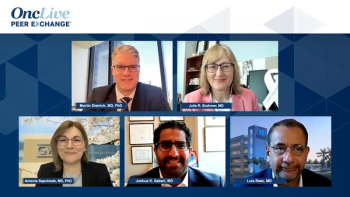
Closing out their discussion on biomarker testing and targeted therapies in non–small cell lung cancer, the panel of expert oncologists share clinical pearls and thoughts on the evolving treatment landscape.
Julie R. Brahmer, MD, details emerging targets in non–small cell lung cancer and the outlook for the future of treatment.
The focus turns to therapeutic strategies for treating MET exon 14 non–small cell lung cancer.
Experts on non–small cell lung cancer share their approaches to treating patients who have RET fusions and review updates on selpercatinib and pralsetinib.
Julie R. Brahmer, MD, and Joshua K. Sabari, MD, review recent data on entrectinib and larotrectinib for the treatment of patients with NSCLC with NTRK fusions.
The expert panel discusses factors that influence treatment decisions when choosing appropriate therapy for patients with ALK-rearranged NSCLC.
Experts on non–small cell lung cancer discuss recent data on brigatinib and lorlatinib for the treatment of patients with ALK rearrangements.
Luis Raez, MD, offers insights on how co-mutations in STK11 or KEAP1 impact the use of immunotherapies in KRAS G12C–mutant non–small cell lung cancer.
Joshua K. Sabari, MD, discusses adagrasib as a treatment of patients with NSCLC with KRAS G12C mutations, and provides insight on treating patients who have progressed on prior KRAS G12C inhibitors.