





Chronic Lymphocytic Leukemia
Latest News
Advertisement
Latest Videos

























































Advertisement
More News
ALPINE Study: Zanubrutinib vs Ibrutinib in R/R CLL
ByWilliam Wierda, MD, PhD, University of Texas MD Anderson Cancer Center,John Allan, MD, Weill Cornell Medicine,Ehab Atallah, MD, Medical College of Wisconsin,Steven Coutre, MD, Stanford University Medical Center,Nicole Lamanna, MD, Herbert Irving Comprehensive Cancer Center,Jennifer Woyach, MD, Ohio State University
An overview of the h ALPINE trial of zanubrutinib vs ibrutinib in patients with relapsed/refractory chronic lymphocytic leukemia (CLL).
Shared insight on clinical trial data for frontline targeted agents—specifically ibrutinib, acalabrutinib, and venetoclax—in chronic lymphocytic leukemia.
Considering a patient’s age, as well as their deletion 17p and IgHV status, experts from around the world share their approach to the frontline management of CLL.
Investigators of the phase 3 ULTRA-V trial are look-ing to leverage the synergistic capabilities of venetoclax for patients with chronic lymphocytic leukemia with the addition of the U2 regimen of ublituximab in combination with umbralisib.

Meghan Thompson, MD, discusses future research directions in chronic lymphocytic leukemia.
Mitigating Toxicities Associated With BTK Inhibitors
ByWilliam Wierda, MD, PhD, University of Texas MD Anderson Cancer Center,John Allan, MD, Weill Cornell Medicine,Ehab Atallah, MD, Medical College of Wisconsin,Steven Coutre, MD, Stanford University Medical Center,Nicole Lamanna, MD, Herbert Irving Comprehensive Cancer Center,Jennifer Woyach, MD, Ohio State University
A continuing discussion about the implications of toxicities with BTK inhibitors.
Safety and Efficacy of BTK Inhibitors in CLL
ByWilliam Wierda, MD, PhD, University of Texas MD Anderson Cancer Center,John Allan, MD, Weill Cornell Medicine,Ehab Atallah, MD, Medical College of Wisconsin,Steven Coutre, MD, Stanford University Medical Center,Nicole Lamanna, MD, Herbert Irving Comprehensive Cancer Center,Jennifer Woyach, MD, Ohio State University
A discussion about managing toxicities associated with Bruton tyrosine kinase (BTK) inhibitors for chronic lymphocytic leukemia (CLL).

Zanubrutinib resulted in a significant improvement in progression-free survival per independent review committee assessment vs bendamustine plus rituximab in treatment-naïve patients with chronic lymphocytic leukemia whose tumors did not exhibit the deletion of chromosome 17p13.1.
A review of how frontline therapy selection for patients with CLL is informed by molecular testing, staging, and risk stratification amidst a multitude of other disease factors.
Expert insight on the impact that targeted therapies have had on the frontline treatment landscape of chronic lymphocytic leukemia.
Lindsey Roeker, MD, discusses the emerging role of minimal residual disease as a predictive end point in chronic lymphocytic leukemia.
BTK Inhibitors as Frontline Treatment for CLL
ByWilliam Wierda, MD, PhD, University of Texas MD Anderson Cancer Center,John Allan, MD, Weill Cornell Medicine,Ehab Atallah, MD, Medical College of Wisconsin,Steven Coutre, MD, Stanford University Medical Center,Nicole Lamanna, MD, Herbert Irving Comprehensive Cancer Center,Jennifer Woyach, MD, Ohio State University
Leukemia experts provide their personal experience using Bruton tyrosine kinase (BTK) inhibitors to treat patients with chronic lymphocytic leukemia (CLL) in the first-line setting.
Long-Term Experience With Ibrutinib in CLL
ByWilliam Wierda, MD, PhD, University of Texas MD Anderson Cancer Center,John Allan, MD, Weill Cornell Medicine,Ehab Atallah, MD, Medical College of Wisconsin,Steven Coutre, MD, Stanford University Medical Center,Nicole Lamanna, MD, Herbert Irving Comprehensive Cancer Center at Columbia University,Jennifer Woyach, MD, Ohio State University
Jennifer Woyach, MD, discusses her experience using ibrutinib for chronic lymphocytic leukemia (CLL) in the first-line setting.

Meghan Thompson, MD, discusses emerging treatment strategies with BTK inhibitors in chronic lymphocytic leukemia.
CLL: Prognostic Markers
ByWilliam G Wierda, MD, University of Texas MD Anderson Cancer Center,John Allan, MD, Weill Cornell Medicine,Ehab Atallah, MD, Medical College of Wisconsin,Steven Coutre, MD, Stanford University Medical Center,Nicole Lamanna, MD, Herbert Irving Comprehensive Cancer Center,Jennifer Woyach, MD, Ohio State University
An overview of prognostic models in chronic lymphocytic leukemia (CLL).
Prognostic Factors in Chronic Lymphocytic Leukemia
ByWilliam G Wierda, MD, University of Texas MD Anderson Cancer Center,John Allan, MD, Weill Cornell Medicine,Ehab Atallah, MD, Medical College of Wisconsin,Steven Coutre, MD, Stanford University Medical Center,Nicole Lamanna, MD, Herbert Irving Comprehensive Cancer Center,Jennifer Woyach, MD, Ohio State University
A discussion about prognostic factors in patients with newly diagnosed chronic lymphocytic leukemia (CLL).

Paul M. Barr, MD, discusses the clinical implications of the long-term results of the phase 3 RESONATE-2 trial in chronic lymphocytic leukemia.
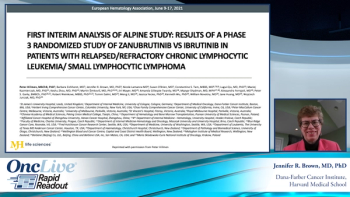
Jennifer R. Brown, MD, PhD presents an interim analysis from the ALPINE study of zanubrutinib vs. ibrutinib in patients with R/R CLL/SLL presented at the 2021 European Hematology Association virtual congress.
Paolo Ghia, MD, PhD, discusses the clinical implications of the phase 2 CAPTIVATE trial in chronic lymphocytic leukemia.
Molecular Testing for Newly Diagnosed CLL
ByWilliam G Wierda, MD, University of Texas MD Anderson Cancer Center,John Allan, MD, Weill Cornell Medicine,Ehab Atallah, MD, Medical College of Wisconsin,Steven Coutre, MD, Stanford University Medical Center,Nicole Lamanna, MD, Herbert Irving Comprehensive Cancer Center,Jennifer Woyach, MD, Ohio State University
Ehab Attallah, MD, provides an overview of molecular testing for patients with newly diagnosed chronic lymphocytic leukemia (CLL).
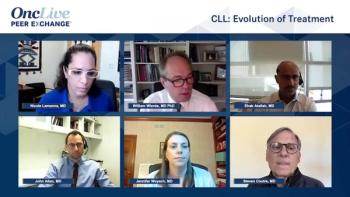
CLL: Evolution of Treatment
ByWilliam Wierda, MD, PhD, University of Texas MD Anderson Cancer Center,John Allan, MD, Weill Cornell Medicine,Ehab Atallah, MD, Medical College of Wisconsin,Steven Coutre, MD, Stanford University Medical Center,Nicole Lamanna, MD, Herbert Irving Comprehensive Cancer Center,Jennifer Woyach, MD, Ohio State University
William Wierda, MD, PhD, leads a panel of experts in a discussion pertaining to the treatment of chronic lymphocytic leukemia (CLL), beginning with the evolving treatment landscape.

Fixed-duration ibrutinib plus venetoclax produced superior progression-free survival when compared with chlorambucil plus obinutuzumab in the frontline treatment of patients with chronic lymphocytic leukemia, with durable responses observed in those who achieved undetectable minimal residual disease negativity.

Michael R. Grunwald, MD, FACP, discusses the clinical implications of tisagenlecleucel in the treatment of patients with B-cell acute lymphoblastic leukemia.

Sameem Abedin, MD, discusses the safety and efficacy of ibrutinib in the treatment of patients with chronic lymphocytic leukemia.

Fixed-duration venetoclax plus obinutuzumab demonstrated prolonged remissions compared with chemoimmunotherapy in elderly patients with previously untreated chronic lymphocytic leukemia and comorbidities.
Advertisement
Advertisement
Trending on OncLive
1
Sacituzumab Govitecan Triplet Elicits Durable Responses in Treatment-Naive Metastatic Urothelial Cancer
2
Perioperative Enfortumab Vedotin Plus Pembrolizumab Improves ctDNA Clearance in Cisplatin-Eligible MIBC
3
Ad Hoc Analysis Supports Contributions of Both Enfortumab Vedotin and Pembrolizumab in Cisplatin-Ineligible MIBC
4
Pembrolizumab Plus Chemo Misses EFS End Point in Cisplatin-Eligible MIBC
5