



Colorectal Cancer
Latest News


Cetuximab β Plus FOLFIRI Displays Significant Clinical Activity in First-Line mCRC
By Kyle Doherty

Capecitabine/Bevacizumab Yields Antitumor Activity and a Favorable Safety Profile in Older mCRC Population
By Ashley Chan
Advertisement
Latest Videos






































































Advertisement
More News

Neoadjuvant dostarlimab led to an 82% clinical complete response and a 92% 2-year RFS rate, supporting nonoperative management in early-stage dMMR tumors.

Van Karlyle Morris, MD, discusses the efficacy of nivolumab plus ipilimumab according to stratification factors in dMMR/MSI-H mCRC.

The top 5 OncLive videos of the week cover insights in colorectal cancer, prostate cancer, myeloma, renal cell carcinoma, and urothelial carcinoma.

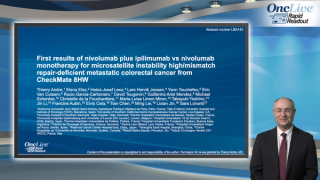
Thierry André, MD, discusses the safety profile of nivolumab/ipilimumab for the treatment of patients with MSI-H/dMMR metastatic colorectal cancer.

Here is your snapshot for all therapeutic options that were cleared by the FDA in April 2025 spanning tumor types.

Trifluridine/tipiracil showed a favorable safety profile and numerically improved DFS vs placebo in MRD-positive CRC.

Scott Kopetz, MD, PhD, FACP, and Mark A. Lewis, MD, discuss how ctDNA assays have improved MRD detection in CRC.
Scott Kopetz, MD, PhD, FACP, and Mark A. Lewis, MD, discuss ongoing research in CRC utilizing ctDNA.
Scott Kopetz, MD, PhD, FACP, and Mark A. Lewis, MD, discuss how to approach conversations about ctDNA with patients with CRC.
Scott Kopetz, MD, PhD, FACP, and Mark A. Lewis, MD, discuss findings for ctDNA in stage II/III CRC from the BESPOKE CRC trial.
Scott Kopetz, MD, PhD, FACP, and Mark A. Lewis, MD, on data from the GALAXY arm of CIRCULATE-Japan for ctDNA in stage II to IV CRC.
Scott Kopetz, MD, PhD, FACP, and Mark A. Lewis, MD, on why ctDNA remains a focus of research in colorectal cancer.

Initial fruquintinib followed by regorafenib extended OS vs the reverse sequence of the agents in patients with metastatic colorectal cancer.

Michael Cecchini, MD, discusses the effects of neoadjuvant chemotherapy on tumor-infiltrating lymphocyte levels in colorectal cancer with liver metastases.

Fruquintinib plus capecitabine demonstrated preliminary efficacy and safety as maintenance therapy in RAS/BRAF wild-type metastatic colorectal cancer.

Eighty percent of patients with early-stage dMMR solid tumors given neoadjuvant dostarlimab underwent nonoperative management of their disease.

S. Daniel Haldar, MD, discusses outcomes for NeoAg-Vax with or without pembrolizumab in MSS metastatic colorectal cancer.

Scott Kopetz, MD, PhD, FACP, highlights the efficacy of encorafenib/cetuximab with mFOLFOX6 in BRAF V600E–mutated metastatic colorectal cancer.
The top 5 OncLive videos of the week cover insights in myelofibrosis, chronic lymphocytic leukemia, colorectal cancer, breast cancer, and ovarian cancer.

Nivolumab/ipilimumab is approved for dMMR/MSI-H mCRC and unresectable or metastatic HCC, larotrectinib wins full approval in NTRK+ solid tumors, and more.

The bevacizumab biosimilar Jobevne was approved by the FDA for the treatment of several solid tumor types, including mCRC, NSCLC, and RCC.

Hideaki Bando, MD, PhD, discusses the safety of trifluridine/tipiracil in patients with MRD following resection of CRC.

The FDA has granted approval to nivolumab plus ipilimumab for the treatment of patients with dMMR/MSI-H metastatic colorectal cancer.

Tanios S. Bekaii-Saab, MD, details studies of ctDNA-guided strategies that are elucidating the role of adjuvant therapies in CRC and agents of promise.
Tanios S. Bekaii-Saab, MD, discusses questions that have arisen regarding the use of immunotherapy in patients with MSI-H/dMMR and MSS/pMMR CRC.
Advertisement
Advertisement
Trending on OncLive
1
The OncFive: Top Oncology Articles for the Week of 10/4/2026
2
FDA Grants Breakthrough Device Designation to Natera’s Multi-Cancer Early Detection Assay
3
FDA Approves Atezolizumab Plus Chemo for Stage III dMMR Colon Cancer
4
FDA Flashback: Hematologic Cancer Decisions and News From September 2026
5