





Genitourinary Cancers
Latest News
Advertisement
Latest Videos





























































Advertisement
More News

Michael B. Atkins, MD, discusses the rationale for launching the phase 2 HCRN GU16-260 trial in patients with advanced renal cell carcinoma.

Laurence Albigès, MD, PhD, discusses on the safety and efficacy of cabozantinib in patients with unresectable, locally advanced or metastatic renal cell carcinoma with a clear cell component.

Drs Moshe Ornstein and Hans Hammers review data from the COSMIC-313 trial investigating ipilimumab, nivolumab, and cabozantinib for the frontline treatment of metastatic renal cell carcinoma.
The panel provides an overview of novel double combination therapies currently under investigation.

Siamak Daneshmand, MD, discusses the rationale for investigating erdafitinib in patients with recurrent, intermediate-risk non–muscle invasive bladder cancer harboring FGFR3 or FGFR2 alterations.

Mehmet Asim Bilen, MD, details how he approaches IO/TKI therapy for patients with renal cell carcinoma with bone metastases.
The panel discusses the use of quality-of-life clinical trial data in metastatic renal cell carcinoma and how liver and brain metastases affect treatment decision-making.

Experts on renal cell carcinoma discuss post-progression treatment options for RCC.
Pedro Barata, MD, MSc, and Benjamin Garmezy, MD, outline factors taken into consideration when selecting advanced RCC treatments.
Renal cell carcinoma experts discuss clinical trials, evaluating immunotherapies and tyrosine kinase inhibitors in the front line setting of advanced RCC.
Benjamin Garmezy, MD, presents the case of a 67-year-old man diagnosed with advanced renal cell carcinoma.

Hans Hammers, MD, PhD, explains the situations in which he would choose an ipilimumab/nivolumab treatment regimen over one of the discussed IO/TKI regimens.
Drs Moshe Ornstein and Mehmet Asim Bilen review updated data from the CheckMate 9ER and CLEAR trials investigating combination treatments for metastatic renal cell carcinoma.

Christopher W. Ryan, MD, discusses the role of adjuvant pembrolizumab in renal cell carcinoma, the use of immunotherapy-based combinations in the frontline setting for metastatic renal cell carcinoma, and key data presented at the 2023 Genitourinary Cancers Symposium in bladder cancer and prostate cancer.
Experts on renal cell carcinoma describe the RCC histologies and tools used for risk stratification.
Pedro Barata, MD, MSc, and Benjamin Garmezy, MD, open the discussion with an overview of renal cell carcinoma.

Laurence Albigès, MD, PhD, discusses what inspired the launch of the CaboPoint study examining second-line cabozantinib in patients with advanced renal cell carcinoma, the efficacy of this approach, and the next steps for this research.

When the fully human IgG4 monoclonal antibody SRK-181 was given as a monotherapy or in combination with anti–PD-1 or PD-L1 agents in patients with locally advanced or metastatic solid tumors, it was found to be generally well tolerated and to demonstrate early indications of efficacy.
Mehmet Asim Bilen, MD, presents a profile of a 65-year-old woman with metastatic renal cell carcinoma for discussion.
Moshe Ornstein, MD, MA, starts a conversation on how patients with metastatic renal cell carcinoma are classified by risk, and how risk category influences approaches to systemic therapy.

Despite a perhaps overwhelming number of combination regimens available for use in the frontline setting for patients with renal cell carcinoma, treatment decisions can still largely boil down to a patient’s risk status. For second-line therapy, investigators are looking to contemporary trials for guidance.
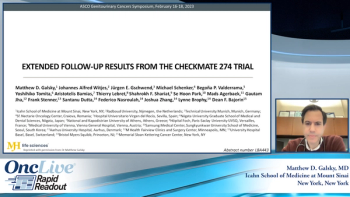
Expert Matthew D. Galsky, MD, shares his perspective on follow-up results from CheckMate 274, which analyzed adjuvant nivolumab in patients with high-risk muscle-invasive urothelial carcinoma.

The combination of cabozantinib and atezolizumab elicited responses in patients with non–clear cell renal cell carcinoma, according to extended follow-up data from the phase 1b COSMIC-021 trial.
The progression-free survival benefit associated with the combination of nivolumab plus cabozantinib compared with sunitinib was largely independent of PD-L1 and c-MET status in previously untreated patients with advanced or metastatic renal cell carcinoma.

Matthew Galsky, MD, discusses the rationale of the phase 3 CheckMate-274 trial in patients with urothelial cancer.
Advertisement
Advertisement
Trending on OncLive
1
Savolitinib Plus Osimertinib NDA Submitted to FDA for MET-Driven, EGFR-Mutated NSCLC After EGFR TKI
2
FDA Grants Priority Review to Elinzanetant for Endocrine Therapy–Associated Vasomotor Symptoms in HR+ Breast Cancer
3
Calculating the Real Cost of False Positive Findings in Cancer Screening
4
China's NMPA Approves Pirtobrutinib Across CLL
5