





Hematologic Oncology
Latest News
Advertisement
Latest Videos






















































Advertisement
More News

Sagar Patel, MD, discusses the utility of the Orca-T platform in patients with hematologic malignancies, highlighting the platform's safety.
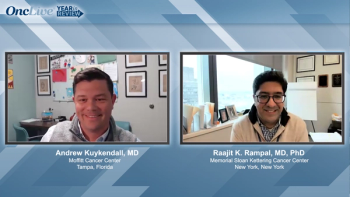
Raajit K. Rampal, MD, PhD, discusses choosing among JAK inhibitors based on specific patient needs, such as platelet counts and anemia, emphasizing the importance of using the full dose for best efficacy and how different scenarios might influence the choice and sequencing of these drugs in practice.
Andrew Kuykendall, MD, discusses the efficacy and adverse effects of fedratinib, highlighting its potential in the second-line setting for patients resistant to ruxolitinib, with updates from FREEDOM-2 emphasizing manageable gastrointestinal tolerability concerns.

Looking to the future, Lori A. Leslie, MD, offers closing thoughts on unmet needs and potential improvements in the lymphoma treatment space.
Clinical insights on managing adverse events associated with CAR T-cell therapy and measuring patient response, highlighting a phase 2 trial on prophylactic anakinra.
The EMA has accepted a MAA seeking the approval of obe-celf or use in patients with relapsed or refractory adult B-cell acute lymphoblastic leukemia.

The FDA has approved danicopan as add-on therapy to ravulizumab or eculizumab for extravascular hemolysis in paroxysmal nocturnal hemoglobinuria.

Voruciclib plus venetoclax had antileukemic activity with acceptable safety in patients with relapsed or refractory acute myeloid leukemia.
Elias Jabbour, MD, expands on the significance of ponatinib’s approval in Philadelphia chromosome–positive acute lymphoblastic leukemia.

Sunil Iyer, MD, expands on the potential role of imetelstat for select patients with lower-risk myelodysplastic syndrome.
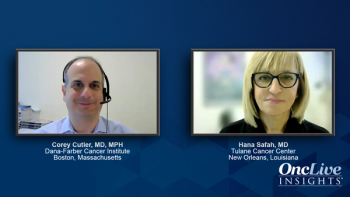
Hana Safah, MD, and Corey Cutler, MD, MPH, conclude with clinical insights on addressing medication access and the supportive care needs of patients with GvHD.

Guenther Koehne, MD, PhD, discusses research efforts to overcome resistance to CAR T-cell therapy in hematologic malignancies.
Drs Rampal and Kuykendall highlight the benefits of pacritinib for patients with low platelet counts, as evidenced by the PERSIST-2 study, and momelotinib for patients with anemia, as shown in the MOMENTUM Phase 3 Study, focusing on their efficacy in spleen volume reduction and symptom relief in patients with myelofibrosis.
Andrew Kuykendall, MD, and Raajit K. Rampal, MD, PhD, reflect on the future of combination therapies in treating myelofibrosis, emphasizing the need to align study endpoints with treatment goals and highlighting the potential of various combinations based on promising preclinical and early phase study results.
The FDA granted priority review to the NDA seeking the approval of revumenib for the treatment of relapsed/refractory, KMT2A-rearranged acute leukemia.
Focusing on mantle cell lymphoma, Lori A. Leslie, MD, reviews the primary analysis of the SYMPATICO trial investigating ibrutinib-venetoclax combination therapy.
Dr Leslie discusses two abstracts on axi-cel recently presented at ASH 2023: a subgroup analysis of ZUMA-7 and the 4-year follow-up from ZUMA-5.

Positive phase 2a topline findings have been announced with SLS009 plus azacitidine and venetoclax in relapsed/refractory acute myeloid leukemia.
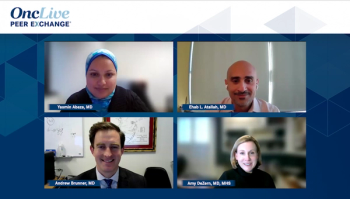
Following its comprehensive discussion on the treatment of MDS, the expert panel concludes with thoughts on the overall treatment landscape.

Liposomal annamycin plus cytarabine elicited responses in patients with acute myeloid leukemia, according to interim data from the phase 1b/2 MB-106 trial.
The FDA issued complete response letters to the BLA for odronextamab in relapsed/refractory follicular lymphoma and diffuse large B-cell lymphoma.

Elias Jabbour, MD, discusses the FDA approval of ponatinib plus chemotherapy for Philadelphia chromosome–positive acute lymphoblastic leukemia.
Drs Cutler and Safah look to the future of chronic GvHD treatment and discuss ongoing research, highlighting studies investigating axatilimab and abatacept.
Hematologist-oncologists give an overview of the 3 approved treatment options for patients with steroid-refractory chronic GvHD—ruxolitinib, ibrutinib, and belumosudil—and highlight the REACH3 and ROCKstar studies.
Andrew Kuykendall, MD, and Raajit K. Rampal, MD, PhD, discuss luspatercept with or without ruxolitinib for the treatment of anemia in patients with myelofibrosis. The combination has demonstrated promise in reducing transfusion dependency, as seen in data from ACE-536-MF-001, with ongoing phase 3 trials.
Advertisement
Advertisement
Trending on OncLive
1
FDA Approves Bioequivalent Olaparib Across Previously Approved Cancer Indications
2
Longer-Term Data Help Shape TKI Selection in ROS1+ and ALK+ NSCLC
3
Experts Revisit the Most Notable Data in GU Oncology From ASCO 2026
4
Alpha DaRT Plus Pembrolizumab Yields 100% ORR in Elderly Recurrent or Metastatic HNSCC
5