




Hematologic Oncology
Latest News
Advertisement
Latest Videos




















































Advertisement
More News

Amira Marouf, MD, PhD student, describes the nature of a comparative analysis conducted based on propensity score matching, and discussed the main takeaways regarding the efficacy of PD-1 inhibitors for patients with relapsed/refractory ENKTCL.

Key opinion leaders reflect on data from the 2023 ASCO meeting and how it may impact the management of diffuse large B-cell lymphoma.

Expert perspectives on recent efforts to move novel therapy from the relapsed/refractory to frontline setting of diffuse large B-cell lymphoma.

Jan Bewersdorf, MD, discusses the design of an ongoing phase 1 trial investigating ruxolitinib plus abemaciclib in patients with primary or secondary myelofibrosis.

Rami Komrokji, MD, summarizes data presented at ASCO 2023 from the COMMANDS trial on the role of luspatercept in lower-risk MDS.
Dr Madanat reviews data from an abstract presented at ASCO 2023 on the outcomes of ESA therapy in patients with SF3B1-mutated lower-risk MDS.

Oral treatment with BMF-219 led to 2 complete responses of 5 patients with relapsed/refractory acute myeloid leukemia with menin-dependent mutations, both of which remain on treatment.

The phase 3 ENHANCE trial evaluating the first-line combination of magrolimab and azacitidine vs placebo plus azacitidine in patients with higher-risk myelodysplastic syndrome has been discontinued due to futility at a planned analysis.

A comprehensive discussion on the members of a healthcare team who might help to diagnose and manage a patient with myelofibrosis.
Expert panelists consider key molecular markers that guide the classification and management of myelofibrosis, along with other important subsets of disease.

Dr Lunning sits down with Kamdar to discuss the design of the POLARIX trial, the ways in which its results have changed their practice when treating patients with DLBCL, and the importance of further research investigating the molecular heterogeneity of DLBCL to determine potential causes of early relapse with pola-R-CHP.

The anti–CSF-R1 antibody axatilimab generated responses in adult and pediatric patients with chronic graft-vs-host disease who received 2 or more prior lines of therapy, meeting the primary end point in all cohorts of patients in the phase 2 AGAVE-201 trial.

The FDA has approved the LeukoStrat CDx FLT3 Mutation Assay for use as a companion diagnostic to select patients with FLT3-ITD–positive acute myeloid leukemia who may be eligible to receive treatment with quizartinib (Vanflyta).1

Before closing out their discussion on the relapsed/refractory setting of diffuse large B-cell lymphoma, panelists identify best practices in bridging therapy.

Comprehensive insight on the optimal sequencing of novel therapies in patients with relapsed/refractory diffuse large B-cell lymphoma.
The European Medicines Agency’s Committee for Medicinal Products for Human Use has recommended the approval of JZP458 for use in combination with multi-agent chemotherapy for the treatment of adult and pediatric patients 1 month and older with acute lymphoblastic leukemia and lymphoblastic lymphoma who developed hypersensitivity or silent inactivation to Escherichia coli–derived asparaginase.

Lorenzo Falchi, MD, iscusses the use of glofitamab monotherapy in patients with relapsed/refractory large B-cell lymphoma.

Harry P. Erba, MD, PhD, discusses the significance of the FDA approval of quizartinib in combination with chemotherapy in patients with newly diagnosed FLT3-ITD–positive acute myeloid leukemia.
The FDA has approved quizartinib in combination with standard cytarabine and anthracycline induction and cytarabine consolidation, and as maintenance monotherapy following consolidation chemotherapy, for the treatment of adult patients with newly diagnosed acute myeloid leukemia that is FLT3-ITD positive, as detected by an FDA-approved test.

Treatment with the CD3 x CD123 bispecific antibody APVO436 plus venetoclax and azacitidine led to durable remissions in patients with relapsed/refractory acute myeloid leukemia who had not received prior venetoclax.
The panel discusses the patient profile of a man with lower-risk MDS and how they would have approached treatment in their practice.
Yazan Madanat, MD, presents the patient profile of a transfusion-dependent 79-year-old man with lower-risk MDS and a KRAS mutation.

Bexmarilimab in combination with standard-of-care azacitidine or azacitidine plus venetoclax demonstrated early signs of efficacy in patients with relapsed or refractory acute myeloid leukemia and myelodysplastic syndrome.
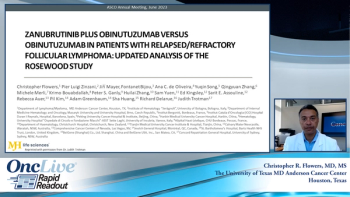
Dr. Christopher Flowers showcases a comprehensive and updated analysis of the ROSEWOOD study, evaluating the efficacy and safety of combining zanubrutinib with obinutuzumab versus obinutuzumab monotherapy.
Shared insight from key opinion leaders in diffuse large B-cell lymphoma on the role of bispecific therapy in the relapsed/refractory space.
Advertisement
Advertisement
Trending on OncLive
1
FDA Approves Bioequivalent Olaparib Across Previously Approved Cancer Indications
2
FDA Approves Zidesamtinib in Pretreated ROS1+ NSCLC
3
Sacituzumab Govitecan Yields Responses in Platinum-Resistant Ovarian Cancer
4
Dr Mardones on Giredestrant Plus Palbociclib in Estrogen Receptor+ Breast Cancer
5