


Hematologic Oncology
Latest News
Advertisement
Latest Videos





















































Advertisement
More News
Novel agents in the pipeline for the treatment of acute and chronic GVHD are discussed.
Dr. Abramson discusses the significance of the FDA approval of lisocabtagene maraleucel in refractory large B-cell lymphoma and provided insight into the efficacy and safety profiles of the CAR T-cell therapy as reported in the TRANSCEND NHL 001 trial.

Following feedback from the FDA, IMV Inc. and Merck have entered into an agreement to open a phase 2b clinical trial examining the combination of maveropepimut-S and pembrolizumab plus low-dose cyclophosphamide in patients with recurrent/refractory diffuse large B-cell lymphoma.

Sequential therapy with CD19.28ζ-directed CAR T cells followed by allogeneic hematopoietic stem cell transplant induced durable disease control in a significant population of children and young adult patients with relapsed/refractory B-cell acute lymphoblastic leukemia.

Jerald Radich, MD, discusses the impact of minimal residual disease on survival outcomes in patients with acute myeloid leukemia.
The panel of transplant experts discuss the results of the phase 2 trial of narsoplimab and the pending FDA approval of this agent for treatment of transplant-associated of thrombotic microangiopathy.
Samer Khaled, MD reviews the design, results, and practical implications of the pivotal phase 2 trial of narsoplimab, a MASP-2 targeted monoclonal antibody under investigation for the treatment of thrombotic microangiopathy associated with hematopoietic stem cell transplantation.
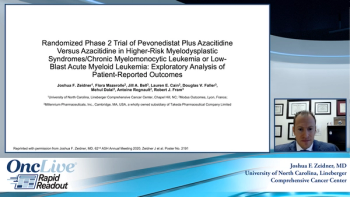
Joshua F. Zeidner, MD, presents data from the 62nd American Society of Hematology (ASH) Annual Meeting on an exploratory analysis of patient-reported outcomes from a randomized phase 2 trial of pevonedistat plus azacitidine vs azacitidine in higher-risk myelodysplastic syndrome (MDS)/chronic myelomonocytic leukemia (CMML) or low-blast acute myeloid leukemia (AML).
The curative potential of allogeneic hematopoietic stem cell transplantation for many hematologic malignancies is hindered by the frequent development of graft-vs-host disease, a potentially fatal complication resulting from a complex interaction between donor immune cells in the graft and the host’s immune system.
Experts in hematology comment on when it’s appropriate to use gilteritinib, particularly as a combination therapy, to treat patients with FLT3-mutated acute myeloid leukemia.
Jessica K. Altman, MD, and Naval G. Daver, MD, discuss what is known in terms of mechanisms of resistance to FLT3 inhibitors used to treat acute myeloid leukemia.

A key opinion leader in diffuse large B-cell lymphoma provides a historical perspective on third-line options for CAR T-cell therapy and shares insights on both clinical trial and real-world data.
Key opinion leaders in hematology-oncology discuss treatment considerations for first-line chemoimmunotherapy in follicular lymphoma and marginal zone lymphoma and when to use maintenance therapy or observation.
A review of treatment options for patients with chronic GVHD who don’t respond to steroid therapy and preliminary findings from the phase 3 REACH3 trial.
An expert in hematology oncology, Amit Patel, BSc, MBBS, PhD, reviews the unmet needs for patients with relapsed/refractory diffuse large B-cell lymphoma.
Defining steroid-refractory acute GVHD, treatment options for patients who don’t respond to steroid therapy, and a review of the REACH2 trial.
Experts in lymphoma provide insight into factors to consider when initiating treatment and emphasize the importance of both clinical judgment and treatment guidelines like the GELF criteria when monitoring patients.

The European Medicines Agency’s Committee for Medicinal Products for Human Use has granted a positive opinion for the approval of oral azacitidine as a maintenance treatment for adult patients with acute myeloid leukemia who had a complete remission or CR with incomplete blood count recovery after induction therapy with or without consolidation treatment, and who are ineligible for or choose to not undergo hematopoietic stem cell transplant

The European Medicines Agency Committee for Medicinal Products for Human Use has recommended to approve venetoclax for use in combination with hypomethylating agents for the treatment of adult patients with newly diagnosed acute myeloid leukemia who are ineligible for intensive chemotherapy.

Stephen M. Ansell, MD, PhD, discusses the role of positron emission tomography scans in patients with Hodgkin lymphoma.

The FDA has granted a priority review designation to SH-111, a sterile injectable therapy, for the treatment of pediatric patients with T-cell leukemia.
Jeffrey Laurence, MD, discusses the role of leptin in the MASP-2 pathway as well as coagulation and complement pathways.
Dr. Pagel discusses the advances that have been made with PI3K inhibitors in lymphoid malignancies, the impact of the FDA approval of umbralisib on the treatment paradigm in follicular lymphoma and marginal zone lymphoma, and ongoing research poised to expand the armamentarium.
The panel reviews therapeutic options for managing transplant-associated thrombotic microangiopathy and the challenges associated with currently existing agents.
Unmet needs and current areas that are being studied in in essential thrombocythemia.
Advertisement
Advertisement
Trending on OncLive
1
FDA Approves Zidesamtinib in Pretreated ROS1+ NSCLC
2
Ivonescimab Plus Chemotherapy Sustains OS Benefit Across Western and Asian Patients in Pretreated EGFR-Mutated NSCLC
3
How Are Treatment Intensification and Sequencing Reshaping Care in Prostate Cancer and RCC
4
NMPA Accepts Toripalimab Plus Chemotherapy Application for Expanded Stage II-III NSCLC Use
5