
Lung Cancer
Latest News
Advertisement
Latest Videos































































Advertisement
More News
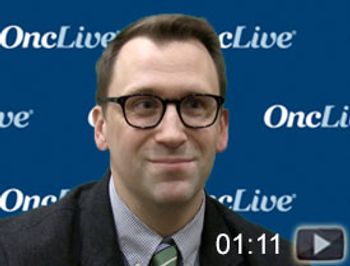
Jeffrey M. Clarke, MD, assistant professor of medicine, Duke Cancer Institute, discusses the evolution of biomarkers in directing treatment for patients with non–small cell lung cancer (NSCLC).

Chad Pecot, MD, assistant professor, School of Medicine, UNC Lineberger Comprehensive Cancer Center, discusses promising combinations for patients with non–small cell lung cancer (NSCLC).

Jarushka Naidoo, MBBCh, discusses some of the most commonly seen immune-related adverse events in patients with lung cancer and how to manage them.
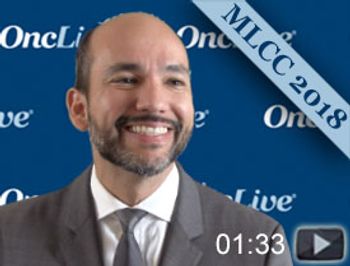
Gilberto Lopes Jr, MD, a medical director for International Programs at Sylvester Comprehensive Cancer Center, University of Miami Miller School of Medicine, discusses the important of addressing financial toxicity during the 5th Annual Miami Lung Cancer Conference.
ROS1, NTRK, MET, and HER2 are all less common molecular targets found in non–small cell lung cancer, but emerging therapeutic strategies are being explored to attack these abnormalities.
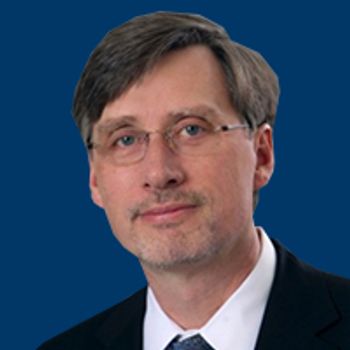
Holger L. Gieschen, MD, discusses the latest developments with radiation therapy in non-small cell lung cancer.
Heather Wakelee, MD, professor of medicine, division of oncology, Stanford University, discusses first-line therapy for patients with EGFR-mutant lung cancer.
Upfront testing for BRAF V600E mutations is necessary for patients with non–small cell lung cancer, but if results are positive, physicians are unsure when to administer BRAF/MEK combination therapy—and they must be prepared to manage the associated adverse events.
Ashley A. Weiner, MD, PhD, assistant professor, UNC Lineberger Comprehensive Cancer Center, discusses clinical trials that have investigated the use of radiotherapy in patients with non–small cell lung cancer (NSCLC).
Heather Wakelee, MD, discusses the rapidly changing landscape of frontline EGFR tyrosine kinase inhibitors in non–small cell lung cancer.
Jarushka Naidoo, MBBCh, assistant professor of oncology, Johns Hopkins University, discusses advancements in the management of immune-related adverse events (irAEs) in patients with lung cancer during the 5th Annual Miami Lung Cancer Conference.
Julie R. Brahmer, MD, associate professor of oncology, co-director of the Upper Aerodigestive Department, Bloomberg Kimmel Institute for Cancer Immunotherapy, Johns Hopkins Medicine, discusses pembrolizumab (Keytruda) in the first-line treatment of non–small cell lung cancer during the 5th Annual Miami Lung Cancer Conference.
Immune-based therapies continue to show promising signals for patients with small cell lung cancer and mesothelioma, but better predictive biomarkers are needed to determine who is most likely to benefit.
With durvalumab (Imfinzi) being hailed as a potentially practice changing therapy in locally advanced non–small cell lung cancer, ongoing studies are seeking to determine the efficacy of immunotherapy in earlier stages of disease.
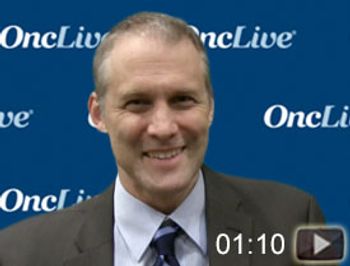
Thomas E. Stinchcombe, MD, professor of medicine, Duke Cancer Institute, discusses pivotal trials that have reshaped the standard of care in non–small cell lung cancer (NSCLC).

Jason M. Long, MD, assistant professor of surgery, Division of Cardiothoracic Surgery, University of North Carolina at Chapel Hill, discusses specific minimally invasive thoracic surgery approaches in lung cancer.

David C. Portnoy, MD, discusses emerging developments with targeted agents in lung cancer.
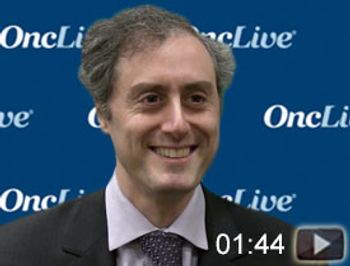
Jared Weiss, MD, associate professor, School of Medicine, UNC Chapel Hill, UNC Lineberger Comprehensive Cancer Center, discusses the clinical applications of the phase III PACIFIC trial in non–small cell lung cancer in the United States.
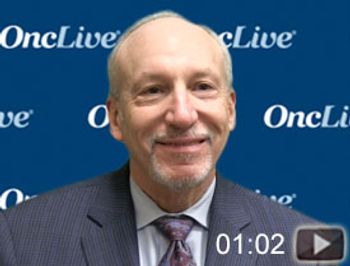
Lee S. Schwartzberg, MD, FACP, chief and professor, Division of Hematology/Oncology, the University of Tennessee Health Science Center, medical director, West Clinic, executive director, West Cancer Center, discusses several emerging biomarkers in non–small cell lung cancer (NSCLC).
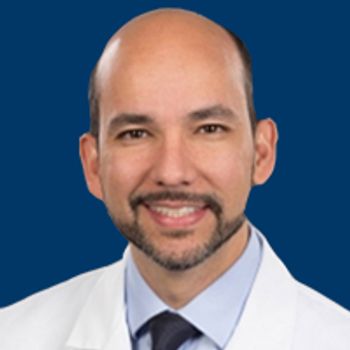
Gilberto Lopes, MD, discusses the global disparities occurring in lung cancer care and some of the steps that are being taken to better serve patients with the available and emerging therapeutic approaches.
David Spigel, MD, chief scientific officer, director, Lung Cancer Research Program, principal investigator, Sarah Cannon Research Institute, discusses the rationale behind the design of PACIFIC, a trial that investigated the use of durvalumab (Imfinzi) in patients with locally advanced, unresectable stage III lung cancer.
Julie R. Brahmer, MD, discusses first-line immunotherapy, targeted therapies for molecularly driven tumors, and recently released guidelines for the treatment of patients with lung cancer.
Sarah B. Goldberg, MD, MPH, an assistant professor of medicine at the Yale School of Medicine and Yale Cancer Center, discusses testing for and treating resistance to EGFR tyrosine kinase inhibitor (TKI) therapy in non–small cell lung cancer.
Advertisement
Advertisement
Trending on OncLive
1
FDA Approves Tucatinib Plus Trastuzumab/Pertuzumab as First-Line Maintenance in Advanced HER2+ Breast Cancer
2
FDA Grants Breakthrough Device Designation to Natera’s Multi-Cancer Early Detection Assay
3
Iberdomide Plus Daratumumab/Dexamethasone Yields Significant PFS Benefit in R/R Myeloma
4
VIR-5500 Receives FDA Fast Track Designation in mCRPC
5