




Lung Cancer
Latest News
Advertisement
Latest Videos






























































Advertisement
More News

The FDA has scheduled an ODAC advisory hearing to discuss the biologics license application for necitumumab in combination with gemcitabine and cisplatin as a first-line treatment for patients with locally advanced or metastatic squamous non-small cell lung cancer.

The FDA has assigned a priority review designation to the PD-1 inhibitor pembrolizumab as a treatment for patients with advanced NSCLC across all histologies whose disease has progressed on or after platinum-containing chemotherapy, as well as a targeted agent in EGFR- or ALK-positive patients.
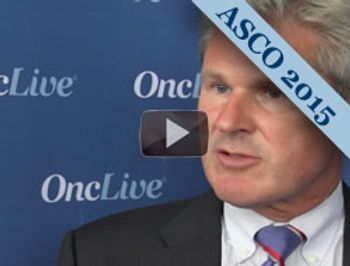
Mark A. Socinski, MD, professor of Medicine and Cardiothoracic Surgery, director, Lung Cancer Section, Division of Hematology/Oncology, clinical associate director, Lung SPORE, co-director, UPMC Lung Cancer Center of Excellence, co-leader, UPCI Lung Cancer Program, discusses a phase III study which examined nivolumab in non-small cell lung cancer (NSCLC).
Alexander Spira, MD, PhD, FACP, medical oncology, hematology, Virginia Cancer Specialists, discusses the POPLAR study for non-small cell lung cancer (NSCLC).

Novel targeted therapies against ALK, BRAF, and RET have demonstrated promising outcomes in molecularly-defined patients with non-small cell lung cancer.

Treatment with atezolizumab doubled overall survival compared with docetaxel in previously treated patients with PD-L1-positive squamous and non-squamous non-small cell lung cancer.

An immunotherapy combination demonstrated "high levels of clinical activity" in previously treated non-small cell lung cancer across a range of doses.

Nivolumab has now been shown to have an overall survival benefit versus docetaxel in both nonsquamous and squamous non–small cell lung cancer.
New England Journal of Medicine Publishes Study Co-Led by Hollings Cancer Center Researcher Showing Potential of New Genomic Test In Lung Screening.
The definition of liquid biopsy has expanded to include the collection of cell-free DNA (cfDNA), along with various species of cell-free RNA and exosomes, all of which are capable of providing information on the disease status of patients with cancer.
Eric Haura, MD, senior member, Moffitt Cancer Center, discusses new approaches to identifying bypass signaling mechanisms and biomarkers in lung cancer.
Jeff Michalski, MD, professor, vice chair of Radiation Oncology, Washington University School of Medicine, Siteman Cancer Center explains the importance of minimizing the long-term consequences of radiation.

The recent approval of nivolumab in the non–small cell lung cancer setting marks a unique shift in the treatment landscape of this malignancy, one that harnesses the patient's own immune system to target the tumors. However, there are challenges in using these agents.
D. Ross Camidge, MD, director, Thoracic Oncology Clinical Program, program director, Thoracic Oncology Clinical and Translational Research Fellowship, University of Colorado Denver, discusses MET and if it is still a relevant target in lung cancer.
Alice Tsang Shaw, MD, PhD, thoracic oncologist, Massachusetts General Hospital Cancer Center, discusses overcoming resistance to targeted therapy in lung cancer.
Roy S. Herbst, MD, PhD, professor, Yale Cancer Center, chief of medical oncology, Smilow Cancer Hospital at Yale-New Haven, discuses the impact of the FDA's approval of nivolumab's for the treatment of squamous non-small cell lung cancer.
James Welsh, MD, associate professor of Radiation Oncology, The University of Texas MD Anderson Cancer Center, discusses a study that examined the regulation of PD-L1 and how it may open up more treatment options for patients with non-small cell lung cancer.

The FDA has granted a breakthrough therapy designation to crizotinib as a potential treatment for patients with ROS1-positive non–small cell lung cancer.
Evan W. Alley, MD, PhD, discusses the results from the phase Ib KEYNOTE-028 trial on a cohort of patients with malignant pleural mesothelioma.
Pembrolizumab had an overall response rate (ORR) of 45.2% among a cohort of patients with PD-L1-positive non–small cell lung cancer (NSCLC) and an ORR of nearly 20% in the full population in the phase I KEYNOTE-001 trial.
John Heymach, MD, PhD, chair of Thoracic/Head and Neck Medical Oncology, MD Anderson Cancer Center, discusses a study on KRAS mutations in lung cancer, which led to the identification of three more KRAS subsets.

Treatment with AZD9291 at 80 mg per day elicited a response in 66% of patients with EGFR T790M-positive non–small cell lung cancer.
Advertisement
Advertisement
Trending on OncLive
1
FDA Approves Tucatinib Plus Trastuzumab/Pertuzumab as First-Line Maintenance in Advanced HER2+ Breast Cancer
2
FDA Approves Atezolizumab Plus Chemo for Stage III dMMR Colon Cancer
3
Iberdomide Plus Daratumumab/Dexamethasone Yields Significant PFS Benefit in R/R Myeloma
4
VIR-5500 Receives FDA Fast Track Designation in mCRPC
5