





Prostate Cancer
Latest News
Advertisement
Latest Videos





























































Advertisement
More News

Comprehensive insight on selecting androgen receptor–targeted therapy for patients with nonmetastatic castration-resistant prostate cancer.

Broad discussion on the role of biomarker testing in prostate cancer, particularly how it has helped to inform therapy selection and patient management.

Focusing on nonmetastatic castration-resistant prostate cancer, panelists review the current treatment armamentarium and shared decisionmaking.

Shared insight on the respective roles of PSMA-PET imaging and PSA doubling time in the current prostate cancer treatment paradigm.

Broad discussion on the evolution of care in prostate cancer from both the therapeutic and imaging standpoints.

The FDA has approved lutetium Lu 177 vipivotide tetraxetan for the treatment of adult patients with prostate-specific membrane antigen–positive metastatic castration-resistant prostate cancer who have previously received other anticancer therapies.

Axel S. Merseburger, MD, discusses the safety and efficacy results from the phase 3b PRESIDE trial examining continued enzalutamide treatment with docetaxel in select patients with metastatic castration-resistant prostate cancer who had progressed on enzalutamide monotherapy and the significance of the data for the treatment paradigm.

The history of radiation therapy for men with prostate cancer extends back more than a century. From those early crude methods, the field has advanced to delivery potentially curative therapies that can be administered in as little as 2 weeks.

Scott T. Tagawa, MD, MS, FACP, discusses the use of radium-223 in prostate cancer.

Robert Dreicer, MD, discusses the impact of the phase 3 CHAARTED trial in metastatic castration-sensitive prostate cancer.

The applications for germline and somatic genetic testing in prostate cancer have skyrocketed, carving out an important role in screening, diagnosis, and treatment.

Immune checkpoint inhibitors represent only one area of effective therapy for patients with advanced prostate cancer, but they are not “be all, end all” of immunotherapy options.

The phase 3 KEYLYNK-001 trial evaluating the combination of pembrolizumab and olaparib in patients with metastatic castration-resistant prostate cancer who progressed following chemotherapy and either abiraterone acetate or enzalutamide will be discontinued for futility.

Overwhelming evidence has pointed to the use of androgen deprivation therapy in combination with 1 or 2 other agents as the standard of care for patients with metastatic castration-sensitive prostate cancer.
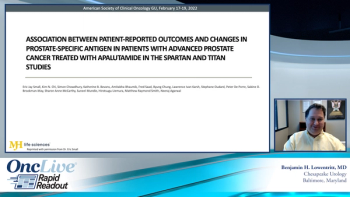
Expert urologist Benjamin Lowentritt, MD, reviews advanced prostate cancer data from the SPARTAN and TITAN studies comparing patient-reported outcomes to changes in PSA.

A supplemental new drug application and a Variation Type II application have been submitted to the FDA and the European Medicines Agency, respectively, seeking the approval of darolutamide plus docetaxel in patients with metastatic hormone-sensitive prostate cancer.

Eleni Efstathiou, MD, PhD, discussed the combination of niraparib and abiraterone acetate and prednisone in patients with metastatic castration-resistant prostate cancer and homologous recombination repair gene alterations, results from the MAGNITUDE trial, and next steps for research.
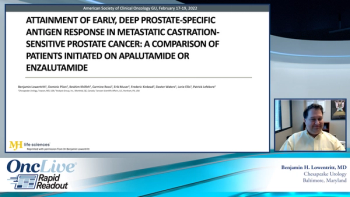
Expert urologist Benjamin Lowentritt, MD, reviews trial data comparing PsA response achieved with apalutamide versus enzalutamide in patients with castration-sensitive prostate cancer.
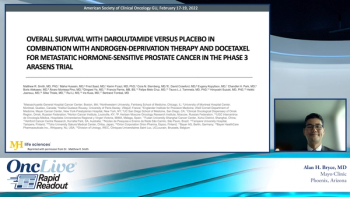
Alan H. Bryce, MD, discusses the ARASENS trial, as presented at The American Society of Clinical Oncology Genitourinary Cancers Symposium in February 2022.

Nima Sharifi, MD, PLCO, discusses the results of the prostate cancer cohort in the PLCO trial and how PAGln could be linked to patients eventually diagnosed with lethal prostate cancer.

The novel androgen receptor PROTAC degrader, bavdegalutamide, was found to be clinically active and tolerable with manageable adverse effects in patients with metastatic castration-resistant prostate cancer.

The PARP inhibitor niraparib elicited a meaningful overall response rate in patients with heavily pretreated metastatic castration-resistant prostate cancer and DNA repair gene defects, particularly those with BRCA alterations.

Benjamin H. Lowentritt, MD, FACS, discusses the real-world analysis of apalutamide and enzalutamide in metastatic castration-sensitive prostate cancer.

Darolutamide produced a well-tolerated safety profile in patients with metastatic castration-resistant prostate cancer, according to pooled data from long-term analyses of 3 trials.

The utilization of 18F-rhPSMA-7.3 imaging displayed a clinically meaningful correct detection rate.
Advertisement
Advertisement
Trending on OncLive
1
Savolitinib Plus Osimertinib NDA Submitted to FDA for MET-Driven, EGFR-Mutated NSCLC After EGFR TKI
2
Calculating the Real Cost of False Positive Findings in Cancer Screening
3
FDA Grants Priority Review to Elinzanetant for Endocrine Therapy–Associated Vasomotor Symptoms in HR+ Breast Cancer
4
Cilta-Cel Shows Long-Term Treatment-Free Remissions in Lenalidomide-Refractory Myeloma
5