




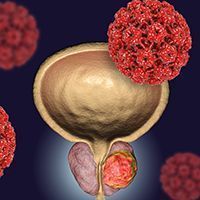

Prostate Cancer
Latest News
Advertisement
Latest Videos






























































Advertisement
More News

Carrie Horton, MS, CGC, discusses how the findings from a retrospective analysis of germline testing rates among racially diverse groups of men with prostate cancer will guide future research and influence the steps community oncologists can take to increase testing rates.

Expert oncologists define appropriate imaging strategies, conventional and novel, in patients with metastatic castration-resistant prostate cancer.
Shared insight on a clinical scenario of metastatic castration-resistant prostate cancer managed with androgen-deprivation therapy and docetaxel.
The addition of SHR3680 to androgen deprivation therapy significantly improved radiographic progression-free survival and overall survival compared with bicalutamide plus ADT in patients with high-volume, metastatic hormone-sensitive prostate cancer, according to data from the phase 3 CHART trial.

Before closing out their second module, panelists highlight remaining unmet needs in the setting of nonmetastatic castration-resistant prostate cancer.
A comprehensive discussion on factors that inform treatment selection of available AR-targeted therapy for patients with nonmetastatic CRPC.

David R. Wise, MD, PhD, discusses unmet needs in the standard of care in prostate cancer.
Expert perspectives on monitoring patients with nonmetastatic castration-resistant prostate cancer and deciding when to initiate systemic therapy.
Shared insight on a clinical scenario of a patient with nonmetastatic castration-resistant prostate cancer who was treated with prostatectomy and adjuvant therapy.

The combination of ModraDoc006—a novel, oral tablet formulation of docetaxel—and ritonavir produced comparable response rates and radiographic progression-free survival to that achieved with intravenous docetaxel in patients with metastatic castration-resistant prostate cancer.
A brief review of predictive and prognostic biomarker needs in hepatocellular carcinoma, followed by discussion on screening and detection.

Shahneen Sandhu, MD, discusses findings with niraparib in metastatic prostate cancer from the phase 3 MAGNITUDE trial.

The CD46-targeted antibody-drug conjugate FOR46 demonstrated encouraging evidence of antitumor activity in patients with metastatic castration-resistant prostate cancer with a safety profile that proved to be similar to other monomethyl auristatin E–based ADCs, according to data from a phase 1a/1b trial.
Closing out their discussion on a clinical scenario of metastatic HSPC, expert panelists consider optimal patient monitoring strategies and novel imaging.
Expert panelists briefly share their excitement for trial data readouts in metastatic hormone-sensitive prostate cancer from the annual ASCO 2022 Annual meeting.

Mark C. Markowski, MD, PhD, discusses the evaluation of sabizabulin in a phase 1b/2 trial in metastatic castration-resistant prostate cancer.
Continuing their discussion on frontline AR-targeted therapy in mHSPC, experts define how accessibility and patient eligibility impact treatment selection.
Expert perspectives on frontline AR-targeted therapy in metastatic hormone-sensitive prostate cancer, with deference to recent clinical trial data on triplet therapy.
A brief review of the respective roles of multidisciplinary care and genetic testing in patients diagnosed with metastatic hormone-sensitive prostate cancer.
Centering discussion on a clinical scenario of metastatic hormone-sensitive prostate cancer, expert panelists consider how they might approach frontline therapy in this setting.

The FDA has placed a partial clinical hold on the phase 1/2 NUV-422-02 trial evaluating the selective small molecule CDK2/4/6 inhibitor NUV-422 in patients with solid tumors such as high-grade glioma, hormone receptor–positive advanced breast cancer, and metastatic castration-resistant prostate cancer.

The prostate specific membrane antigen-targeting therapy, lutetium Lu 177 vipivotide tetraxetan, was approved by the FDA for patients with metastatic castration-resistant prostate cancer in March.

Shahneen Sandhu, MD, discusses the design of the phase 3 MAGNITUDE trial in metastatic prostate cancer.

Dr. Wise highlights how intensified treatment with doublet or triplet therapy can lead to better long-term outcomes in prostate cancer, potential treatment sequencing options, and the importance of communication between patients and physicians.

Press Release
Research underscores the need to subdivide Hispanics and other racial and ethnic groups to fully understand actual disparities.
Advertisement
Advertisement
Trending on OncLive
1
Savolitinib Plus Osimertinib NDA Submitted to FDA for MET-Driven, EGFR-Mutated NSCLC After EGFR TKI
2
Calculating the Real Cost of False Positive Findings in Cancer Screening
3
FDA Grants Priority Review to Elinzanetant for Endocrine Therapy–Associated Vasomotor Symptoms in HR+ Breast Cancer
4
Cilta-Cel Shows Long-Term Treatment-Free Remissions in Lenalidomide-Refractory Myeloma
5