




Prostate Cancer
Latest News

Advertisement
Latest Videos

































































Advertisement
More News

Eleni Efstathiou, MD, PhD, expands on the updated interim data from the MAGNITUDE trial and sheds light on the utility of PARP inhibitor combinatorial strategies in patients with mCRPC and HRR gene alterations.

Chandler Park, MD, MSc, FACP, discusses how the emerging field of radiotheranostics and increasing utilization of biomarker testing will improve the treatment of patients with metastatic hormone-sensitive prostate cancer.

Daniel P. Petrylak, MD, discusses efficacy and safety data from the phase 3 KEYNOTE-921 trial of pembrolizumab and docetaxel in metastatic castrate-resistant prostate cancer.

Medical oncologist Tian Zhang, MD, outlines the remaining unmet needs and knowledge gaps surrounding imaging of prostate cancer.
Five expert panelists in prostate cancer consider how recent advances in imaging, particularly PSMA-PET, have impacted the field, and highlight guidelines that may aid clinicians in selecting amongst the available imaging modalities.

Neil H. Bander, MD, discusses preliminary results from a phase 1/2 study of pembrolizumab in combination with an androgen-receptor signaling inhibitor and alpha-PSMA-targeted radionuclide therapy in mCRPC.

Phillip J. Koo, MD, discusses ongoing areas of technological and therapeutic advancements within the prostate cancer landscape.

Neal Shore, MD, FACS, US discusses the continued evaluation of darolutamide in patients with non-metastatic castration-resistant prostate cancer.

A new drug application has been submitted to the FDA seeking the approval of niraparib in combination with abiraterone acetate, in the form of a dual-action tablet, and prednisone, for the first-line treatment of patients with metastatic castration-resistant prostate cancer harboring BRCA mutations.

Paul L. Nguyen, MD, discusses primary findings from the phase 2 FORMULA-509 trial in prostate cancer.

The addition of pembrolizumab to standard therapies failed to improve survival outcomes in patients with metastatic castration-resistant prostate cancer in the KEYNOTE-641 trial and patients with EGFR-mutated non–small cell lung cancer in the KEYNOTE-789 trial.

Michael S. Leapman, MD, MHS, discusses key factors that influence patient experiences with biopsy-based genomic testing during active surveillance for prostate cancer, and how to best address them in clinical practice.

Matthew Rettig, MD, discusses emerging treatment options for patients with stage IV metastatic prostate cancer and highlights key data from clinical trials in the space.

Andrei H. Iagaru, MD, discusses molecular imaging and the use of prostate-specific membrane antigen PET scans in prostate cancer and highlights other key presentations from the 2023 Prost8 Cancer Conference.

Tian Zhang, MD, MHS, discusses findings with single-agent PARP inhibitors within homologous recombination repair–deficient metastatic castration-resistant prostate cancer and describes how these advances pave the way for combining PARP inhibitors with hormonal therapies.

Phillip J. Koo, MD, highlights insights garnered from prostate cancer experts on topics such as radioligands and modern radiopharmaceuticals, which, along with artificial intelligence, have the potential to revolutionize the field.

Tian Zhang, MD, MHS, discusses the use of PARP inhibitor–based combinations in patients with metastatic castration-resistant prostate cancer.

Michael S. Cookson, MD, MMHC, explains how discrepancies in defining biochemical recurrence are sparking a conversation about creating more consistent definitions that could allow for more widely applicable standards of care in prostate cancer .

Brian Ramnaraign, MD, discusses the investigation of atezolizumab with tivozanib in castrate-resistant prostate cancer.

The PARP inhibitor rucaparib improved median radiographic progression-free survival by 4.8 months compared with physician’s choice of therapy for men with BRCA-altered metastatic castration-resistant prostate cancer.
Radium-223 demonstrated efficacy with low rates of treatment-related adverse effects and treatment discontinuation in patients with metastatic castration-resistant prostate cancer that metastasized to the bones.

Darolutamide maintained an acceptable long-term safety profile in patients with nonmetastatic castration-resistant prostate cancer, with approximately 30% of patients remaining on the treatment for at least 4 years

The final prespecified overall survival analysis of PROpel showed that the combination of abiraterone acetate plus olaparib sustained a trend toward improved efficacy vs standard-of-care abiraterone in patients with metastatic castration-resistant prostate cancer.

Talazoparib plus enzalutamide generated a statistically significant and clinically meaningful improvement in radiographic progression-free survival vs placebo plus enzalutamide as first-line treatment for patients with metastatic castration-resistant prostate cancer, irrespective of homologous recombination repair status.

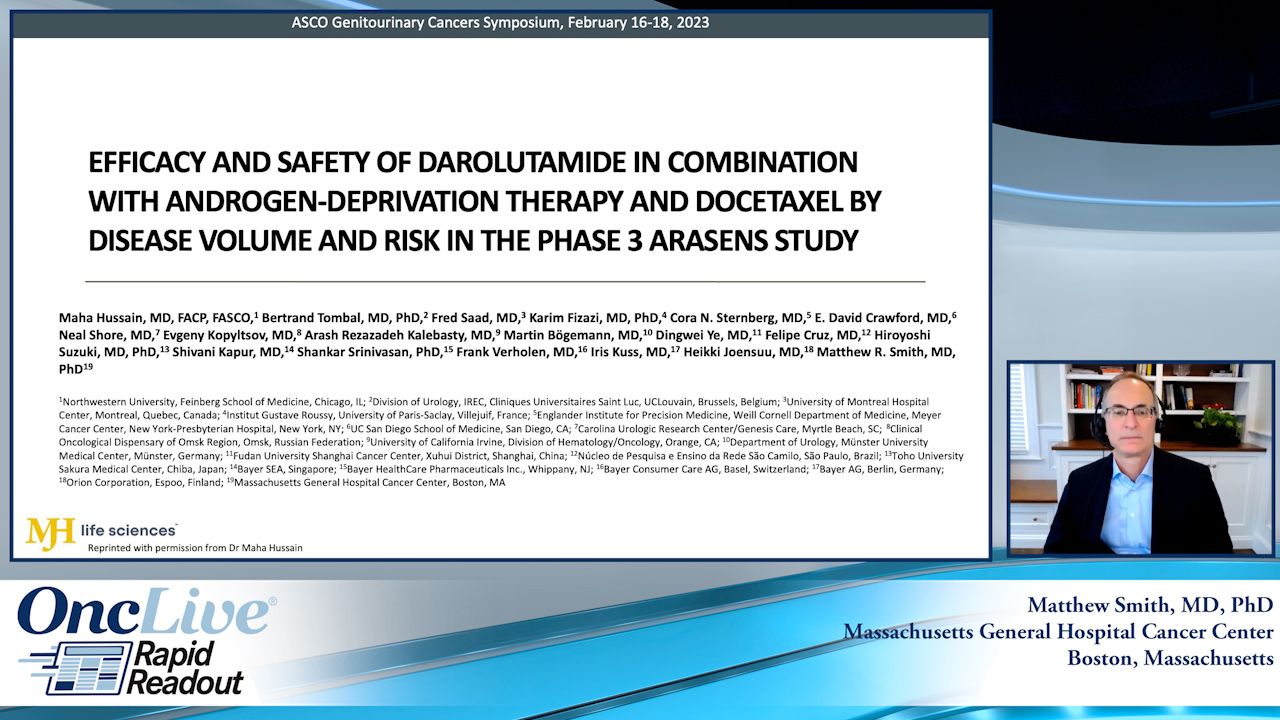
The addition of darolutamide to androgen deprivation therapy and docetaxel prolonged overall survival in patients with metastatic hormone-sensitive prostate cancer, irrespective of disease volume or disease risk.
Advertisement
Advertisement
Trending on OncLive
1
Savolitinib Plus Osimertinib NDA Submitted to FDA for MET-Driven, EGFR-Mutated NSCLC After EGFR TKI
2
FDA Grants Priority Review to Elinzanetant for Endocrine Therapy–Associated Vasomotor Symptoms in HR+ Breast Cancer
3
Calculating the Real Cost of False Positive Findings in Cancer Screening
4
Cilta-Cel Shows Long-Term Treatment-Free Remissions in Lenalidomide-Refractory Myeloma
5