
Evolving Paradigms in the SCLC Treatment Landscape
Expert oncologists review updates in the treatment of small cell lung cancer that were presented at key conferences in 2022 and discuss data in the context the current treatment landscape.

Expert oncologists review updates in the treatment of small cell lung cancer that were presented at key conferences in 2022 and discuss data in the context the current treatment landscape.
Experts from the John Theurer Cancer Center reflect on the real-world management of patients with myelofibrosis at their institution.
Expert oncologists reflect on the state of molecular testing in non–small cell lung cancer and how it informs the management of patients with uncommon EGFR mutations.
In this series, we will discuss recent advances in the treatment of HR+ breast cancer. We will review two patient cases and discuss our treatment approach to illustrate how we are incorporating recent trial data into our clinical practice.
Key opinion leaders in the field of follicular lymphoma management center discussion on patient cases to review the evolving treatment paradigm of relapsed/refractory disease.
Thought leaders review the impact of myelosuppression in patients undergoing chemotherapy for SCLC as well as the role of supportive care in treatment.
Expert oncologists Matteo Lambertini, MD, PhD, and Virginia Kaklamani, MD, DSc, review recent clinical data and discuss the current state of fertility preservation in premenopausal patients with breast cancer.
Experts discuss the evolving treatment landscape in advanced or recurrent endometrial cancer. They review the latest updates in clinical research, highlighting non-chemotherapy approaches and their impact on treatment selection.
Expert oncologists review the current treatment landscape of biliary tract cancers and consider how they would apply data from clinical trials to their own practice.
Two expert oncologists review the standard-of-care and unmet needs in the treatment of lower-risk Myelodysplastic Syndromes [MDS]. They discuss emerging data on novel therapies and consider their impact on the treatment landscape for patients with lower-risk MDS.
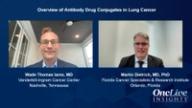
Martin Dietrich, MD, PhD, and Wade Thomas Iams, MD, discuss the role of antibody-drug conjugates (ADCs) in non-small cell lung cancer (NSCLC) and review the various biomarkers for targeted therapy.
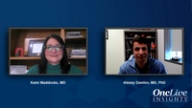
Kami Maddocks, MD, and Alexey Danilov, MD, PhD, discuss the use of Bruton tyrosine kinase (BTK) inhibitors for the treatment of relapsed/refractory mantle cell lymphoma.
Robert L Coleman, MD, FACOG, FACS, and Bradley J Monk, MD, FACOG, FACS, provide insights on treating patients with advanced ovarian cancer and the evolving treatment landscape.
Expert panelists from the UT Southwestern Medical Center review real world patient cases of renal cell carcinoma to illustrate recent clinical data and exhibit how it has been applied at their institution.
Experts in oncology center discussion on patient scenarios and share insight on the treatment landscape for patients with HER2+ metastatic breast cancer.
Andrew Armstrong, MD, and Matthew Manning, MD, review the profiles of three patients with metastatic castration-resistant prostate cancer (mCRPC) and discuss how they would have approached their treatment, given recent advances in radiotherapy and other options in the field.
A panel of skin cancer experts have a comprehensive discussion on advanced cutaneous squamous cell carcinoma and melanoma, and offer insights on the evolving treatment landscape.
Nelson J. Chao, MD, MBA, discusses the treatment of acute and chronic graft-versus-host disease through the lens of two patient profiles.
Sophie Paczesny, MD, PhD, and Yi-Bin Chen, MD, discuss recent updates in the prophylactic and treatment strategies for acute and chronic graft versus host disease (GVHD).
Expert panelists review current and emerging treatment approaches in myeloproliferative neoplasms, with focused discussion on monitoring, sequencing, and combination therapy strategies using JAK inhibitors in myelofibrosis.
Pedro Barata, MD, MSc, and Benjamin Garmezy, MD, discuss the evolving treatment landscape for advanced renal cell carcinoma.
Expert perspectives on the evolving treatment paradigm of HER2-expressing breast cancer and how learnings from recent clinical trials are impacting real-world practices.
Komal Jhaveri, MD, FACP, and Paolo Tarantino, MD, discuss updates in the treatment of metastatic breast cancer (mBC) from SABCS 2022 and other recent meetings, and how to best incorporate recent data into clinical practice.
Expert oncologists discuss the hormone receptor–positive (HR+) breast cancer treatment landscape and their suggested approaches to treating patients in both the early and metastatic disease settings.
An expert panel discusses recent advances in the treatment of Stage I-III NSCLC and their impact on clinical practice.
Expert oncologist Martin Dietrich, MD, PhD, shares his excitement for an upcoming program wherein he and Meghan Mooradian, MD, highlight the evolving role of immunotherapy and biomarker-driven therapy in non-small cell lung cancer.
Expert perspectives on the prevention and treatment of tumor lysis syndrome (TLS) in patients on therapy for cancer.
Shaji Kumar, MD, and Krina Patel, MD, discuss key updates in the diagnosis and treatment of multiple myeloma. Jenny Ahlstrom, a patient, and Bonnie Falbo, a caregiver and patient advocate, share their personal journeys with multiple myeloma.
Expert oncologists work together to review the current treatment paradigm for metastatic castration-resistant prostate cancer in the context of clinical trials and real-world experience.
Expert perspectives on the advent of KRAS G12C mutations in non–small cell lung cancer, with a focus on the development of targeted therapies in this setting.