

The CD3 and CD20 bispecific antibody mosunetuzumab demonstrated promising complete remission rates with tolerable toxicity for patients with relapsed/refractory B-cell indolent and aggressive non-Hodgkin lymphoma.

Your AI-Trained Oncology Knowledge Connection!
The CD3 and CD20 bispecific antibody mosunetuzumab demonstrated promising complete remission rates with tolerable toxicity for patients with relapsed/refractory B-cell indolent and aggressive non-Hodgkin lymphoma.
The triplet regimen of pembrolizumab (Keytruda) plus umbralisib and ublituximab reached a 90% response rate in patients with relapsed/refractory chronic lymphocytic leukemia.

Initial findings from the Beat AML study showed that rapid genetic testing in patients with AML was feasible and helpful, and that a precision medicine approach is possible for these patients, who must be treated urgently given the disease’s rapid progression.
Lisocabtagene maraleucel appeared tolerable and induced an 81.3% best overall response rate and 43.8% complete response rate in heavily pretreated, high-risk patients with chronic lymphocytic leukemia who previously received ibrutinib.

Single-agent ibrutinib continued to demonstrate strong results after 7 years of follow-up in both the frontline and heavily pretreated, relapsed/refractory setting for patients with CLL and SLL.
Two-year maintenance therapy with ixazomib led to a 39% improvement in progression-free survival compared with placebo in patients with newly diagnosed multiple myeloma who achieved a partial response to induction treatment with a proteasome inhibitor and/or an immunomodulatory agent following autologous stem cell transplant.

The combination of ibrutinib and venetoclax is well tolerated and eradicates minimal residual disease in the marrow after 12 months in 39% of patients with relapsed/refractory chronic lymphocytic leukemia.

The investigational agent zanubrutinib, a next-generation Bruton’s tyrosine kinase inhibitor, is highly active in patients with relapsed/refractory mantle cell lymphoma.
Checkpoint inhibition showed promise for augmenting or extending response to chimeric antigen receptor T-cell therapy in some patients with relapsed B-cell acute lymphoblastic leukemia.

Daratumumab added to bortezomib, lenalidomide, and dexamethasone induced at least a very good partial response in all patients and a stringent complete response or CR in 63% of patients at the end of consolidation therapy in the run-in phase of an open-label study of transplant-eligible patients with newly diagnosed multiple myeloma.
Receiving a stem cell transplant for the first time following CD19 CAR T-cell therapy induced a reduction in the risk for acute lymphoblastic leukemia (ALL) recurrence, according to a retrospective analysis of the phase I/II PLAT-02 study.
Farhad Ravandi, MBBS, professor of medicine, department of leukemia, The University of Texas MD Anderson Cancer Center, discusses a phase I first-in-human study of AMG 330, an anti-CD33 bispecific T-Cell engager (BiTE) antibody construct, in patients with relapsed/refractory acute myeloid leukemia (AML) during the 2018 ASH Annual Meeting.

Tycel J. Phillips, MD, assistant professor, University of Michigan Cancer Center, discusses safety and efficacy findings for acalabrutinib plus bendamustine and rituximab in patients with treatment-naive or relapsed/refractory mantle cell lymphoma (MCL) during the 2018 ASH Annual Meeting.

Concurrent treatment with ibrutinib and the CD19-targeted chimeric antigen receptor T-cell therapy JCAR014 was well tolerated and led to an overall response rate of 83% in patients with relapsed or refractory chronic lymphocytic leukemia.
Treatment with luspatercept significantly reduced the need for frequent red blood cell transfusions in nearly 53% of patients with anemia associated with low- to intermediate-risk myelodysplastic syndrome.
Treating younger patients with low-risk diffuse large B-cell lymphoma with 2 fewer frontline cycles of R-CHOP greatly reduced toxicity without sacrificing efficacy, according to findings from the FLYER trial.
Tisagenlecleucel continued to demonstrate durable objective response rates with a median of 19 months of follow-up for patients with relapsed or refractory diffuse large B-cell lymphoma, according to updated findings from the phase II JULIET study.
Treatment with the CD19-targeted CAR T-cell therapy tisagenlecleucel demonstrated sustained rates of relapse-free survival and overall survival at 24 and 18 months for pediatric and young adult patients with relapsed or refractory acute lymphoblastic leukemia.
Ibrutinib as monotherapy and combined with rituximab significantly improved progression-free survival compared with bendamustine plus rituximab as frontline therapy for older patients with chronic lymphocytic leukemia.

Five leaders in the fight against gastrointestinal cancers from academia, the community, and clinic were honored at the 2018 Luminary Awards.

Ahead of the 2018 ASH Annual Meeting, multiple myeloma experts Sundar Jagannath, MBBS, selected the most pivotal abstracts in their field.
There is limited data on when and whether oncologists should change systemic therapy for patients with non–small cell lung cancer, but some studies provide useful guidance.
In light of recent advancements, the current paradigm for choosing first-line therapy for patients with metastatic non–small cell lung cancer who do not harbor an actionable driver oncogene depends upon PD-L1 expression level and histology.
Roy S. Herbst, MD, PhD, discusses where future research is headed for immunotherapy in lung cancer.

Nasser Hanna, MD, Tom and Julie Wood Family Foundation Professor of Lung Cancer Clinical Research, at Indiana University Melvin and Bren Simon Cancer Center, discusses the efficacy of consolidation immunotherapy in patients with stage III non–small cell lung cancer.
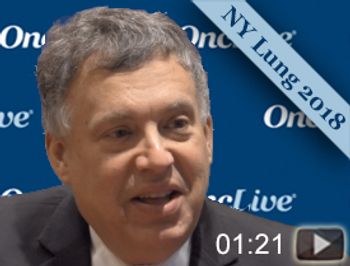
Roy S. Herbst, MD, PhD, chief of medical oncology, professor of medicine, Yale Cancer Center, Smilow Cancer Hospital, discusses mechanisms of immune resistance for patients with lung cancer.
Although driver mutations have been identified for significant NSCLC subsets, patients with metastatic disease benefit from broad panel next-generation sequencing testing because of the growing clinical relevance of less common alterations and gene signatures.
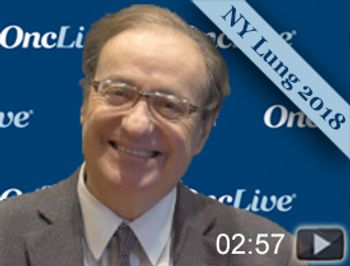
Roman Perez-Soler, MD, chairman of the Department of Oncology and chief of the Division of Medical Oncology at Montefiore Medical Center, discusses the efficiency of next-generation sequencing in lung cancer.
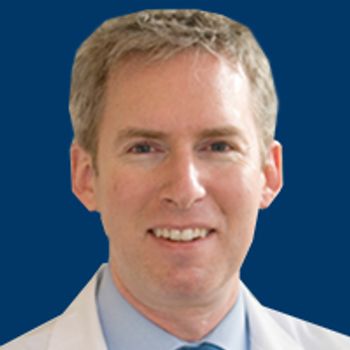
D. Ross Camidge, MD, PhD, discusses the crowded landscape of oncogene-driven non­–small cell lung cancer.
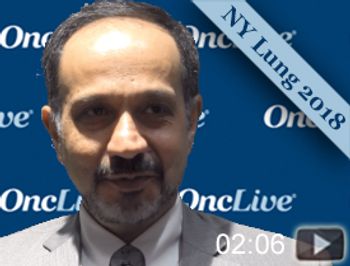
Hossein Borghaei, DO, chief, Division of Thoracic Medical Oncology, director, Lung Cancer Risk Assessment, associate professor, Department of Hematology/Oncology, Fox Chase Cancer Center, discusses the evolving second line of treatment in small cell lung cancer.