
Final 5-year efficacy and safety data from the phase III COMFORT-I trial confirm previous findings that ruxolitinib confers a significant benefit in patients with intermediate-2 and high-risk myelofibrosis.

Your AI-Trained Oncology Knowledge Connection!
Final 5-year efficacy and safety data from the phase III COMFORT-I trial confirm previous findings that ruxolitinib confers a significant benefit in patients with intermediate-2 and high-risk myelofibrosis.
Patients with acute myeloid leukemia who are cured after allogeneic hematopoietic stem cell transplantation produce antibodies that destroy leukemia cells.

Combining the CD38-targeted antibody daratumumab with lenalidomide and dexamethasone reduced the risk of disease progression by 63% versus lenalidomide and dexamethasone alone in patients with relapsed/refractory multiple myeloma, according to findings from the phase III POLLUX (MMY3003) trial.

A host of novel agents that target distinct molecular targets are pushing complete remission rates beyond historical boundaries for patients with acute myeloid leukemia.
Frontline treatment with the CD33-directed antibody-drug conjugate vadastuximab talirine plus a hypomethylating agent induced deep and durable remissions for older patients with acute myeloid leukemia.

Christian Gisselbrecht, MD, a Professor of Haematology in the Haemato-Oncology Department of Hôpital Saint-Louis, at Diderot University, Paris, discusses stratifying refractory disease in aggressive diffuse large b-cell lymphoma (DLBCL).

Wojciech Jurczak, MD Head of Lymphoma, Department of Hematology, Jagiellonian University, Kopernika, Poland, discuses a subgroup analyses of diffuse large b-cell lymphoma (DLBCL) and indolent lymphoma cohorts from a phase IIa study of single-agent MOR208 in patients with relapsed or refractory non-Hodgkin's lymphoma (NHL).

Tyrosine kinase inhibitors can safely be halted in select patients with chronic phase chronic myeloid leukemia followed a maintained deep molecular remission.

The median overall survival with the anti-CD19 immunotherapy blinatumomab was 7.7 months versus 4 months with standard chemotherapy in patients with Philadelphia chromosome–negative relapsed or refractory B-cell precursor acute lymphoblastic leukemia, according to results from the phase III TOWER study.

Ibrutinib continued to demonstrate impressive antitumor activity in a pooled analysis of 243 patients with deletion 17p chronic lymphocytic leukemia.


Cabozantinib reduced the risk of death by 34% compared with everolimus in patients with previously treated advanced renal cell carcinoma, according to updated data from the phase III METEOR trial.
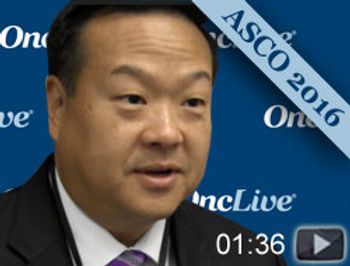
Edward S. Kim, MD, chair, Solid Tumor Oncology and Investigational Therapeutics, Donald S. Kim Distinguished Chair for Cancer Research, Levine Cancer Institute, Carolinas HealthCare System, discusses the significance of the TAPUR clinical trial, which is being conducted by ASCO.

Three-fourths of patients with advanced lymphoma achieved durable objective responses to treatment with chimeric antigen receptor T-cell therapy targeting CD19 even after a low-dose chemotherapy conditioning regimen.
An immunotherapy/antiangiogenesis combination proved to be safe and tolerable for patients with recurrent glioblastoma, preliminary data from an ongoing trial showed.
The PD-L1 inhibitor avelumab demonstrated durable responses and promising early survival data for patients with pretreated metastatic Merkel cell carcinoma.
Pembrolizumab (Keytruda) is associated with an exceptional overall response rate in patients with relapsed/refractory Hodgkin lymphoma.
Robert Ferris, MD, PhD, vice chair for Clinical Operations, associate director for Translational Research, and coleader of the Cancer Immunology Program at the University of Pittsburgh Cancer Institute, discusses the CheckMate-141 trial, which found that treatment with single-agent nivolumab (Opdivo) reduced the risk of death by 30% and doubled 1-year overall survival (OS) rates compared with investigator's choice of therapy for patients with recurrent or metastatic head and neck squamous cell carcinoma (SCCHN).
Maura N. Dickler, MD, Memorial Sloan Kettering Cancer Center, discusses the results of the single-arm MONARCH 1 trial, which examined the efficacy of the CDK4/6 inhibitor abemaciclib in heavily pretreated patients with refractory, hormone-receptor (HR)–positive, HER2-negative advanced breast cancer.
Adding the CDK 4/6 inhibitor palbociclib (Ibrance) to letrozole reduced the risk of disease progression by 42% compared with letrozole alone in patients with ER-positive, HER2-negative advanced or metastatic breast cancer.

The combination of dabrafenib and trametinib continued to demonstrate impressive overall survival and progression-free survival findings for patients with BRAF-mutant metastatic melanoma in 3-year follow-up data from the phase III COMBI-d study.
Reinhard Dummer, MD, professor, Department of Dermatology, University of Zurich Hospital, discusses the results of the phase III NEMO trial, which compared the efficacy of binimetinib with dacarbazine in patients with NRAS-mutant metastatic melanoma.

Alectinib improved progression-free survival by 66% compared with the current standard crizotinib as initial inhibitor therapy in patients with advanced or recurrent ALK-positive non–small cell lung cancer.

At a minimum follow-up of 18 months, the combination of nivolumab and ipilimumab reduced the risk of disease progression by 58% compared with ipilimumab alone, and single-agent nivolumab lowered the risk of progression by 45% versus ipilimumab monotherapy in patients with advanced melanoma.
David A. Reardon, MD, discusses results of a cohort from the open-label CheckMate-143 trial, which explored the combination of nivolumab (Opdivo) and ipilimumab (Yervoy) in patients with recurrent glioblastoma multiforme (GBM).

The MEK inhibitor binimetinib reduced the risk of progression or death by 38% compared with dacarbazine in patients with NRAS-mutant metastatic melanoma.

Avelumab demonstrated clinical activity in patients with advanced or unresectable mesothelioma, with an overall response rate of 14.3%.