Jae Park, MD, discusses the importance and utility of MRD testing in the current acute lymphoblastic leukemia management field.

Jae Park, MD, is chief of Cellular Therapy Service at Memorial Sloan Kettering Cancer Center in New York, New York.
Jae Park, MD, discusses the importance and utility of MRD testing in the current acute lymphoblastic leukemia management field.
Jae Park, MD, discusses obe-cel in relapsed or refractory acute lymphoblastic leukemia and how new data are helping to shape its role.
Jae Park, MD, discusses recent developments for obe-cel and brexu-cel in acute lymphoblastic leukemia.
Bijal Shah, MD, MS, and Jae Park, MD, discuss quality-of-life data for obe-cel in acute lymphoblastic leukemia.
Bijal Shah, MD, MS, and Jae Park, MD, discuss other key data in acute lymphoblastic leukemia from EHA 2025.
Bijal Shah, MD, MS, and Jae Park, MD, discuss how inotuzumab exposure may influence response to obe-cel in ALL.
Bijal Shah, MD, MS, and Jae Park, MD, predictors of sustained remission with obe-cel in acute lymphoblastic leukemia.
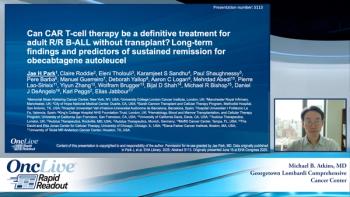
Jae Park, MD, presents long-term follow-up data from the FELIX study showing sustained remission in a subset of adult patients with relapsed/refractory B-cell acute lymphoblastic leukemia (B-ALL) treated with obecabtagene autoleucel (obe-cel), with predictors of long-term benefit and no new safety concerns identified.
Bijal Shah, MD, MS, and Jae Park, MD, discuss an age-based analysis of outcomes with obe-cel in acute lymphoblastic leukemia.
Bijal Shah, MD, MS, and Jae Park, MD, discuss how the integration of obe-cel has affected the acute lymphoblastic treatment paradigm.
Dr. Shah and faculty provide updates on emerging therapies, which exhibit promise for the treatment of relapsed or refractory acute lymphoblastic leukemia such as tisagenlecleucel and Obe-cel; obecabtagene autoleucel, preliminary outcomes of which were presented in the FELIX study at the 65th ASH Annual Meeting.
Dr. Shah and colleagues dissect the social determinants of health, including limited personal resources, frailty, distance to treatment facilities, therapeutic compliance, and other considerations that impact effective treatment sequencing for patients with relapsed or refractory ALL, including access to care and CAR-T cell availability.
Dr. Park and co-panelists review the patient and disease characteristics, including patient age, high pre-apheresis disease burden, and bridging response to inotuzumab or blinatumomab among other variables that might best support consideration of post-CART19 maintenance therapy.
Dr. Roloff and faculty assess outcomes from the retrospective, multicenter ROCCA analysis (Real-world Outcomes Collaborative of CAR-T in Adult ALL) and propose some social determinants of health SDoH variables that bear further investigation.
Dr. Roloff and colleagues offer expert opinion on optimizing treatment sequences for patients with relapsed or refractory ALL who have received two or more prior lines of therapy and the disease and patient factors that inform their treatment plans.
Panelists evaluate PFS, OS, and the prognostic significance of negative MRD.
Dr. Bijal and colleagues discuss the objectives, clinical outcomes, and safety profile of the Phase 2 ZUMA 3 clinical trial, which evaluated treatment of adult patients with relapsed or refractory, B-precursor, acute lymphoblastic leukemia with the anti-CD-19/anti-CD20 bispecific CAR-T cell therapy, KTE-X19 (brexucabtagene autoleucel).
Drs. Roloff, Park, and Shah provide a brief overview of the current, CAR-T cell therapeutic landscape for relapsed or refractory acute lymphoblastic leukemia in adults with a particular focus on those who have completed two or more lines of prior therapy.
Faculty review the objectives of the 2023 ASH Insights Program on the Efficacy and Safety of Brexucabtagene Autoleucel CART19 Cell Therapy in Adults with Advanced Acute Lymphoblastic Leukemia.
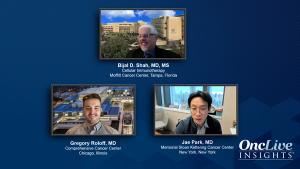
Panelist introductions by Gregory Roloff, MD from the University of Chicago Comprehensive Cancer Center, Chicago, Illinois; Jae Park, MD, Memorial Sloan Kettering Cancer Center, New York, New York; and Bijal Shah, MD, from the Moffitt Cancer Center, Tampa, Florida.
Jae Park, MD, wraps up his discussion by highlighting exciting investigational agents on the horizon for the treatment of relapsed/refractory B-cell acute lymphoblastic leukemia.
Dr Jae Park shares his experience with using brexucabtagene autoleucel for patients with relapsed/refractory B-cell acute lymphoblastic leukemia in clinical practice since its FDA approval in October 2021.
Jae Park, MD, explains how real-world CAR T-cell therapy data in patients with relapsed/refractory B-cell acute lymphoblastic leukemia shows high response rates but emphasizes the ongoing need for optimizing toxicity management, with trends toward earlier treatment and cell collection.
Dr Jae Park discusses managing cytokine release syndrome and the neurotoxicity side effects of CAR T-cell therapy in patients with relapsed/refractory B-cell acute lymphoblastic leukemia through medications, disease burden reduction, and earlier intervention to prevent severe toxicities.
Jae Park, MD, reviews updated data from the ZUMA-3 trial on the use of the CAR T-cell therapy brexucabtagene autoleucel (brexu-cel) for relapsed/refractory B-cell acute lymphoblastic leukemia, noting high remission rates, management of side effects like cytokine release syndrome, and post-CAR-T consolidation, including transplant.
Dr Jae Park details the treatment options for relapsed/refractory B-cell acute lymphoblastic leukemia, including blinatumomab, inotuzumab ozogamicin, and CAR T-cell therapy, with the treatment choice dependent on patient factors like comorbidities, disease burden, and transplant status.
Jae Park, MD, explains how B-cell acute lymphoblastic leukemia is diagnosed, and the testing done for detection of genetic abnormalities, which impacts treatment and prognosis.
Practical considerations for treatment selection in patients who progress on CAR T-Cell therapy.
Dr. Jae Park comments on the findings from the ELIANA study and tisagenlecleucel as a potential option for adults with R/R B-ALL.