
David A. Reardon, MD, discusses results of a cohort from the open-label CheckMate-143 trial, which explored the combination of nivolumab (Opdivo) and ipilimumab (Yervoy) in patients with recurrent glioblastoma multiforme (GBM).
David A. Reardon, MD, discusses results of a cohort from the open-label CheckMate-143 trial, which explored the combination of nivolumab (Opdivo) and ipilimumab (Yervoy) in patients with recurrent glioblastoma multiforme (GBM).

The MEK inhibitor binimetinib reduced the risk of progression or death by 38% compared with dacarbazine in patients with NRAS-mutant metastatic melanoma.

Avelumab demonstrated clinical activity in patients with advanced or unresectable mesothelioma, with an overall response rate of 14.3%.
Treatment with single-agent nivolumab improved overall survival and objective response rates compared with investigator's choice of therapy for patients with recurrent or metastatic head and neck squamous cell carcinoma.

Young black women with breast cancer are much less likely to have BRCA testing or, if they carry a BRCA mutation, to undergo risk-reducing prophylactic mastectomy or salpingo-oophorectomy.

An analysis of over 28,000 patients younger than 65 with incurable cancers found that approximately three-fourths of them received aggressive care within the last 30 days of life and one-third died in the hospital.
Patients with lung cancer who participated in a web-based system for reporting and tracking their symptoms achieved dramatic gains in survival compared with individuals who were followed with typical protocols.
Researchers who set out to understand the affordability of cancer drugs across the globe concluded that lower prices in some poorer countries don’t equate to better access.

The combination of dabrafenib and trametinib was highly effective as a treatment for patients with BRAF V600E-mutant non–small cell lung cancer.
Single-agent nivolumab induced responses in 66% of patients with classical Hodgkin lymphoma who had progressed following autologous stem cell transplant and brentuximab vedotin.
About one third of patients with advanced renal cell carcinoma who were treated with single-agent nivolumab in the second-line setting or later were still alive at 4 and 5 years in long-term follow-up data from phase I and phase II clinical trials.
Patients with metastatic urothelial carcinoma who were ineligible for standard cisplatin-based chemotherapy achieved a 24% reduction in tumor size and had a median survival of 14.8 months after taking the immunotherapy agent atezolizumab (Tecentriq).

Bernard A. Fox, PhD, chief, Laboratory of Molecular and Tumor Immunology, Earle A. Chiles Research Institute at Providence Portland Medical Center, discusses the significance of the Immunoscore Validation Project.

Women who extended their adjuvant therapy with an aromatase inhibitor to 10 years after treatment for their early-stage HR-positive breast cancer reduced their risk of recurrence by more than a third and experienced no new toxicities or worsening of quality of life.
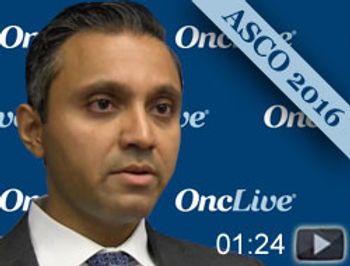
Arjun V. Balar, MD, assistant professor, Department of Medicine, co-leader of the Genitourinary Cancers Program, discusses updated results of cohort 1 of the IMvigor 210 study, which examined the efficacy of atezolizumab as first-line therapy in patients with cisplatin-ineligible locally advanced/metastatic urothelial carcinoma.
A novel antiangiogenic gene therapy, added to bevacizumab, led to significantly better overall survival in recurrent glioblastoma multiforme compared with historical patients treated with bevacizumab alone, a small phase II trial showed.

IMAB362 reduced the risk of death or progression by approximately 50% when added to standard chemotherapy for patients with CLDN18.2-positive advanced gastric cancers.
Nivolumab (Opdivo) as a monotherapy and in combination with ipilimumab (Yervoy) demonstrated promising antitumor activity in patients with high microsatellite instability (MSI-H) metastatic colorectal cancer.
Treatment with rovalpituzumab tesirine demonstrated single-agent activity and a manageable safety profile for patients with recurrent/refractory small cell lung cancer.

Adding daratumumab to bortezomib and dexamethasone reduced the risk of progression or death by 61%, and doubled response rates compared with the standard 2-drug regimen alone for patients with recurrent or refractory multiple myeloma.

Adding temozolomide to short-course radiotherapy after surgery boosted overall survival by nearly 2 months, bringing 1-year survival rates up from 22.2% to 37.8% for elderly patients with glioblastoma.
Antonio Palumbo, MD, chief, Myeloma Unit, Department of Oncology, Section of Hematology, University of Torino, Italy, discusses the phase III results of the CASTOR trial, which was a randomized controlled study examining the efficacy of daratumumab (Darzalex), bortezomib (Velcade), and dexamethasone versus bortezomib and dexamethasone in patients with relapsed or refractory multiple myeloma.

Upfront treatment with the combination of nivolumab and ipilimumab demonstrated an objective response rate of 57% in patients with PD-L1-positive advanced non–small cell lung cancer.

CPX-351 reduced the risk of death by 31% compared with cytarabine and daunorubicin (7+3) for older patients with high-risk, secondary AML.
The combination of the 4-1BB agonist utomilumab and the PD-1 inhibitor pembrolizumab was safe and effective as a treatment for patients with advanced solid tumors.

John D. Hainsworth, MD, co-founder; principal investigator, Sarah Cannon Research Institute, discusses the results of the MyPathway trial, which was an open-label, phase IIa umbrella basket study.
Michele Cavo, MD, professor, Seràgnoli Institute of Hematology Bologna University School of Medicine, discusses the results of the phase III EMN02/HO95 MM trial, which compared the efficacy of upfront autologous stem cell transplantation versus novel agent-based therapy for the treatment of patients with multiple myeloma.

Two-year follow-up data showed sustained improvements in overall survival with nivolumab in pretreated patients with either nonsquamous or squamous non–small cell lung cancer in updated findings from the phase III CheckMate-057 and -017 trials.
Single-agent nivolumab demonstrated encouraging signs of activity with a mild adverse event profile for patients with recurrent glioblastoma multiforme.

Treating patients based on the presence of molecular abnormalities regardless of tumor type proved to be a promising strategy in an ongoing phase IIa umbrella basket study.