
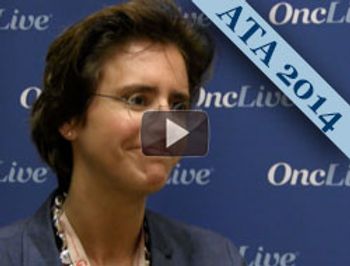
Julie A. Sosa, MD, MS, professor of surgery and medicine, chief of endocrine surgery, Duke University, discusses molecular testing for thyroid cancer.

Your AI-Trained Oncology Knowledge Connection!
Julie A. Sosa, MD, MS, professor of surgery and medicine, chief of endocrine surgery, Duke University, discusses molecular testing for thyroid cancer.

A next-generation sequencing assay has shown promise as a new tool to aid in the diagnosis and treatment of indeterminate thyroid nodules.
The ThyroSeq v2 next-generation sequencing assay was highly accurate at diagnosing cancer in thyroid nodules with follicular neoplasm or those suspected of follicular neoplasm cytology.

Preoperative vitamin D deficiency is associated with postoperative symptomatic hypocalcemia in patients with thyroid cancer undergoing total thyroidectomy plus central compartment neck dissection.
Roy S. Herbst, MD, PhD, presented a top 10 list on immunotherapy in non-small cell lung cancer at the 2014 Multidisciplinary Symposium in Thoracic Oncology.
In vivo models for two aggressive thyroid cancers have shown that downregulation of miR-30a-5p leads to overexpression of LOX, a target which appears amenable to treatment with β-aminopropionitrile fumarate.

The detection of BRAFV600E in patients with papillary thyroid cancer using a blood-based assay was shown to be feasible in a cohort of patients undergoing thyroidectomy.
Ian Ganly, MD, PhD, from Memorial Sloan Kettering Cancer Center, discusses the development of a postoperative nomogram for predicting cancer-specific mortality in MTC.
Jyoti D. Patel, MD, thoracic oncologist, Northwestern University Feinberg School of Medicine, discusses the benefits of multidisciplinary approach for the treatment of patients with stage III disease.
David Spigel, MD, director of Lung Cancer Research at the Sarah Cannon Research Institute, discusses results from a phase III study exploring eribulin for the treatment of patients with non-small cell lung cancer.
Nivolumab combined with platinum-based doublet chemotherapy achieved a manageable safety profile with clinical efficacy that was similar to single-agent nivolumab in patients with advanced NSCLC.

Jyoti D. Patel, MD, provides insight into managing the toxicities associated with molecular therapies used to treat patients with lung cancers.
Keith C. Bible, MD, PhD, professor of oncology, Mayo Clinic, discusses the promise of pemetrexed and carboplatin as a potential treatment option for patients with follicular cell-derived thyroid cancers.

The impact of RAI on long-term outcomes, potential combination strategies, molecular profiling, and novel therapeutics for patients with thyroid cancer were among some of the topics highlighted at the 2014 ATA Annual Meeting.
Naifa L. Busaidy, MD, associate professor, MD Anderson Cancer Center, discusses the results of a cooperative study that investigated the association between long-term thyroid hormone suppression therapy and improved outcomes in patients.

The PD-1 immune checkpoint inhibitor nivolumab achieved an ORR of 15% with a median duration of response that was not yet reached at a median 11-month follow-up for patients with advanced, refractory NSCLC.
Long-term moderate thyroid hormone suppression therapy is associated with improved outcomes in patients with differentiated thyroid cancer.
Carmelo Nucera, MD, PhD, endocrinologist, assistant professor, Harvard Medical School, Division of Experimental Pathology, Beth Israel Deaconesss Medical Center, Boston, discusses the role of RNA in thyroid cancer
Numerous disease-related variables could serve as prognostic and predictive factors for treatment outcomes with sorafenib in patients with radioactive iodine-refractory differentiated thyroid cancer.

First-line afatinib (Gilotrif) improved overall survival (OS) by about 1 year in patients with advanced non–small cell lung cancer (NSCLC) whose tumors harbor EGFR exon 19 deletions according to results from the LUX-Lung 3 and the LUX-Lung 6 phase III randomized trials.
Ramona Dadu, MD, from the MD Anderson Cancer Center, discusses the results of a pilot study that examined the efficacy of CASAD, a natural clay, to reduce medullary thyroid cancer-related diarrhea.

Ramaswamy Govindan, MD, Director, Thoracic Oncology, Co-Director, Section of Medical Oncology, Washington University School of Medicine, Siteman Cancer Center, discusses the potential for the ALK inhibitor alectinib.

Treatment with PD-1 immunotherapy across various oncology clinical trials has been associated with the induction of painless thyroiditis, characterized by transient thyrotoxicosis and hypothyroidism, in patients with metastatic malignancies

Patients with NSCLC who received postoperative radiation therapy lived 4 months longer on average than patients who did not receive radiation but who had the same disease site, tumor histology, and treatment criteria, according to a large retrospective study.
D. Ross Camidge, MD, PhD, discusses CO-1686 (rociletinib) and AZD9291, two agents that inhibit initial activating EGFR mutations and the T790M resistance mutation.
Ezra Cohen, MD, professor of medicine, UC San Diego Moores Cancer Center, discusses the challenges of treating Medullary Thyroid Cancer (MTC).
Molecular profiling has revealed several tumor markers that could be utilized as therapeutic targets for patients with small cell lung cancer (SCLC) or lung neuroendocrine tumors (NETs).

A new study suggests a knowledge gap in Primary Care Providers' familiarity with screening guidelines could also be a barrier to successful implementation.
Lecia V. Sequist, MD, medical oncologist, associate professor, Massachusetts General Hospital, Harvard Medical School, discusses the overall survival analysis of the LUX-Lung 3 and LUX-Lung 6 trials.
Biopsies were found to be the most costly tool used in lung cancer diagnosis, and may be performed too frequently based on negative test results and adverse events.