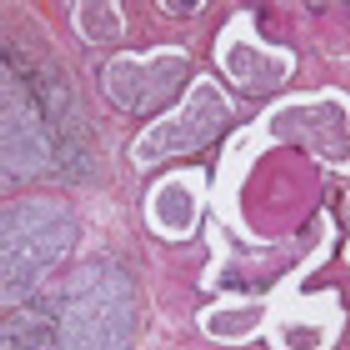
Women who received signed letters from their family physician along with scheduled postcard reminders are more likely to return for mammography screening than women who only received a postcard

Women who received signed letters from their family physician along with scheduled postcard reminders are more likely to return for mammography screening than women who only received a postcard

New generations of potent ALK inhibitors have been designed with extensive CNS activity and the ability to overcome acquired resistance mutations.

Everett E. Vokes, MD, Giant of Cancer Care: Lung Cancer, John E. Ultmann Professor Chair, Department of Medicine, Physician-in-Chief, University of Chicago Medicine and Biological Sciences, discusses PARP inhibitors as treatments for patients with lung cancer.

Emerging agents and pressing research questions in immunotherapy were reviewed in depth during the 15th Annual International Lung Cancer Congress, with Roy S. Herbst, MD, PhD, of the Yale Cancer Center, leading the way.

Vassiliki Papadimitrakopoulou, MD, Professor, Department of Thoracic/Head and Neck Medical Oncology, University of Texas MD Anderson Cancer Center, discusses the Lung-MAP trial, which uses next-generation sequencing as a screening test rather than screening for one mutation.

Third generation EGFR TKIs have demonstrated dramatic benefits for patients with non-small cell lung cancer (NSCLC) and should be considered as a standard second-line option following resistance to frontline therapy

Tyrosine kinase inhibitors (TKIs) are effective as single agents in EGFR-positive non-small cell lung cancer (NSCLC), but investigators continue to ask questions about how to improve the results of these agents.

Curative strategies for patients with advanced lung cancer remain elusive despite several exciting advancements, according to Paul A. Bunn Jr, MD, and Primo N. Lara Jr, MD, who delivered keynote lectures during the 15th Annual International Lung Cancer Congress.

Fred R. Hirsch, MD, PhD Professor of Medicine and Pathology, Associate Director for International Programs, University of Colorado Cancer Center, discusses the role of next-generation EGFR inhibitors.

The KRAS mutation in lung cancer is an especially thorny problem, as it is an indicator of a poor prognosis and has not, in the past, been targeted specifically by any medications.

Suresh S. Ramalingam, MD, a professor of medical oncology at the Winship Cancer Institute of Emory University, discusses the utility of the vaccine tecemotide as treatment for non-small cell lung cancer.

Paul A. Bunn, Jr., MD, professor of medicine in medical oncology, head of the division of medical oncology, University of Colorado, discusses the pros and cons of having companion diagnostic tests in lung cancer.

When the US Preventive Services Task Force (USPSTF) recommended last year that asymptomatic, high-risk individuals should receive annual screening for lung cancer with low-dose computed tomography (LDCT), it made a healthy decision for the American population

James L. Mulshine, MD, professor, Associate Provost for Research, Vice President, Rush University Medical Center discusses new USPSTF recommendations for lung cancer screening.

Five novel agents for the treatment of patients with advanced squamous cell carcinoma of the lung will be evaluated in the recently launched Lung-MAP trial

The 15th Annual International Lung Cancer Congress, which began today in Huntington Beach, California and will continue through Saturday, will offer an array of information presented by multidisciplinary experts-in a brand-new format.

Lori Goldstein, MD, director, The Naomi and Phil Lippincott Breast Evaluation Center, deputy associate director, Clinical Research, Fox Chase Cancer Center, discusses mechanisms of resistance to endocrine therapy.

Debu Tripathy, MD, discusses a decision-making framework for sequencing therapies for HER2-positive metastatic breast cancer.

Joyce A. O'Shaughnessy, MD, discusses the evolving area of breast cancer subtype-specific cytotoxic agents.

Takayuki Yoshino, MD, medical oncologist, National Cancer Center Hospital East, Chiba, Japan, discusses the safety profile of TAS-102 as seen in a phase III study of the agent versus placebo, with best supportive care, in patients with metastatic colorectal cancer (mCRC) refractory to standard therapies.

Aprepitant is significantly more effective than a comparator placebo-added regimen in preventing CINV in children, with benefits seen across all phases of treatment.

A head-to-head comparison of cetuximab and bevacizumab in a phase III trial that was nearly 10 years in the making showed equivalence for chemotherapy plus either agent in terms of OS, PFS, and response rates for patients with certain previously untreated metastatic colorectal cancers.

Treatment with enobosarm demonstrated an increase in lean body mass compared with a decline with placebo in patients with non-small cell lung cancer.

Initial treatment with surgical resection of the primary tumor followed by systemic treatment yielded a 4.7-month OS benefit compared with the same treatments administered in the reverse order in patients with mCRC receiving palliative care.

Johanna Bendell, MD, director of GI Cancer Research Program, associate director, Drug Development Program, Sarah Cannon Research Institute, discusses a randomized phase III placebo-controlled trial that explored apatinib as a treatment for patients with advanced gastric cancer.

Alan P. Venook, MD, a professor in the Department of Medicine (Hematology/Oncology) at the University of California, San Francisco, discusses implications from the CALGB/SWOG 80405 trial on the targeted therapies administered in colorectal cancer.

Treatment with the oral nucleoside TAS-102 significantly extended OS and PFS for patients with metastatic colorectal cancer refractory to standard therapies.

A single oral dose of rolapitant was found to be effective, safe, and long-lasting for the prevention of CINV in patients whose cancer was being treated with either highly or moderately emetogenic chemotherapy.

Andrea Wang-Gillam, MD, PhD, from the Siteman Cancer Center, discusses the trial design and results of the phase III NAPOLI-1 trial that examined MM-398 with 5-fluorouracil and leucovorin in patients with metastatic pancreatic cancer following progression on gemcitabine-based therapy.

Two active maintenance regimens following disease stabilization with standard induction therapy demonstrated superior disease-free outcomes compared with no treatment in patients with metastatic colorectal cancer.