
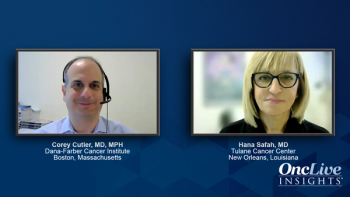
Hana Safah, MD, and Corey Cutler, MD, MPH, conclude with clinical insights on addressing medication access and the supportive care needs of patients with GvHD.
Hana Safah, MD, and Corey Cutler, MD, MPH, conclude with clinical insights on addressing medication access and the supportive care needs of patients with GvHD.
Drs Cutler and Safah look to the future of chronic GvHD treatment and discuss ongoing research, highlighting studies investigating axatilimab and abatacept.
Hematologist-oncologists give an overview of the 3 approved treatment options for patients with steroid-refractory chronic GvHD—ruxolitinib, ibrutinib, and belumosudil—and highlight the REACH3 and ROCKstar studies.
Drs Safah and Cutler discuss treatment practices for patients with steroid-refractory graft-vs-host disease and highlight patients who are steroid dependent.
Hematologist-oncologists discuss the first-line treatment options for patients with chronic GvHD and the advantages and disadvantages of steroids.
Hana Safah, MD, reviews the NIH staging system for graft-vs-host disease and discusses the importance of staging in determining prognosis and informing treatment decisions.
Corey Cutler, MD, MPH, discusses the role of prognostic markers in graft-vs-host disease and how they can potentially inform treatment selection.
Hematologist-oncologists Corey Cutler, MD, MPH, and Hana Safah, MD, discuss how graft-vs-host disease presents and the importance of early intervention.
Experts on graft-vs-host disease (GvHD) introduce themselves and provide an overview of GvHD, highlighting diagnosis, symptoms, risk stratification, and prevention.

Press Release
The Tulane Transplant Institute offers comprehensive disease management for patients with end-stage organ disease of the kidney, liver, and pancreas.

Press Release
The Novel Machine-learning-based Automatic Fly-behavioral Detection and Annotation system uses cameras and a newly developed software to track and identify complex interactive behaviors of individual flies within a larger group, allowing researchers to compare and contrast the behaviors of fruit flies with different genetic backgrounds.
Press Release
Stefan C. Grant, MD, JD, MBA, will serve as the next Chief of the Section of Hematology and Medical Oncology in the John W. Deming Department of Medicine at Tulane University School of Medicine.
Pedro C. Barata, MD, MSc, discusses the evolving treatment landscape of urothelial cancer.
Pedro C. Barata, MD, MSc, discusses the role of maintenance avelumab in advanced urothelial cancer.
Pedro C. Barata, MD, MSc, discusses challenges associated with treating advanced urothelial carcinoma.

Russell J. Ledet, PhD, discusses being a Black man in the field of oncology.

The PARP inhibitor olaparib is now available for patients with metastatic castration-resistant prostate cancer whose tumors harbor mutations in homologous recombination repair genes.

A. Oliver Sartor, MD, professor of medicine, medical director, Tulane Cancer Center, and C. E. and Bernadine Laborde Professor of Cancer Research, Departments of Medicine and Urology, Tulane University, discusses emerging agents in prostate cancer.
A. Oliver Sartor, MD, discusses research on immunotherapy, radiopharmaceuticals, and combinations in prostate cancer.

A. Oliver Sartor, MD, discusses the phase III VISION trial in patients with prostate-specific membrane antigen-positive metastatic castration-resistant prostate cancer.
An increasing amount of evidence shows that a proportion of patients with cancer found to have low-volume metastases at diagnosis see meaningful benefit from aggressive local therapy. Equally important, there have been no meaningful reductions in reported quality of life among patients receiving intensive local therapy, and a small percentage of patients appear to be cured with this strategy.

Oliver Sartor, MD, medical oncologist at Tulane University School of Medicine, discusses conclusions drawn from an analysis of African-American patients receiving sipuleucel-T (Provenge) in metastatic castration-resistant prostate cancer and the potential for combinations with this agent.
Research from Tulane University provides a strong case that, across demographic and clinical populations, informed patients are less wary of palliative care and more inclined to take advantage of the favorable effects that palliative care services can offer for patient-centered outcomes.
Amid a rising incidence of thyroid cancer, endocrine surgeons have increasingly explored minimally invasive approaches for operating on patients with the disease.

Oliver Sartor, MD, medical director of Tulane Cancer Center, discusses the mechanism of action of radium-223 dichloride (Xofigo) as well as its safety profile for the treatment of patients with metastatic castration-resistant prostate cancer (mCRPC).
Much work needs to be done to increase Lynch syndrome screening rates and better understand the factors that are associated with low testing rates.

Retreatment with radium-223 dichloride (Xofigo) after initial therapy and progression was determined to be safe in patients with bone-metastatic castration-resistant prostate cancer.
Oliver Sartor, MD, expands on the impact of the STAMPEDE and CHAARTED trials and discusses how the results may change the treatment paradigm for prostate cancer going forward.
Determining the optimal sequencing of novel agents with standard chemotherapy has become a key issue in the management of castration-resistant prostate cancer.
Oliver Sartor, MD, medical oncologist, Tulane University School of Medicine, discusses key points for community oncologists regarding radium-223 for the treatment of prostate cancer.