
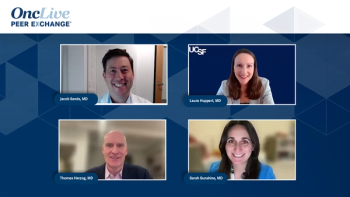
Experts discuss the importance of monitoring ocular toxicities in cancer treatment, emphasizing timely interventions and effective communication between oncologists and ophthalmologists.

Jacob Sands, MD, is associate chief of the Lowe Center for Thoracic Oncology and oncology medical director of the International Patient Center at Dana-Farber Cancer Institute; as well as an assistant professor at Harvard Medical School
Experts discuss the importance of monitoring ocular toxicities in cancer treatment, emphasizing timely interventions and effective communication between oncologists and ophthalmologists.
Experts discuss the alignment of clinical trial data with real-world experiences in managing ocular toxicities in cancer treatments.
Explore the roles of optometrists and ophthalmologists in managing ocular toxicities, ensuring timely patient care and effective treatment strategies.
Experts discuss the challenges of ocular toxicities in oncology, emphasizing collaboration and the importance of preservative-free eye drops for patient care.
Experts discuss the challenges of ocular toxicities in oncology, emphasizing collaboration and the importance of preservative-free eye drops for patient care.

Explore the complex case of a 70-year-old woman battling metastatic adenocarcinoma, highlighting treatment challenges and HER2 testing results.
Jacob Sands, MD, discusses the importance of multidisciplinary screening strategies for the identification of SCLC-associated LEMS.
Explore the latest insights on antibody-drug conjugates in oncology and their associated ocular toxicities, enhancing patient care and treatment outcomes.
Medical oncologists explore the importance of ophthalmology referrals for ocular toxicities, emphasizing collaboration for optimal patient care.
Explore the complex case of a 70-year-old woman battling metastatic adenocarcinoma, highlighting treatment challenges and HER2 testing results.
Explore a detailed case study on managing HER2-mutant non-small cell lung cancer, highlighting treatment strategies and progression monitoring.
Jacob Sands, MD, discusses challenges in the diagnosis and management of LEMS in patients with small cell lung cancer.
Ophthalmologists discuss the importance of grading dry eye symptoms and the necessity of eye exams before starting certain treatments.
Experts discuss the integration of ocular toxicity management in solid tumor care, focusing on antibody-drug conjugates and their impact on treatment.
Explore a detailed case study on managing HER2-mutant non-small cell lung cancer, highlighting treatment strategies and progression monitoring.
Explore innovative strategies for managing HER2 alterations in non-small cell lung cancer, including testing, treatment sequencing, and real-world case studies.
Ocular toxicities from cancer treatments present complexities; understanding symptoms and timely ophthalmology involvement is crucial for effective management.
Experts discuss the integration of ocular toxicity management in solid tumor care, focusing on antibody-drug conjugates and their impact on treatment.
Drs Sands and Shah discuss LEMS symptom identification and what guidelines currently note as best practices for the diagnosis of this disease.

Panelists discuss how the next 3 to 5 years will likely see T-cell engagers moving into earlier treatment lines, potential ADCs replacing chemotherapy in first-line therapy, and the critical need for better biomarker testing to optimize treatment sequencing and patient selection in an increasingly complex therapeutic landscape.
Panelists discuss how emerging therapies including DLL3-targeted ADCs, trispecific T-cell engagers, CAR T cells, and radioligand therapies represent promising approaches that may offer single-dose treatments or enhanced efficacy, though more data on durability and optimal sequencing are needed.
Panelists discuss how antibody-drug conjugates targeting B7-H3 show impressive response rates compared to historical controls, while T-cell engagers remain the priority for second-line therapy due to their demonstrated durability, though patient preferences and contraindications may influence individual treatment decisions.
Panelists discuss how tarlatamab implementation requires careful infrastructure planning, including 24-hour monitoring capabilities, staff education about cytokine release syndrome management, patient counseling, and coordination with community partners to ensure all eligible patients have access to this standard-of-care therapy.
Panelists discuss how neutropenia management varies widely across institutions, with some using primary prophylaxis with G-CSF or trilaciclib, while others tailor supportive care based on individual patient risk factors including age, comorbidities, and prior treatment tolerance.
Panelists discuss how monitoring for long-term immunotherapy toxicities requires regular imaging and symptom assessment, with early recognition and treatment of pneumonitis, hypothyroidism, and adrenal insufficiency being critical for maintaining patients on therapy and preventing chronic complications.
Panelists discuss how managing toxicities during chemoradiation requires proactive counseling about esophagitis and fatigue, while immunotherapy consolidation typically doesn’t enhance these acute toxicities, making it feasible to start within the recommended timeframe after completion of chemoradiation.
Panelists discuss how preliminary neoadjuvant chemoimmunotherapy data showing high response rates and pathologic complete responses in limited-stage SCLC appears promising but requires larger studies and careful patient selection given the complexity of staging and surgical candidacy.
Panelists discuss how while emerging biomarkers like inflamed subtypes and MHC class I expression show promise for predicting immunotherapy benefit, current clinical practice treats all patients with immunotherapy since the potential for exceptional responses cannot be reliably predicted.
Panelists discuss how the concerning underutilization of first-line chemoimmunotherapy in extensive-stage SCLC may stem from clinical nihilism, lack of urgency in treatment initiation, and inadequate education about the substantial benefits these therapies provide to patients.
Panelists discuss how pneumonitis risk management requires intensive patient education about symptoms, close monitoring for several months post radiation, and multidisciplinary coordination with pulmonology and radiation oncology teams to distinguish between radiation-induced and immunotherapy-related pneumonitis.