
New WCLC insights show how EGFR and KRAS G12C biomarkers shape lung cancer biology, resistance, prognosis, and smarter testing for personalized care.
New WCLC insights show how EGFR and KRAS G12C biomarkers shape lung cancer biology, resistance, prognosis, and smarter testing for personalized care.
Dr. Primdahl describes optimal multidisciplinary CA LEMS care models.
Dr. Primdahl details amifampridine (Firdapse), FDA-approved in 2018 for CA LEMS based on 2 randomized placebo-controlled studies demonstrating clinically meaningful functional improvement with a favorable safety profile.
Dr. Sen addresses the significance of the 2025 NCCN SCLC guideline update explicitly naming CA LEMS symptom recognition (proximal weakness paired with autonomic dysfunction) and recommending P/Q-type and N-type VGCC antibody testing under the neurologic workup section, with early subspecialty consultation recommended.
Dr. Sen explains how to manage discordant serologic and electrodiagnostic results without allowing disagreement between tests to paralyze decision-making.
Dr. Primdahl walks through clinical differentiation of CA LEMS from the most important diagnostic mimics encountered in SCLC.
Dr. Primdahl addresses management of seronegative CA LEMS in a patient with SCLC and a compelling clinical picture.
Dr. Sen explains VGCC antibody testing in depth.
Dr. Sen recommends against testing VGCC antibodies in isolation when CA LEMS is suspected in SCLC.
Dr. Primdahl describes the diagnostic delays and misattributions that characterize the CA LEMS journey in patients with SCLC.
Dr. Sen addresses the striking gap between CA LEMS prevalence in prospective studies (3-6% of SCLC) and real-world diagnosis rates (under 1%), citing the Drapkin et al. published dataset.

Lung cancer and neurology experts discuss the ties between cancer-associated LEMS and small cell lung cancer, diagnostic tips, and management strategies.
Dr. Sands discusses geographic and practice setting variations, noting lurbinectedin presents no administration challenges anywhere, whereas tarlatamab's rollout has been slower, initially concentrated in academic centers with clinical trial experience managing T-cell engagers and cytokine release syndrome.
Dr. Shields addresses choosing between atezolizumab-based (IMpower133) and durvalumab-based (CASPIAN) induction regimens, noting both demonstrate similar OS benefits (approximately 2.5-3 months) with real-world data showing general equipoise between agents.
Dr. Primdahl describes what CA LEMS looks like clinically for oncologists with limited exposure to this diagnosis. Patients are unlikely to self-report proximal weakness in clinical terms; they more commonly describe difficulty with everyday tasks, such as climbing stairs, getting in and out of a car or chair.
Learn how subtle weakness and autonomic signs in small cell lung cancer may signal LEMS—and why early neurology referral improves outcomes.
Dr. Sands addresses the NCCN footnote stating lurbinectedin cannot be reused after relapse following maintenance use, comparing this to how progression on one PD-L1 inhibitor doesn't necessarily preclude using another.
Dr. Shields discusses trilaciclib, an FDA-approved supportive care medication from 2021 that prevents myelosuppression across red cells, white cells, and platelets, plus neutropenia.
Dr. Leal outlines current decision-making, noting lurbinectedin plus atezolizumab represents the approved standard frontline maintenance strategy for patients tolerating induction well, achieving stable disease or response, and motivated for treatment intensification.
Dr. Chiang addresses whether tarlatamab used in maintenance retains efficacy if used again after progression, acknowledging significant unknowns regarding resistance mechanisms for novel T-cell engager therapies compared to better-understood chemotherapy resistance.
Dr. Sands argues that successful second-line agents should move earlier in treatment sequencing, citing precedent from other oncology fields. With only 40% to 50% of patients with ES-SCLC receiving second-line therapy due to rapid disease progression, declining functional status, or brain metastases, moving effective agents like tarlatamab earlier addresses this attrition problem.
Dr. Shields addresses limitations of phase 1b single-arm studies, noting smaller patient numbers may introduce selection bias toward patients most likely to benefit from T-cell engager therapy targeting DLL3 and CD3. She emphasizes the importance of randomized phase 3 data for head-to-head comparisons, particularly given that DeLLphi-303's control arm involved immunotherapy alone, preventing cross-trial comparisons with IMforte's different control arm.
Dr. Sands discusses tarlatamab's unique mechanism as a bispecific T-cell engager linking DLL3 on tumor cells to CD3 on T cells, creating an antigen-directed immune response distinct from other therapeutic approaches. He characterizes the second-line DeLLphi-304 trial as establishing an entirely new paradigm, representing the only example of one drug outperforming others in SCLC's second-line setting across PFS, OS, tolerability, and symptom improvement.
Dr. Leal discusses practical logistics of lurbinectedin plus atezolizumab, administered together every 21 days. She incorporates maintenance discussions into initial treatment planning, particularly important for patients traveling long distances with caregivers. Most patients with ports prefer intravenous administration despite subcutaneous atezolizumab being an option with comparable efficacy, safety, and drug levels but shorter infusion time.
Dr. Shields confirms that NCCN guidelines now recommend lurbinectedin plus atezolizumab as preferred maintenance therapy following 4 cycles of chemotherapy and immunotherapy, with the specific footnote limiting this to patients with ECOG performance status 0 to 1 and no history of brain metastases. She strictly follows the brain metastasis exclusion criteria for treatment-naive patients but notes this restriction wasn't applied in second or third-line relapse settings.
Dr. Joshua Sabari introduces the program on evolving maintenance and sequencing strategies in extensive-stage small cell lung cancer (ES-SCLC), joined by Dr. Anne Chiang from Yale, Dr. Jacob Sands from Dana-Farber, Dr. Misty Shields from Indiana University, and Dr. Ticiana Leal from Emory University's Winship Cancer Institute.
Dr Shields discusses the realities of treating patients with SCLC in the community setting and how emerging therapies are shaping care delivery.
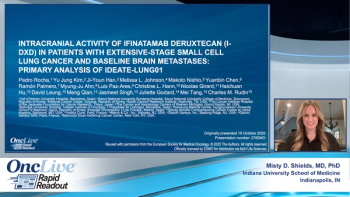
Misty D. Shields, MD, PhD, reviews primary findings from the IDeate-Lung01 trial, highlighting the promising systemic and intracranial efficacy and manageable safety profile of ifinatamab deruxtecan (I-DXd) in patients with extensive-stage small cell lung cancer, including those with baseline brain metastases.
Misty D. Shields, MD, PhD, discusses the modern role for prophylactic cranial irradiation in extensive-stage SCLC management.
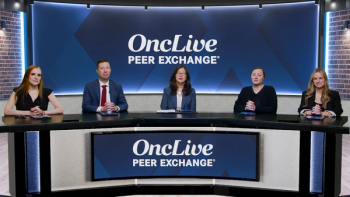
Panelists discussed the evolving small cell lung cancer treatment landscape, emphasizing the need to improve clinical trial accessibility, advance biomarker research, and better manage brain metastases, while highlighting promising therapies like checkpoint inhibitors and antibody-drug conjugates that offer hope for durable responses amid ongoing challenges.

September 30th 2025
