Misty D. Shields, MD, PhD
Articles by Misty D. Shields, MD, PhD

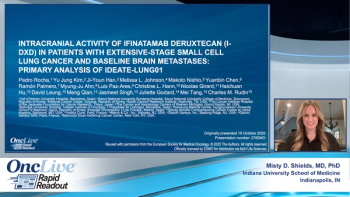
Misty D. Shields, MD, PhD, reviews primary findings from the IDeate-Lung01 trial, highlighting the promising systemic and intracranial efficacy and manageable safety profile of ifinatamab deruxtecan (I-DXd) in patients with extensive-stage small cell lung cancer, including those with baseline brain metastases.

Misty D. Shields, MD, PhD, discusses the modern role for prophylactic cranial irradiation in extensive-stage SCLC management.
Final Thoughts and Future Perspectives in SCLC
ByAnne Chiang, MD, PhD, Yale Cancer Center,Misty D. Shields, MD, PhD,Jacob Sands, MD,Catherine Meador, MD, PhD ,Christine Lovly, MD, PhD, FASCO Panelists discussed the evolving small cell lung cancer treatment landscape, emphasizing the need to improve clinical trial accessibility, advance biomarker research, and better manage brain metastases, while highlighting promising therapies like checkpoint inhibitors and antibody-drug conjugates that offer hope for durable responses amid ongoing challenges.

Emerging ADCs in SCLC: Spotlight on B7-H3 and MHB088C
ByAnne Chiang, MD, PhD, Yale Cancer Center,Misty D. Shields, MD, PhD,Jacob Sands, MD,Catherine Meador, MD, PhD ,Christine Lovly, MD, PhD, FASCO Panelists discussed the challenges of biomarkers in SCLC, emphasizing that targets like DLL3 and B7-H3 show promise but require dynamic monitoring, and highlighted ongoing trials exploring antibody-drug conjugates and targeted therapies to potentially complement or replace platinum chemotherapy in personalized treatment approaches.

Insights on Resistance Mechanisms and Sequencing Strategies for DLL3-Targeted and ADC Therapies in ES-SCLC
ByAnne Chiang, MD, PhD, Yale Cancer Center,Misty D. Shields, MD, PhD,Jacob Sands, MD,Catherine Meador, MD, PhD ,Christine Lovly, MD, PhD, FASCO Panelists discussed advances in overcoming resistance in extensive-stage small cell lung cancer, highlighting promising antibody-drug conjugates and immune-based therapies targeting DLL3 and B7-H3, including bispecific T-cell engagers and CAR T cells, while emphasizing the critical need for biomarkers to guide therapy selection and optimize combinations to improve durability, intracranial activity, and patient outcomes amid the challenges of relapse and immune evasion.

Exploring the Future of SCLC: Insights Anticipated From the SWOG S2409 (PRISM) Trial
ByAnne Chiang, MD, PhD, Yale Cancer Center,Misty D. Shields, MD, PhD,Jacob Sands, MD,Catherine Meador, MD, PhD ,Christine Lovly, MD, PhD, FASCO Panelists highlighted a forthcoming large cooperative-group trial in small cell lung cancer that pioneers precision medicine by using molecular subtyping to guide biomarker-driven therapy combined with immunotherapy, aiming to personalize treatment across diverse patient populations and generate extensive molecular and clinical data to advance understanding and improve outcomes in this historically challenging disease.

Patient Conversations and Considerations in the Extensive-Stage Relapse Setting
ByAnne Chiang, MD, PhD, Yale Cancer Center,Misty D. Shields, MD, PhD,Jacob Sands, MD,Catherine Meador, MD, PhD ,Christine Lovly, MD, PhD, FASCO Panelists emphasized that clear, compassionate, and ongoing communication with patients diagnosed with small cell lung cancer is vital to support informed decision-making amid evolving treatment options, highlighting the importance of maintaining a broad therapeutic arsenal, integrating multidisciplinary and palliative care early, and regularly reassessing goals to optimize quality of life and treatment outcomes throughout the often prolonged disease course.

Lurbinectedin in Relapsed ES-SCLC: Response, Real-World Data, and Clinical Implications
ByAnne Chiang, MD, PhD, Yale Cancer Center,Misty D. Shields, MD, PhD,Jacob Sands, MD,Catherine Meador, MD, PhD ,Christine Lovly, MD, PhD, FASCO Panelists discussed real-world data confirming that a novel targeted agent for extensive-stage small cell lung cancer offers consistent efficacy and durable responses across multiple lines of therapy, with a favorable toxicity profile enhancing quality of life; treatment selection is individualized based on patient factors and logistical considerations, while vigilant brain metastasis surveillance and multidisciplinary coordination remain essential to optimize outcomes.

Tarlatamab in Relapsed SCLC: An Expert Discusses DeLLphi Trial Insights
ByAnne Chiang, MD, PhD, Yale Cancer Center,Misty D. Shields, MD, PhD,Jacob Sands, MD,Catherine Meador, MD, PhD ,Christine Lovly, MD, PhD, FASCO Panelists highlighted a pivotal phase 3 trial demonstrating that a novel targeted therapy significantly improves overall survival and offers durable responses in second-line small cell lung cancer, positioning it as a preferred option after frontline chemoimmunotherapy despite logistical challenges and the need for multidisciplinary coordination, with careful patient selection and ongoing clinical trials essential to optimizing sequencing and expanding treatment options.

ASCO 2025: Expert Insights on IMforte Trial Findings and Lurbinectedin in First-Line ES-SCLC Maintenance
ByAnne Chiang, MD, PhD, Yale Cancer Center,Misty D. Shields, MD, PhD,Jacob Sands, MD,Catherine Meador, MD, PhD ,Christine Lovly, MD, PhD, FASCO Panelists emphasized that while the addition of the new drug to maintenance therapy marks a major advance with improved survival, it also brings increased toxicity that necessitates careful patient selection and shared decision-making—especially considering real-world tolerability, impacts on quality of life, subsequent treatment sequencing, and the unresolved questions around its use in patients with brain metastases, underscoring the need for biomarkers and individualized care in this evolving treatment landscape.

Optimizing Maintenance Therapy in ES-SCLC: Expert Approaches and Key Decision Factors
ByAnne Chiang, MD, PhD, Yale Cancer Center,Misty D. Shields, MD, PhD,Jacob Sands, MD,Catherine Meador, MD, PhD ,Christine Lovly, MD, PhD, FASCO Panelists highlighted the M40 trial’s promising results showing that adding chemotherapy to atezolizumab maintenance after initial chemo-immunotherapy significantly improves overall survival in extensive-stage disease, offering a new strategy to reduce relapse risk during the vulnerable post-induction period with manageable toxicity, and marking a potential shift in the treatment paradigm for extending long-term patient outcomes.

ES-SCLC Treatment Decisions: Use of Radiotherapy for Consolidation
ByAnne Chiang, MD, PhD, Yale Cancer Center,Misty D. Shields, MD, PhD,Jacob Sands, MD,Catherine Meador, MD, PhD ,Christine Lovly, MD, PhD, FASCO Panelists discussed the nuanced management of brain metastases in small cell lung cancer, highlighting the preference for systemic therapy first in asymptomatic cases to avoid upfront radiation adverse effects, the selective use of stereotactic radiosurgery for symptomatic lesions, and the cautious, individualized approach to thoracic consolidation radiation amid concerns about toxicity and mixed data, emphasizing the critical role of multidisciplinary collaboration and ongoing research to optimize treatment strategies.

ES-SCLC Treatment Decisions: Expert Insights into Clinical Trial Data and Real-World Evidence
ByAnne Chiang, MD, PhD, Yale Cancer Center,Misty D. Shields, MD, PhD,Jacob Sands, MD,Catherine Meador, MD, PhD ,Christine Lovly, MD, PhD, FASCO Panelists reviewed first-line treatment for extensive-stage SCLC, emphasizing platinum-based chemotherapy plus a PD-L1 inhibitor—typically carboplatin with either atezolizumab or durvalumab—with 4 cycles standard, noting both agents offer survival benefits and are largely interchangeable, while highlighting emerging therapies and ongoing trials that may soon refine and personalize this evolving treatment landscape.

ADRIATIC Trial: Key Insights Into Progression Patterns and Their Impact on Treatment Decisions
ByAnne Chiang, MD, PhD, Yale Cancer Center,Misty D. Shields, MD, PhD,Jacob Sands, MD,Catherine Meador, MD, PhD ,Christine Lovly, MD, PhD, FASCO Panelists highlighted the ADRIATIC trial’s survival benefits with durvalumab in LS-SCLC while discussing exploratory data that identified immune microenvironment features distinguishing long-term responders from early progressors, emphasizing the need for validated biomarkers to personalize immunotherapy and improve outcomes beyond current standards.

Navigating Disease Progression During and After Durvalumab: Expert Insights
ByAnne Chiang, MD, PhD, Yale Cancer Center,Misty D. Shields, MD, PhD,Jacob Sands, MD,Catherine Meador, MD, PhD ,Christine Lovly, MD, PhD, FASCO Panelists discussed the importance of close monitoring during consolidation durvalumab in LS-SCLC—especially for pneumonitis risk—and noted that relapse management is shifting away from routine platinum rechallenge toward more personalized use of newer agents like lurbinectedin and tarlatamab, based on timing, tolerability, and individual patient factors.

Multidisciplinary Approaches to Managing LS-SCLC: Immunotherapy, Paraneoplastic Syndromes, and Post-CCRT Care
ByAnne Chiang, MD, PhD, Yale Cancer Center,Misty D. Shields, MD, PhD,Jacob Sands, MD,Catherine Meador, MD, PhD ,Christine Lovly, MD, PhD, FASCO Panelists emphasized that while timely initiation of durvalumab post chemoradiation is ideal in LS-SCLC, consistent with ADRIATIC trial protocols, patient recovery and multidisciplinary input—especially in cases involving treatment-related toxicity or neurologic comorbidities—are essential to guide safe, individualized decision-making.

Panel Insights: Interpreting ADRIATIC Outcomes and Tailoring LS-SCLC Treatment
ByAnne Chiang, MD, PhD, Yale Cancer Center,Misty D. Shields, MD, PhD,Jacob Sands, MD,Catherine Meador, MD, PhD ,Christine Lovly, MD, PhD, FASCO Panelists agreed the ADRIATIC trial is practice-changing for limited-stage small cell lung cancer, establishing durvalumab as the new standard post chemoradiation due to its significant survival benefit and manageable toxicity, while also highlighting the need for multidisciplinary coordination and raising questions about agent selection and evolving radiation strategies.

Panelists discuss how treatment decisions for advanced non–small cell lung cancer (NSCLC) without actionable mutations depend on factors like PD-L1 status, histology (eg, squamous [SQ]), and biomarkers like STK11/KEAP1. Chemotherapy may be added based on individual patient factors, with promising advancements expected in 2025.

Panelists discuss how emerging data on novel HER2-targeted agents, including Beamion LUNG-1 (zongertinib) and SOHO-1 (BAY 2927088), show promise for advanced non–small cell lung cancer (NSCLC). Additionally, the eNRGy trial and FDA approval of zenocutuzumab for NRG1 fusion–positive non–small cell lung cancer (NSCLC) offers new treatment avenues. Patient selection will depend on genetic profiling and treatment efficacy.

Panelists discuss how treatment decisions for advanced non–small cell lung cancer (NSCLC) without actionable mutations depend on factors like PD-L1 status, histology (eg, squamous [SQ]), and biomarkers like STK11/KEAP1. Chemotherapy may be added based on individual patient factors, with promising advancements expected in 2025.

Panelists discuss how emerging data on novel HER2-targeted agents, including Beamion LUNG-1 (zongertinib) and SOHO-1 (BAY 2927088), show promise for advanced non–small cell lung cancer (NSCLC). Additionally, the eNRGy trial and FDA approval of zenocutuzumab for NRG1 fusion–positive non–small cell lung cancer (NSCLC) offers new treatment avenues. Patient selection will depend on genetic profiling and treatment efficacy

Panelists discuss how the 5-year follow-up data from the CROWN trial support lorlatinib as a frontline treatment for ALK-positive non–small cell lung cancer NSCLC with brain metastasis. For frontline therapy, starting at full dose is preferred, adjusting if needed. Post progression, lorlatinib can be continued or combined with other agents. Biomarker testing for ROS1 is essential, with recent data (TRIDENT-1 trial) favoring lorlatinib for ROS1-positive central nervous system (CNS) involvement. Novel agents like taletrectinib and zidesamtinib from TRUST-I/II and ARROS-1 trials show promise in expanding treatment options for ROS1-positive NSCLC.

Panelists discuss how MARIPOSA-2 (Popat S, et al, ESMO 2024) and the September 2024 FDA approval of amivantamab plus chemo as a second-line option highlight advances in non–small cell lung cancer (NSCLC) treatment. Strategies involve sequencing with emerging therapies like HERTHENA-Lung01, addressing resistance, and central nervous system (CNS) metastases. The complete response letter (CRL) for HER3-DXd and the shift in biologics license application (BLA) status for Dato-DXd from TROPION-Lung05 (Lisberg A, et al, ASCO 2024) will shape clinical practices and resistance management moving forward.

Panelists discuss how the 5-year follow-up data from the CROWN trial support lorlatinib as a frontline treatment for ALK-positive non–small cell lung cancer NSCLC with brain metastasis. For frontline therapy, starting at full dose is preferred, adjusting if needed. Post progression, lorlatinib can be continued or combined with other agents. Biomarker testing for ROS1 is essential, with recent data (TRIDENT-1 trial) favoring lorlatinib for ROS1-positive central nervous system (CNS) involvement. Novel agents like taletrectinib and zidesamtinib from TRUST-I/II and ARROS-1 trials show promise in expanding treatment options for ROS1-positive NSCLC.

Panelists discuss how MARIPOSA-2 (Popat S, et al, ESMO 2024) and the September 2024 FDA approval of amivantamab plus chemo as a second-line option highlight advances in non–small cell lung cancer (NSCLC) treatment. Strategies involve sequencing with emerging therapies like HERTHENA-Lung01, addressing resistance, and central nervous system (CNS) metastases. The complete response letter (CRL) for HER3-DXd and the shift in biologics license application (BLA) status for Dato-DXd from TROPION-Lung05 (Lisberg A, et al, ASCO 2024) will shape clinical practices and resistance management moving forward.

Panelists discuss how the MARIPOSA trial (ASCO 2024) showed improved overall survival (OS) with amivantamab plus lazertinib vs osimertinib in first-line EGFR-mutant non–small cell lung cancer (NSCLC), supporting its FDA approval (October 2024). This regimen may become standard of care for select patients, but osimertinib with or without chemo remains vital. The complete response letter (CRL) for subcutaneous amivantamab may delay uptake.

Panelists discuss how osimertinib has been approved for patients with unresectable, EGFR-mutated stage III non–small cell lung cancer (NSCLC) following chemoradiation, based on the LAURA trial, which demonstrated a significant improvement in progression-free survival. In clinical practice, osimertinib is administered as consolidation therapy until disease progression or unacceptable toxicity. Ongoing studies like PACIFIC-9 and PACIFIC-8 are exploring the efficacy of combining durvalumab with other agents, potentially influencing future chemo-immunotherapy strategies in advanced NSCLC.

Panelists discuss how the MARIPOSA trial (ASCO 2024) showed improved overall survival (OS) with amivantamab plus lazertinib vs osimertinib in first-line EGFR-mutant non–small cell lung cancer (NSCLC), supporting its FDA approval (October 2024). This regimen may become standard of care for select patients, but osimertinib with or without chemo remains vital. The complete response letter (CRL) for subcutaneous amivantamab may delay uptake.

Panelists discuss how osimertinib has been approved for patients with unresectable, EGFR-mutated stage III non–small cell lung cancer (NSCLC) following chemoradiation, based on the LAURA trial, which demonstrated a significant improvement in progression-free survival. In clinical practice, osimertinib is administered as consolidation therapy until disease progression or unacceptable toxicity. Ongoing studies like PACIFIC-9 and PACIFIC-8 are exploring the efficacy of combining durvalumab with other agents, potentially influencing future chemo-immunotherapy strategies in advanced NSCLC.

Panelists discuss how, in clinical practice, ADAURA (osimertinib) and ALINA (alectinib) are integrated based on EGFR/ALK status, stage, and recurrence risk. Adjuvant therapy duration is typically 3 years. Circulating tumor DNA (ctDNA), minimal residual disease (MRD) from ADAURA (ASCO 2024, Abs 8005) may refine treatment decisions by detecting MRD.