
Drs Park and Beckermann discuss kidney cancer highlights from the 2026 Genitourinary Cancers Symposium.

Kathryn E. Beckermann, MD, PhD, is director of Genitourinary Cancer Research at Tennessee Oncology
Drs Park and Beckermann discuss kidney cancer highlights from the 2026 Genitourinary Cancers Symposium.

Brian I. Rini, MD, FASCO, and Katy Beckermann, MD, PhD, sit down with Chandler Park, MD, FACP, to discuss the latest abstracts in renal cell carcinoma presented during the 2025 ESMO Congress.
Kathryn E. Beckerman, MD, PhD, details the rationale for evaluating tivozanib/nivolumab following immune checkpoint inhibitors in renal cell carcinoma.
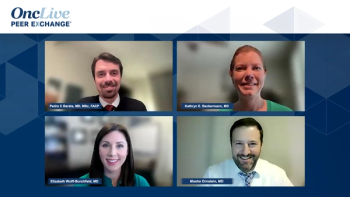
Experts discuss how treatment sequencing in advanced renal cell carcinoma (RCC) may evolve with the emergence of novel combinations and highlight emerging data from ASCO GU 2025 likely to impact clinical practice.
Experts discuss the role of belzutifan and tivozanib in the treatment paradigm for advanced renal cell carcinoma (RCC), including key findings from the phase 3 LITESPARK-005 trial investigating belzutifan vs everolimus in previously treated advanced RCC patients.

Experts discuss key findings from the phase 3 CONTACT-03 trial investigating atezolizumab plus cabozantinib vs cabozantinib alone in inoperable advanced renal cell carcinoma (aRCC) after immune checkpoint inhibitor (ICI) treatment, along with insights from real-world data on sequencing strategies and the efficacy of tyrosine kinase inhibitors (TKIs) after prior ICI therapy.
Experts discuss emerging patterns of progression with current frontline regimens for advanced renal cell carcinoma (RCC), differences between immunotherapy (IO)/IO and IO/tyrosine kinase inhibitor (TKI) combinations, and how these progression patterns impact prognosis and subsequent therapy selection, considering whether the patient received IO/IO or IO/TKI in the first line and the clinical factors influencing later-line treatment decisions.
Experts discuss regimens with the most favorable toxicity profiles and how they personalize treatment to minimize patient burden, while also exploring preferred strategies for patients who have completed pembrolizumab in the adjuvant setting and how the timing of recurrence relative to adjuvant therapy completion influences treatment selection.
Experts discuss key factors influencing the decision between immunotherapy (IO)/IO and various IO/tyrosine kinase inhibitor (TKI) combinations in advanced renal cell carcinoma (RCC) treatment, including patient characteristics, risk stratification, PD-L1 status, and other clinical features, while also exploring the patient experience with IO-TKI regimens, strategies for managing adverse effects, and the approach to hepatotoxicity management.
Experts discuss the key findings from the final follow-up results of the CheckMate 9ER trial, evaluating nivolumab plus cabozantinib in advanced renal cell carcinoma (RCC) and share perspectives on the clinical implications of these updated data, along with insights from other studies of note, including LITESPARK-003 (belzutifan plus cabozantinib) and LITESPARK-024 (belzutifan plus palbociclib).
Kathryn E. Beckermann, MD, PhD, details the role of tivozanib as second- and third-line therapy in patients with locally advanced or metastatic ccRCC.
Experts discuss how emerging novel doublet regimens in the frontline setting for advanced renal cell carcinoma may address current unmet needs, highlighting specific biomarkers, patient populations, and clinical scenarios where these combinations could offer distinct advantages over existing standards like immunotherapy (IO)/IO or established IO/tyrosine kinase inhibitor (TKI) combinations.
Experts discuss the 8-year follow-up data from the CheckMate 214 trial evaluating nivolumab plus ipilimumab for first-line treatment of advanced renal cell carcinoma (RCC), and how these mature overall survival (OS) data influence the view of nivolumab plus ipilimumab as a frontline option, alongside insights from efficacy, safety, post hoc subgroup analyses (Albiges et al, Eur Urol, 2022), and health-related quality of life (HRQOL) data (Cella et al, J Clin Oncol, 2022).
Kathryn Beckermann, MD, PhD, discusses ongoing studies investigating the role of TREM2 in the treatment of patients with clear cell renal cell carcinoma.
Kathryn Beckermann, MD, PhD, discusses the treatment of PY314 in combination with pembrolizumab in patients with clear cell renal cell carcinoma.
The panel closes their discussion with a look at the standards for genetic counseling for patients with non-clear cell RCC.
The panel discusses the best approaches to treating patients with non-clear cell RCC.
The panel shares their preferred treatment regimens for patients with refractory renal cell carcinoma.

Hans Hammers, MD, presents a profile of a 47-year-old male with refractory renal cell carcinoma.
The panel discusses recent clinical trial data in the adjuvant treatment of metastatic renal cell carcinoma.
Drs Moshe Ornstein and Hans Hammers review data from the COSMIC-313 trial investigating ipilimumab, nivolumab, and cabozantinib for the frontline treatment of metastatic renal cell carcinoma.
The panel provides an overview of novel double combination therapies currently under investigation.
Mehmet Asim Bilen, MD, details how he approaches IO/TKI therapy for patients with renal cell carcinoma with bone metastases.
The panel discusses the use of quality-of-life clinical trial data in metastatic renal cell carcinoma and how liver and brain metastases affect treatment decision-making.
Hans Hammers, MD, PhD, explains the situations in which he would choose an ipilimumab/nivolumab treatment regimen over one of the discussed IO/TKI regimens.
Drs Moshe Ornstein and Mehmet Asim Bilen review updated data from the CheckMate 9ER and CLEAR trials investigating combination treatments for metastatic renal cell carcinoma.
Mehmet Asim Bilen, MD, presents a profile of a 65-year-old woman with metastatic renal cell carcinoma for discussion.
Moshe Ornstein, MD, MA, starts a conversation on how patients with metastatic renal cell carcinoma are classified by risk, and how risk category influences approaches to systemic therapy.
Kathryn E. Beckermann, MD, PhD, discusses the evolving adjuvant treatment setting for renal cell carcinoma.
Kathryn E. Beckermann, MD, PhD, discusses the future of treatment in renal cell carcinoma.

February 28th 2025